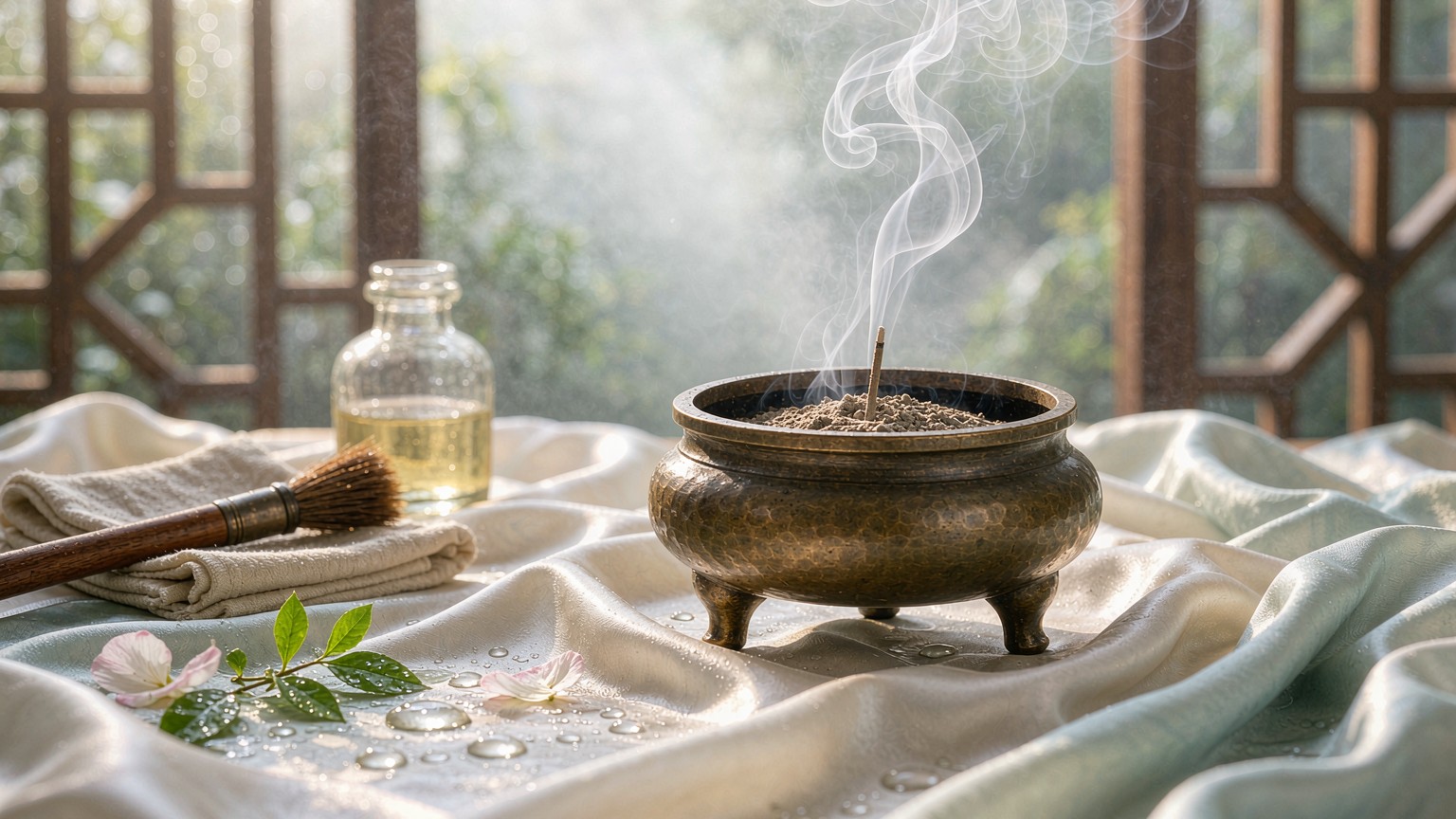
The Six Records of Agarwood — Prologue: The Seal on a Rainy Night
Source:《沉香六记》原创小说 · 中国沉香网「小说」频道首发· 2026-10-13· 刘家沉檀店· 155 views
The rain began at dusk.
Autumn had come to the capital, and the rain fell differently now — not the hammering of summer, but a slanting drift, fine and endless, soaking into the blue bricks of the alley until layer upon layer turned dark. By eleven at night the whole lane was slick and glistening; the streetlamp light shattered into shards of yellow across the standing water.
Liu Zhiqiang was about to close up.
He switched off the lamps beneath the two shop signs at the door, then wiped the incense ash from the counter with a cloth. The shop was small — one storefront, two rows of shelves stocked with stick incense, coiled incense, incense seals, and raw wood, plus a few glass jars holding broken agarwood from different regions. The air held a heavy scent — sweet with a thread of medicine, like the clothes of an old friend.
The black lacquer board with gilt characters hung above the door — he had dug it out of the old house cellar six years ago. He had retraced the characters three times, yet they remained a little weathered.
Liu Family Shang-se Chen-tan Emporium.
He looked up at it, as he did every evening at closing.
Then he heard someone knocking.
Not knocking — scratching. Fingernails raking the wood: three light strokes, then a second set, urgent. Liu Zhiqiang froze. This hour, this lane, this rain. He set the cloth down, walked to the door, and did not open it at once.
"Who is it?"
The rain outside was too loud; no one answered.
He pulled the door open.
Old Zhou was slumped against the frame.
Liu started. Old Zhou was sixty, a servant his father had left behind — strictly, "the one who watches the house." For six years Old Zhou had come twice a week, swept the leaves, drunk a cup of tea, and left. He seldom spoke; Liu had always taken him for a silent old man. Now Old Zhou was soaked through, hair plastered to his forehead, his face a strange white, like paper left too long in water.
"Old Zhou? What —"
Old Zhou said nothing. He raised a hand, with great effort, drew something from inside his coat, and pressed it into Liu Zhiqiang's palm.
Cold.
A piece of jade. Round, about six centimeters across, with an exceedingly fine crack running through it. Liu looked down; six-petaled flowers were carved on it — only half; the rest of the pattern broke off at the fissure.
"What is this?"
Old Zhou's hand still pressed his, hard, fingernails digging into his skin. His lips moved.
"Don't go to Tokyo," he said.
Liu Zhiqiang went blank.
"What Tokyo?"
"Don't go looking for those six pieces," Old Zhou gasped, word by word. "Your father — he just wouldn't listen."
"My father?" Liu's heart lurched. His father had "gone on a business trip and not returned" the year Liu turned twelve; his mother never spoke the two words again, and the family put away even the photographs. That was twenty-three years ago. No one had ever told him "your father wouldn't listen."
"Old Zhou, say it clearly —"
"Remember this," Old Zhou's eyes locked on him. "As long as the incense stands, the man stands."
With that, his hand went slack.
He slid down the doorframe, settled on the threshold, head lolling to one side. Rain dripped from the eaves, one drop, then another, onto his shoulder.
Liu Zhiqiang stood there, the cold jade clenched in his palm, not moving for several seconds.
He would think of those seconds often afterward.
Because in those seconds, he caught a very faint smell — not rain, not Old Zhou's own scent, but incense. Very old incense, like a long-kept piece of wood slowly breathing out. The scent came from Old Zhou.
And he knew what incense it was.
He would only realize later that he knew; but in that moment, he felt instinctively — I have smelled this before. Long ago, in his father's cellar.
The police came. The ambulance came. Neighbors were roused, stood at the alley mouth in raincoats. Some said Old Zhou had a heart attack; others said robbery, because the old man's wallet was gone.
Liu Zhiqiang finished his statement and got back to the shop at two in the morning.
He did not turn on the main light, only the small lamp behind the counter. The plastic evidence bag sat on the table, the jade inside — the police had examined it, called it "an ordinary jade trinket, not worth much, probably something the old man carried," and returned it after logging it.
He switched on only that small lamp, and set the jade beneath it.
Six-petaled pattern, half of it.
He turned it over and over. The jade was warm now, no longer cold. He looked a long time, then noticed — there were characters on the inside.
Carved impossibly shallow, almost scraped on. He brought the jade close to the lamp, tilted it, and made out three characters.
Lan She Dai.
Liu Zhiqiang did not sleep that night.
The next morning he closed the shop, hung a "Temporarily Closed" sign, and went to the old house.
The old house was in the east city, a tiny courtyard his father had left. He had not been back much in six years, leaving only one room for old furniture and clutter. Entering, he found the pomegranate in the yard had shed all its leaves, standing wet.
He went to the cellar first.
That was where his father had first taken him, the year he turned twelve. The stone steps were few, seven or eight; below was a small room, its four walls lined with wooden shelves — empty now. He remembered they had not been empty as a child; wooden boxes had stood there, and his father told him not to touch them. Later his father left, and his mother sold those boxes, saying "they're no use anymore."
Now the room held only dust.
He turned on his phone's flashlight, sweeping the walls inch by inch. At the innermost wall — one brick was loose.
He did not know how he knew. Perhaps in the flashlight's beam, the mortar around that brick looked wrong. He pried it out; inside was a tiny hollow, and in it an oilpaper parcel.
He opened it: a booklet.
Very thin, the paper yellowed and brittle, thread-bound, no writing on the cover. He turned to the first page; the characters were brush-written, small and dense. He recognized the hand — his father's.
In the spring of the thirty-seventh year of the Republic, I took up the charge of keeping the incense, and learned at last that our family trade is no trade in incense.
Among the Liu, across generations, we have kept one of the Six Incenses. My father (name withheld), my grandfather (name withheld), back nineteen generations, each age a keeper.
To keep the incense is to observe three prohibitions: do not gather, do not transmit, do not resist.
I understood none of this as a child; only now do I grasp the weight of "do not gather."
Liu Zhiqiang sat on the cold brick floor, turning the pages one by one. His fingers shook later; he turned them slowly.
A sheet of paper was folded into the middle of the booklet, in his father's hand, scrawled as if in haste:
There are characters behind the plaque in the old house. If I do not return, and Zhiqiang has grown, he may look.
But do not read them all.
I read them all.
There was one more line, barely written:
All who read them all must leave.
The final stroke of "leave" dragged on, tearing the paper.
Liu Zhiqiang sat in that cellar a long time.
It was morning outside; light leaked from the skylight, touching a small patch of floor. He looked up; fine dust drifted in the light.
Then he did two things.
First, he tucked the booklet into his coat. Second, he stood and went to the back courtyard — to see the back of that plaque.
The plaque now hung in his shop, but another piece of the same board remained in the old house's tool room — same black lacquer, no characters, the spare stock his father had left when making the plaque.
He turned that spare piece over.
On the back was carved an extremely small figure — not characters, but lines. A few lines, winding, like the course of a river, or the stroke of a brush. At the end of the lines was a tiny dot.
He looked a long time, and suddenly felt — he had seen this line before.
Where?
He stood there; his mind went blank for a moment, then a thought surfaced, so absurd he laughed at himself:
The Qingming Riverside Scroll.
He had seen that painting in textbooks, on television, in elementary-school art class. It depicts Bianliang of the Northern Song — a river, a bridge, crowds above and below.
He remembered that brushstroke.
In the painting there is a bridge, and at its eastern end a tiny shop — so small the textbooks can't make it out. But in middle school he had once enlarged that detail, because the shop's signboard bore four characters that had struck him as interesting, and he copied them into his notebook.
Shang-se Chen-tan.
He had thought it a coincidence. His family's shop was "Liu Family Shang-se Chen-tan Emporium"; the painting had a "Shang-se Chen-tan" shop. A curiosity, nothing more.
But now —
The six-petaled pattern on the jade was half.
The line behind the plaque was a brushstroke.
And on that shop in the painting, among the four characters "Shang-se Chen-tan" on its signboard, the left-falling stroke of "se" ran in exactly the same direction as the line behind the plaque.
Exactly the same.
Liu Zhiqiang stood in the tool room, the wood cold in his hand. He suddenly recalled Old Zhou's words from the night before.
Don't go to Tokyo.
He looked down at the wood.
Tokyo.
The Tokyo of the Northern Song was Bianliang. Present-day Kaifeng.
All his life he had only known that his shop bore a name passed down from ancestors; no one had ever told him the name first opened in Tokyo.
And it had first opened in Tokyo.
He returned to the shop at noon that day.
The rain had stopped when he entered; water still lay in the lane, reflecting light. He took in the "Temporarily Closed" sign and reopened. Then he pulled an old chair from under the counter, sat by the door, the jade clenched in his hand.
A thought turned over and over in his mind:
Since when did Old Zhou know all this? How much does he know? Did he come looking for me last night, or was someone chasing him to me?
And what incense was on him?
He closed his eyes.
The scent was still in his memory. Very old, very heavy, like pine needles after rain mixed with old book pages.
He suddenly found himself counting — among all the scents he had ever smelled, only one resembled it.
It was the year he turned twelve, when his father took him into the cellar and kept a small piece of wood clenched in his palm. His father did not show it to him, only let him smell it.
"Remember this scent," his father said. "If one day you can name it, you will understand everything."
He had not understood then.
He did not understand now. But he remembered.
He remembered that scent.
At three in the afternoon, someone came in.
Liu Zhiqiang looked up.
A young woman, around thirty, in a plain blouse with rolled cuffs and thin-rimmed glasses. She carried a half-worn cloth bag; the corner of a deep-blue notebook showed at the opening, its cover bearing three characters in regular script: Guan Shu. She stood at the door, glanced at the plaque above it for a while, then stepped inside.
"Boss," she said, "do you have agarwood?"
"I do," Liu Zhiqiang said. "Which kind?"
She did not answer, but walked straight to the counter, her gaze falling on the jade by his hand.
She looked for one second.
Then she looked up and said, very calmly:
"Why is your seal only half?"
Frequently Asked Questions
What is The Six Records of Agarwood — Prologue?
On a rainy night, Old Zhou knocks on Liu Zhiqiang's door clutching half a jade seal engraved with "Lan She Dai", says "As long as the incense stands, the man stands", and collapses. Liu unearths his father's hidden cellar codex and the strokes behind the old plaque — which quietly align with a thousand-year-old masterpiece painting.
How should I choose agarwood?
Buy from traceable, testable channels and match the form (incense, beads, raw wood) to your use. Avoid exaggerated claims such as "wild" or "sinking grade" without proof, and prefer products with lab reports and origin documentation.
How should agarwood be stored and maintained?
Agarwood dislikes moisture, odours and direct sunlight. Keep it sealed, dark and cool, store different origins separately, and air and inspect long-stored pieces periodically against mould and insects.
How can I tell real agarwood from fake?
Authentication combines sensory checks with technical ones: natural agarwood has a clean, long-lasting, cool-sweet scent and burns with pale, non-pungent smoke. GC-MS analysis of characteristic compounds (chromones, sesquiterpenes) adds objective confirmation. Buying through traceable channels with certificates lowers the risk.
How do agarwood origins differ?
Climate, tree species and resin-induction methods give each origin a distinct scent profile — for example Hainan tends to be clean and elegant, Vietnam sweet and cool, Indonesia deep and full. Origin is a key factor in grading and pricing.
What is the current agarwood market like?
Prices diverge sharply by resin density, origin and form, with both top-end collectibles and entry-level consumer products active. Use actual transactions from legal, testable channels as reference rather than a single quotation.
What is the relationship between agarwood and incense culture?
Agarwood is the core medium of East Asian incense culture, spanning temple offerings, literati gatherings and contemporary lifestyle aesthetics. Understanding this cultural background helps explain its value.
Does agarwood have health benefits?
Traditionally agarwood has been used for calming and sleep-related rituals, but evidence quality and dosage need careful reading. Keep traditional use and scientific evidence clearly separated and follow professional guidance.
参考资料
Related Agarwood Picks
While reading, you might also like these compliant cultivated-agarwood products.
Visit Mall
评论区
评论匿名可浏览,登录后可发表;提交后先审后显。
评论加载中…
Check related market data
Want the reference price for this category? Compare on the market page.
Go to market