How to Read Agarwood Appraisal Certificates: Institution, Tests, and Conclusions
· 2026-10-13· 中国沉香网编辑· 3 views
The core of an agarwood appraisal certificate lies in whether the issuing institution has CMA/CNAS accreditation, whether the test items cover key indicators, and whether the conclusion is clearly stated. Reading a certificate requires attention to institutional authority, testing methods, data ranges, and the limiting conditions of conclusions—not just the conclusion itself.
1. Institution First: Who Issues the Certificate Matters More Than the Certificate Itself
When you receive an agarwood appraisal certificate, the first thing to check is the issuing institution, not the conclusion. In China, institutions that can issue agarwood certificates fall into three categories: first, third-party testing institutions with CMA (China Metrology Accreditation) and CNAS (China National Accreditation Service for Conformity Assessment) qualifications; second, professional research institutions in forestry and traditional Chinese medicine; third, various commercial appraisal centers or industry associations. The first two usually have clear legal validity and technical support, while the third requires caution.
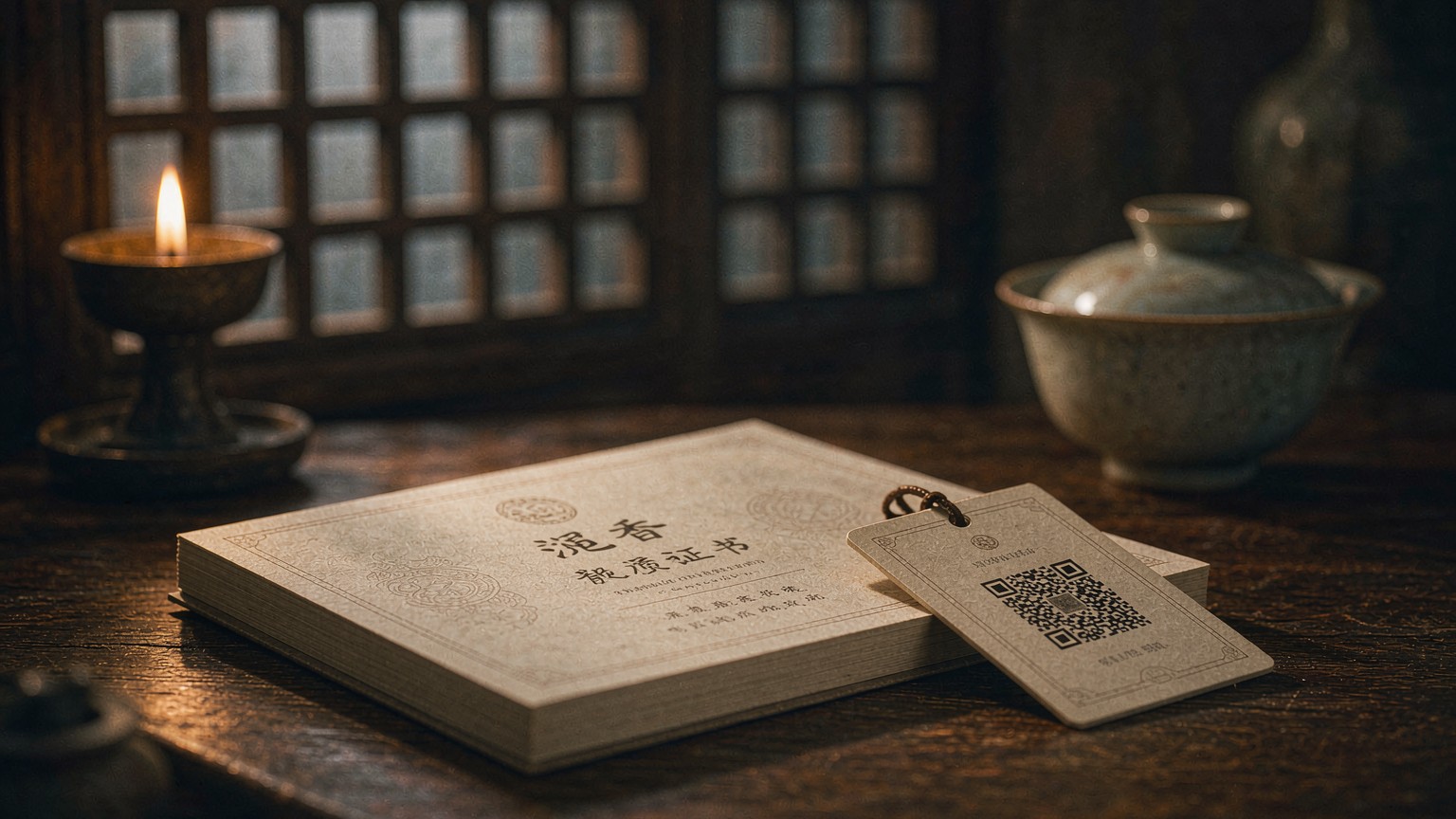
To judge whether an institution is reliable, check three things: whether the qualification certificate number can be verified on official platforms, whether the testing scope includes 'agarwood' or 'wood identification', and whether the report has a骑缝章 (perforation seal) and anti-counterfeiting code. If a certificate only has the institution name and conclusion without qualification numbers, testing basis, and tester signatures, its reference value is very limited. For systematic knowledge on agarwood identification, refer to the Identification Pillar Page.
2. Test Items: What Was Tested Determines What the Certificate Can Prove
Test items on agarwood certificates typically include: first, species identification through wood anatomy or DNA barcoding to determine if it belongs to the Aquilaria genus of Thymelaeaceae; second, component analysis using gas chromatography-mass spectrometry (GC-MS) to detect characteristic agarwood compounds such as agarotetrol and chromones; third, physicochemical indicators like density, ash content, and alcohol-soluble extract content; fourth, sensory evaluation by appraisers describing aroma, oil lines, and texture.
Note that species identification only proves 'whether it is Aquilaria wood', not 'whether it is naturally formed' or 'where it originated'. Component analysis can help detect artificial oil injection or chemical additives, but composition varies greatly by origin and formation method, so conclusions cannot be drawn from one or two components alone. If a certificate only states 'characteristic agarwood compounds detected' without specific data and spectra, its probative value is weak. For more on test items and identification methods, see the Agarwood Encyclopedia.
3. Conclusion: The Wording Hides the Boundaries
The conclusion section is the most easily misinterpreted. Common conclusions include: 'conforms to Aquilaria wood characteristics', 'characteristic agarwood compounds detected', 'no artificial additives detected', 'sensory evaluation conforms to agarwood characteristics'. Each has boundaries:
'Conforms to Aquilaria wood characteristics' only means the species is correct, not the quality of resin formation; 'characteristic agarwood compounds detected' only means certain compounds are present, not whether it is natural or artificially treated; 'no artificial additives detected' only applies to the submitted sample, not the entire batch. Therefore, pay special attention to qualifiers—whether it is responsible for the sample or the batch, whether standard or in-house methods were used, and what the detection limit is.
If the conclusion simply says 'identified as agarwood' without any conditions, be cautious, because rigorous reports usually specify testing basis, methods, and limitations. For traditional Xiangxue experience and standards in agarwood appraisal, refer to the Chinese Xiangxue · Agarwood Identification topic. For special categories like Kyara, the reference dimensions differ; see the Kyara Pillar Page.
4. Practical Advice: Three Looks and One Check
In summary, reading an agarwood certificate follows 'three looks and one check': look at institution qualifications, look at test items, look at conclusion wording, and check the certificate number's authenticity. A certificate is an auxiliary tool, not a quality guarantee. Truly judging agarwood quality requires combining aroma, oil lines, density, and source channels. If a certificate makes you feel it 'proves everything', it often means it proves nothing.
(This is industry observation and popular-science summary, not investment advice. Buy agarwood through legal channels with traceable, testable sources.)
Compiled from industry information; not trading or investment advice.
常见问题
How to Read Agarwood Appraisal Certificates是什么?
The core of an agarwood appraisal certificate lies in whether the issuing institution has CMA/CNAS accreditation, whether the test items cover key indicators, and whether the conclusion is clearly stated. Reading a certificate requires attention to institutional authority, testing methods, data ranges, and the limiting conditions of conclusions—not just the conclusion itself.
沉香怎么选购?
选购沉香应认准可溯源、可检测的渠道,按用途选择形态(线香 / 手串 / 原料),不盲目追高、不轻信「野生」「沉水」等夸大宣传。
沉香如何保养?
沉香怕潮、怕串味、怕暴晒,应密封、避光、阴凉存放,不同产区分开保存;长期不用的香材定期通风检查,防霉防虫。
Related reading

评论区
评论匿名可浏览,登录后可发表;提交后先审后显。
评论加载中…
Check related market data
Want the reference price for this category? Compare on the market page.
Go to market