
Wild Ancient Agarwood Population Discovered in Zhuhai, Guangdong
Source:中国沉香网· 2025-07-27· 中国沉香网· 77 views
Recently, a wild ancient agarwood population was discovered in Zhuhai, Guangdong Province, specifically located in Lianjiang Village, Liantou Town, Doumen District, Zhuhai. The largest wild agarwood tree is 148 years old, and numerous wild agarwood saplings are distributed around it.

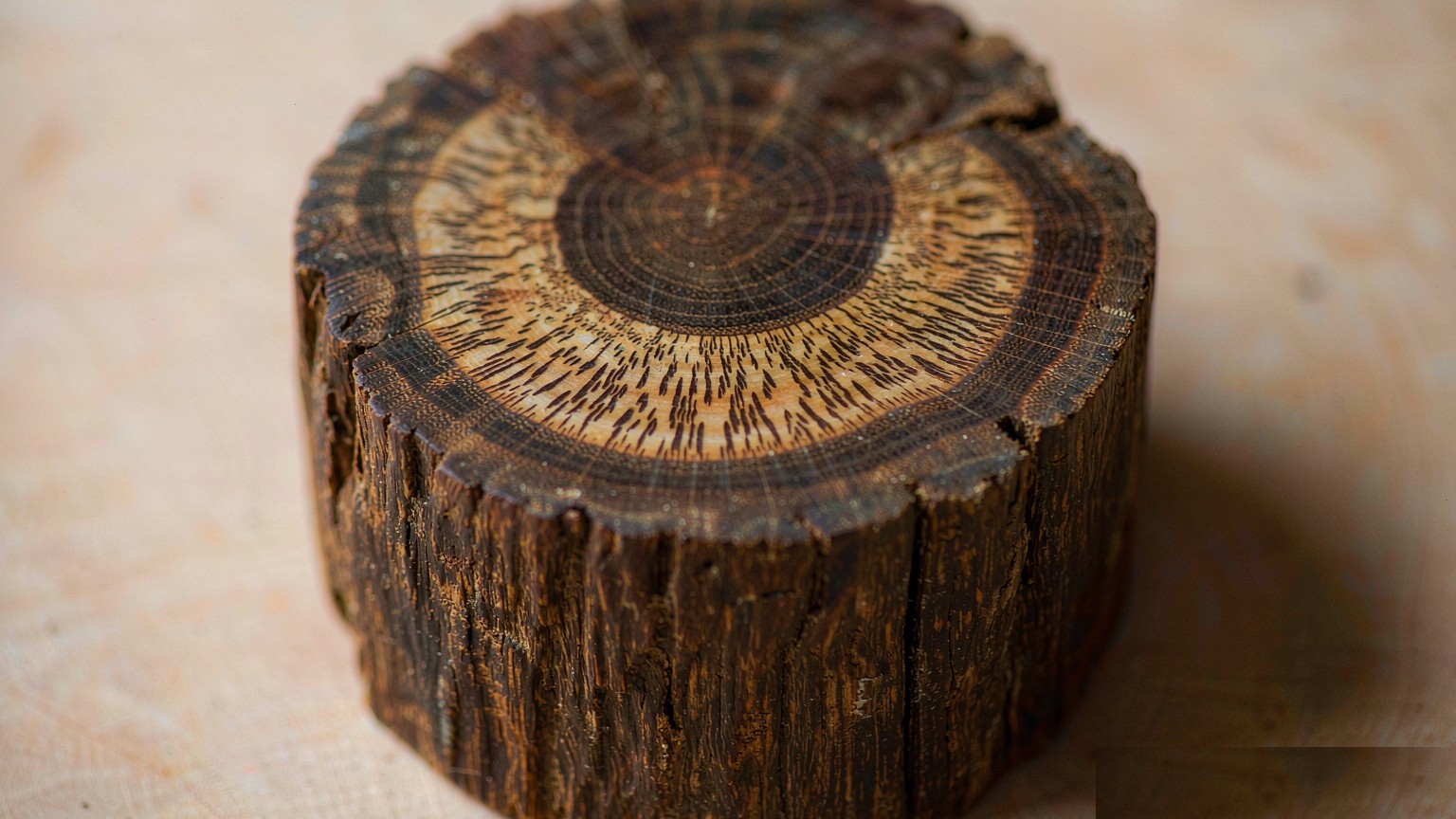
The newly discovered wild ancient agarwood population grows on Wuzhi Mountain in Lianjiang Village. The largest tree has a trunk diameter exceeding 80 cm and stands about 20 meters tall, with lush branches and leaves. The wounded parts of the trunk have undergone resin formation, showing the typical "baotou" (head-wrapping) feature of agarwood trees. Three other agarwood trees have trunk diameters exceeding 20 cm.

This wild agarwood grove echoes the 3,000 agarwood saplings planted in Lianjiang Village last year.

Agarwood, the foremost of the four famous fragrances "agarwood, sandalwood, ambergris and musk," has been renowned worldwide since ancient times for its unique aroma profile and medicinal value.
Zhuhai has had an agarwood cultural heritage since ancient times. The Xiangzhou Shanchang area of Zhuhai was China's earliest agarwood trading market during the Sui and Tang dynasties.

The agarwood industry is also a new growth point for rural industry revitalization in Zhuhai.
Below, Chenxiang123 provides a detailed introduction to agarwood
I. Introduction to Agarwood
Agarwood refers to the natural composite substance composed of xylem tissue and its secretions formed during the growth of tree species in the genus Aquilaria spp. or Gyrinops spp. of the family Thymelaeaceae. In China, the Aquilaria species capable of forming agarwood is primarily Aquilaria sinensis.
Agarwood is a world-renowned fragrance material, ranking first among China's four famous fragrances "agarwood, sandalwood, ambergris and musk." It is hailed as the foremost of all fragrances and has been used since ancient times as a traditional precious medicinal material and natural spice, widely used in China, Japan, India, Middle Eastern countries and Southeast Asian nations. As an important raw material for precious essences and spices, religious supplies, traditional Chinese medicines and daily health products, agarwood and related products have long been in short supply in both international and domestic markets. Early agarwood came mainly from natural forests of Aquilaria sinensis. As wild agarwood resources gradually dwindled, especially after Aquilaria sinensis was listed as a national second-class protected wild plant in 1999, the harvesting of natural Aquilaria sinensis was prohibited, causing agarwood and related products to be severely undersupplied for a long period, with prices soaring continuously. Consequently, many southern regions began attempting artificial cultivation of Aquilaria sinensis. After years of scientific experiments and cultivation practice, artificial Aquilaria sinensis plantations have grown well at scale in multiple regions; however, problems such as long resin formation time, difficulty in resin formation and low resin quality are widespread, making industrialization difficult to achieve.
II. Qinan Agarwood
Agarwood has been graded differently since ancient times. For example, in the Song Dynasty, Ding Wei's "Tianxiang Zhuan" divided agarwood into four grades: sinking grade, zhanxiang, shengjie and shujie. In modern times, agarwood is divided into three grades—first, second and third—based on resin content, and by origin is typically classified into the Guanxiang, Hui'an and Xingzhou systems. "Qinan" has always been regarded as the top grade of agarwood. The earliest descriptions of qinan in ancient texts can be traced to the Ming Dynasty's "Xingcha Shenglan," generally referring to premium agarwood with rich resin and a unique aroma profile. There are also documentary records of qinan from the Ming and Qing dynasties, where it was also called "jianan" or "qinan" in ancient texts. However, ancient texts contain only qualitative descriptions of agarwood characteristics, lacking detailed biological descriptions.
In recent years, special agarwood germplasms distinct from Aquilaria sinensis have been discovered in Maoming, Guangdong, Hainan and other places. These special germplasms possess multiple excellent traits such as early resin formation, rapid resin formation and high resin quality, and are therefore also called "easy-resin" agarwood. Cultivation practice has shown that when scions of such special agarwood germplasms are grafted onto Aquilaria sinensis and grown for 3–5 years, resin can be induced by ordinary electric drilling; after 2–3 years of resin formation, relatively high-quality agarwood can form. Because the resulting agarwood characteristics closely match ancient records of qinan, such easy-resin agarwood is collectively referred to as qinan agarwood.
The team of Xu Daping/Liu Xiaojin (Chief Expert Group on Forest Cultivation Theory and Technology) at the Research Institute of Tropical Forestry, Chinese Academy of Forestry, has conducted extensive systematic research on genetics, morphological anatomy, photosynthetic physiology, resin formation processes, physiological and molecular mechanisms of resin formation, and germplasm identification. They found that such special agarwood germplasms originate from Aquilaria sinensis, but qinan agarwood differs from Aquilaria sinensis to some extent in apparent morphology, microanatomical structure and physiological-biochemical indicators.
The leaf morphology of qinan agarwood (leaf length, leaf width, leaf perimeter, leaf area and length-width ratio) differs somewhat from Aquilaria sinensis, manifesting as significantly higher leaf thickness, chlorophyll content, nitrogen content, specific leaf weight and net photosynthetic rate than Aquilaria sinensis. The palisade tissue and spongy tissue thickness as well as leaf stomatal density are all greater than in Aquilaria sinensis, but the xylem vessel wall thickness of qinan agarwood is thinner than that of Aquilaria sinensis, the ray cell walls are thicker, and the interxylary phloem area is larger than in Aquilaria sinensis, indicating that the carbohydrate synthesis and storage capacity of qinan agarwood is stronger than that of Aquilaria sinensis.
By comparing the stress response changes of qinan and Aquilaria sinensis under external stress, combined with differential analysis of defense response hormones, antioxidant enzyme activities, total phenol and total terpene contents, it was found that agarwood formation is the result of a trade-off between tree growth and defense.
During resin formation in qinan agarwood, starch and soluble sugars in xylem rays and interxylary phloem are heavily consumed. The intensity and duration of the stress response are greater than in Aquilaria sinensis. The starch and soluble sugar utilization rate of qinan agarwood reaches 76.25%, while that of Aquilaria sinensis is only 6.15%. After agarwood formation, most agarwood substances fill the xylem ray cells and interxylary phloem, with only a small amount filling the xylem vessels. The main components are chromones and sesquiterpenes, especially 2-(2-phenylethyl)chromone and 2-[2-(4-methoxyphenyl)ethyl]chromone compounds. As agarwood substances further fill in, the active cells in the resin-forming xylem gradually die. When agarwood substances completely fill the xylem, a barrier layer forms between the living and dead parts of the tree.
The reason qinan agarwood forms resin better and with higher quality than Aquilaria sinensis is mainly that qinan agarwood has a stronger defense response to external stimuli (stress) that lasts longer.
By comparing molecular expression differences between qinan agarwood and Aquilaria sinensis during resin formation, it was found that there is clear genotypic separation between these two types of agarwood, with significant differences in metabolite accumulation at the metabolome level. Based on resequencing technology, core SNP marker loci for identifying qinan agarwood germplasm have been developed (Patent No.: ZL 202311514597.7). The detection results are accurate and reliable, and the detection method is simple to operate and low in cost, making it suitable for seedling identification of qinan agarwood on the market and for predicting the resin formation characteristics of breeding materials. Therefore, in a sense, this type of qinan agarwood can be understood as a chemotype of Aquilaria sinensis.
Note:
Agarwood is the collective term for plants in the genus Aquilaria of the family Thymelaeaceae, order Malvales. According to the Catalogue of Life (COL), as of December 2024, there are 22 species in the genus Aquilaria. Aquilaria plants are trees or small trees with alternate leaves. Flowers are bisexual, axillary or terminal, usually forming sessile or pedunculate umbels; petals are 10, reduced to scale-like; stamens number twice the calyx lobes, with very short filaments; the ovary is hairy, incompletely or completely 2-locular, with a short style and capitate stigma. Capsules are pedunculate and laterally compressed. Seeds are ovate or ellipsoid, with a hard brittle seed coat and no endosperm.
Wild resources of the genus Aquilaria are distributed worldwide mainly in Asia, including Myanmar, Thailand, Vietnam, Laos and Cambodia [1], and in China in Hainan, Guangdong, Guangxi, Yunnan and Fujian provinces [7] [13-14]. Most species of this genus grow in tropical rainforests of Southeast and South Asia and have strong environmental adaptability, growing well in areas with average daily temperatures of 20–22°C and elevations of 0–850 meters.
Aquilaria plants have good ornamental value. For example, Aquilaria sinensis has a beautiful tree form, elegant posture, lush branches and leaves, and remains evergreen year-round, making it a highly ornamental landscaping tree species [12]. Aquilaria plants have hard wood rich in resin and are one of the preferred materials for carving.
Because agarwood has wide uses and global demand has increased, agarwood trees in origin countries such as Hainan, Indonesia, Vietnam, Malaysia, India and Myanmar have been over-logged, and wild resources continue to decline.
The IUCN Red List of Threatened Species has assessed 20 species of the genus Aquilaria, including 4 Critically Endangered, 1 Endangered and 8 Vulnerable; all species of the genus Aquilaria are listed in Appendix II of the Convention on International Trade in Endangered Species of Wild Fauna and Flora (2023 edition); in China, Aquilaria sinensis and Aquilaria yunnanensis of the genus Aquilaria are included in the List of National Key Protected Wild Plants (2021 edition) and are national second-class protected wild plants. Protecting wild agarwood is everyone's responsibility.
This article was compiled by "Chenxiang123". Original source: https://www.chenxiang123.com/zhuhai-yesheng-chenxiang/
Compiled from industry information; not trading or investment advice.
Frequently Asked Questions
What is Wild Ancient Agarwood Population Discovered in Zhuhai, Guangdong?
A wild ancient agarwood population has been found in Lianjiang Village, Liantou Town, Doumen District, Zhuhai, Guangdong, with the largest wild agarwood tree aged 148 years.
How should I choose agarwood?
Buy from traceable, testable channels and match the form (incense, beads, raw wood) to your use. Avoid exaggerated claims such as "wild" or "sinking grade" without proof, and prefer products with lab reports and origin documentation.
How should agarwood be stored and maintained?
Agarwood dislikes moisture, odours and direct sunlight. Keep it sealed, dark and cool, store different origins separately, and air and inspect long-stored pieces periodically against mould and insects.
How can I tell real agarwood from fake?
Authentication combines sensory checks with technical ones: natural agarwood has a clean, long-lasting, cool-sweet scent and burns with pale, non-pungent smoke. GC-MS analysis of characteristic compounds (chromones, sesquiterpenes) adds objective confirmation. Buying through traceable channels with certificates lowers the risk.
How do agarwood origins differ?
Climate, tree species and resin-induction methods give each origin a distinct scent profile — for example Hainan tends to be clean and elegant, Vietnam sweet and cool, Indonesia deep and full. Origin is a key factor in grading and pricing.
What is the current agarwood market like?
Prices diverge sharply by resin density, origin and form, with both top-end collectibles and entry-level consumer products active. Use actual transactions from legal, testable channels as reference rather than a single quotation.
What is the relationship between agarwood and incense culture?
Agarwood is the core medium of East Asian incense culture, spanning temple offerings, literati gatherings and contemporary lifestyle aesthetics. Understanding this cultural background helps explain its value.
Does agarwood have health benefits?
Traditionally agarwood has been used for calming and sleep-related rituals, but evidence quality and dosage need careful reading. Keep traditional use and scientific evidence clearly separated and follow professional guidance.
This is an aggregated digest. Original source:View original(中国沉香网)
参考资料
Related reading
Related Agarwood Picks
While reading, you might also like these compliant cultivated-agarwood products.
Visit Mall
评论区
评论匿名可浏览,登录后可发表;提交后先审后显。
评论加载中…
Check related market data
Want the reference price for this category? Compare on the market page.
Go to market