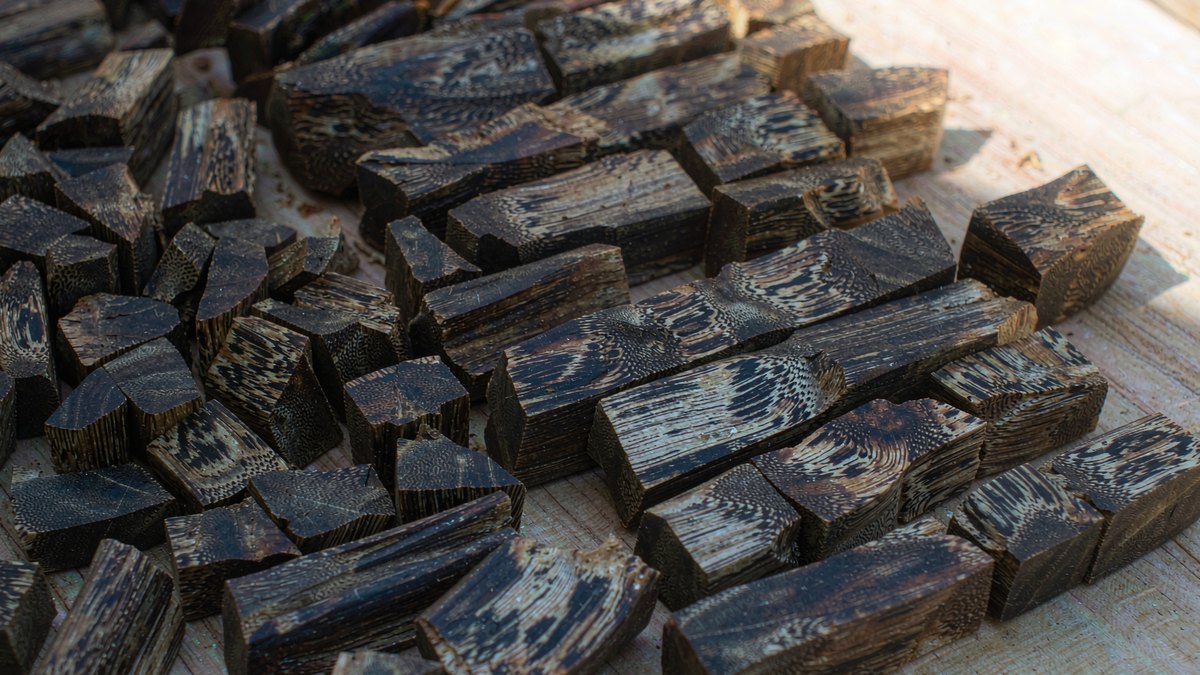
Maoming Agarwood Export "Full-Process Guidebook" Released
Source:中国沉香网· 2026-09-21· 中国沉香网· 86 views
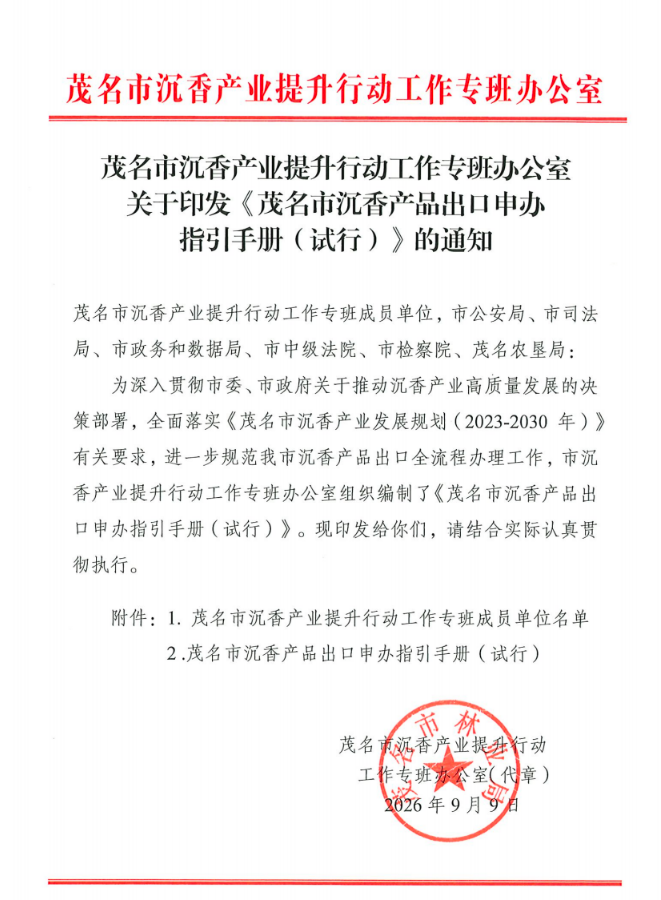
Recently, the office of the Maoming City agarwood industry upgrading action task force issued the Maoming City Agarwood Product Export Application Guidebook (Trial) (hereinafter the "Guidebook"), compiling the full set of procedures for agarwood products—from planting registration to customs declaration and export—into a "manual" that enterprises can follow step by step. From now on, local Maoming agarwood companies that want to sell their fine incense abroad will have a clear pathway for handling the paperwork.
Agarwood is a signature forest product of Maoming, but it has a special "status": it is listed in Appendix II of the Convention on International Trade in Endangered Species of Wild Fauna and Flora (CITES)—an international protection list whose species require government control and permits for cross-border trade. To declare agarwood for export, a CITES Export Permit must first be obtained—commonly known as the "endangered species certificate"; without it, customs will not release the goods under any circumstances. Precisely because regulation is strict, agarwood export is not as simple as "packing it up and shipping it out": forestry pre-approval procedures must be completed first, followed by customs registration, then application for the endangered species certificate, a non-detriment finding, fumigation and disinfection certificates as needed, and finally customs declaration. Each step links to the next—none can be skipped or taken out of order.
In the past, when companies handled agarwood export, they often got stuck at "not knowing whom to contact or what materials to bring." The newly issued Guidebook, with 13 chapters and 6 attached forms, links these steps into a closed loop, explaining step by step "whom to contact, what to bring, how to proceed, and how long it takes." For example, for registration of artificially planted agarwood, completion takes 15 working days from village committee public notice through township preliminary review to forestry department verification; a yield estimation opinion takes 10 working days, and a certificate of origin takes 5 working days. With the Guidebook in hand, companies know exactly which step comes next and can proceed with confidence.
"In the past, the application process was cumbersome—we could only keep calling around asking questions, and often couldn't reach anyone. Now with the Guidebook, whenever we're unsure about a step, we just follow it, and everything is clear," said Luo Fumei, chairman of Senhai agarwood Planting Professional Cooperative. The cooperative is currently following the Guidebook to handle overseas business registration for a new trading company, which has been "much more convenient."
The relevant business division of the Maoming Forestry Bureau reminds that the entire agarwood product export process should be planned with 90 calendar days in reserve. Because expert review, on-site verification, and other steps are involved, the time required for these is not counted within the statutory administrative approval time limit; enterprises should plan ahead to avoid shipment delays caused by underestimating the cycle.
There is also good news on costs. Administrative approvals, registrations, and permit issuance by customs and forestry departments are all exempt from administrative and institutional fees. The only costs enterprises actually bear are market-based service fees such as third-party testing, fumigation and pest elimination, and electronic port card processing—spent transparently.
The Guidebook makes clear "who does what." Agarwood farmers are responsible for providing materials on planting rights, seedling sources, and origin traceability, and simply need to cooperate with enterprises—they do not need to handle registration and customs declaration themselves. The actual agarwood export declaration can only be made by compliant agarwood export enterprises. Individuals and smallholder growers without import-export qualifications cannot handle customs clearance directly. This also serves as a reminder to smallholders who wish to participate in exports: joining forces with an enterprise is more reliable than going it alone.
The implementation of the Guidebook gives Maoming agarwood a steadier pace in "going global." At present, some enterprises are already preparing their first agarwood export orders in accordance with the Guidebook. As the guidance becomes more widely adopted, local agarwood is expected to open up overseas markets step by step and gradually gain momentum.
This article was compiled by "Chenxiang123"; original source: https://www.chenxiang123.com/maoming-chengxiang-chukou-shuomingshu/
Compiled from industry information; not trading or investment advice.
Frequently Asked Questions
What is Maoming Agarwood Export "Full-Process Guidebook" Released?
The Maoming agarwood industry task force has issued a trial guidebook mapping the entire agarwood export process, from planting registration to customs declaration, giving local firms a clear path to overseas markets.
How should I choose agarwood?
Buy from traceable, testable channels and match the form (incense, beads, raw wood) to your use. Avoid exaggerated claims such as "wild" or "sinking grade" without proof, and prefer products with lab reports and origin documentation.
How should agarwood be stored and maintained?
Agarwood dislikes moisture, odours and direct sunlight. Keep it sealed, dark and cool, store different origins separately, and air and inspect long-stored pieces periodically against mould and insects.
How can I tell real agarwood from fake?
Authentication combines sensory checks with technical ones: natural agarwood has a clean, long-lasting, cool-sweet scent and burns with pale, non-pungent smoke. GC-MS analysis of characteristic compounds (chromones, sesquiterpenes) adds objective confirmation. Buying through traceable channels with certificates lowers the risk.
How do agarwood origins differ?
Climate, tree species and resin-induction methods give each origin a distinct scent profile — for example Hainan tends to be clean and elegant, Vietnam sweet and cool, Indonesia deep and full. Origin is a key factor in grading and pricing.
What is the current agarwood market like?
Prices diverge sharply by resin density, origin and form, with both top-end collectibles and entry-level consumer products active. Use actual transactions from legal, testable channels as reference rather than a single quotation.
What is the relationship between agarwood and incense culture?
Agarwood is the core medium of East Asian incense culture, spanning temple offerings, literati gatherings and contemporary lifestyle aesthetics. Understanding this cultural background helps explain its value.
Does agarwood have health benefits?
Traditionally agarwood has been used for calming and sleep-related rituals, but evidence quality and dosage need careful reading. Keep traditional use and scientific evidence clearly separated and follow professional guidance.
This is an aggregated digest. Original source:View original(中国沉香网)
参考资料
Related reading

Related Agarwood Picks
While reading, you might also like these compliant cultivated-agarwood products.
Visit Mall
评论区
评论匿名可浏览,登录后可发表;提交后先审后显。
评论加载中…
Check related market data
Want the reference price for this category? Compare on the market page.
Go to market