Hainan Institute of Medicinal Plants: Focus on Sustainable Development of the Agarwood Industry
Source:中国沉香网· 2026-09-17· 中国沉香网· 73 views
Recently, a joint research team composed of the Guangzhou Office of the National Forestry and Grassland Administration, the China National Committee for Endangered Species, and the Wildlife Protection Monitoring Center of the National Forestry and Grassland Administration, led by Division Chief Zhai Xincui, visited the Hainan Branch of the Institute of Medicinal Plants to investigate the development of the agarwood industry. Personnel from relevant Hainan provincial units accompanied the research team.
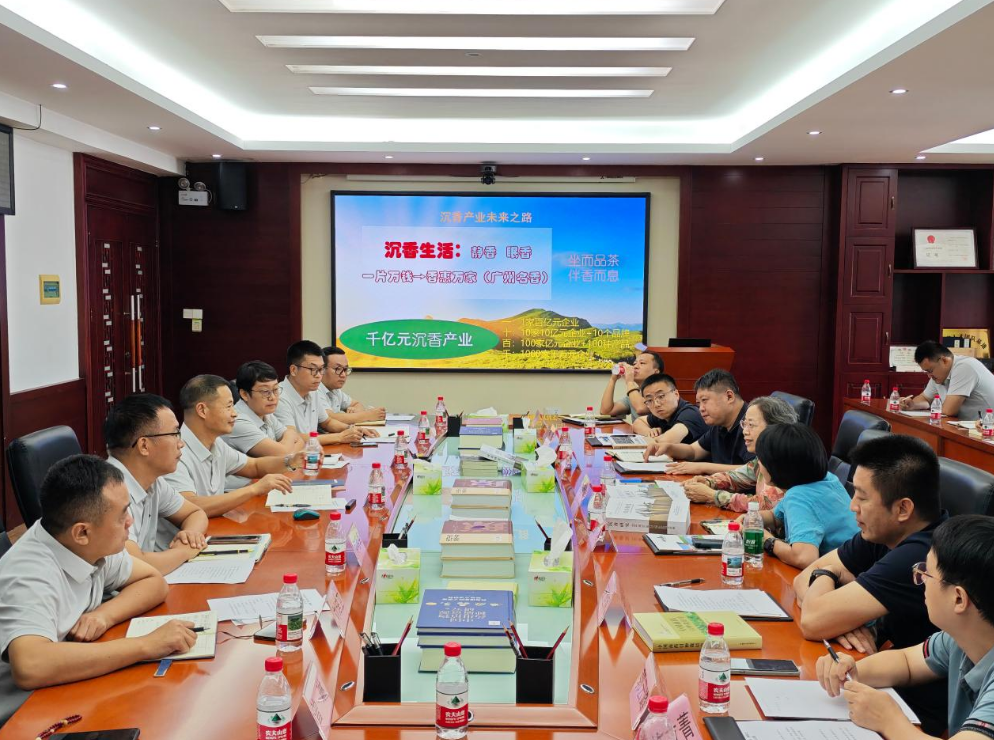
The research team conducted on-site inspections of scientific research platforms including the National Southern Medicinal Plant Gene Resource Bank, the Hainan Provincial Traditional Chinese Medicine Herbarium, the agarwood identification center, and the aromatic medicinal plant germplasm bank, learning about the achievements of the branch in research on induced medicinal plants such as agarwood and rosewood, as well as in the protection of rare and endangered medicinal plant resources. At the symposium, the research team and Director Wei Jianhe of the Hainan Branch and his research team engaged in in-depth consultation and discussion on the sustainable development path of the agarwood industry. The research team and researchers held in-depth exchanges on core issues such as the current confusion in agarwood provenance, CITES export restrictions on endangered agarwood species, and the promotion and application of the agarwood mother tree system.
As a member of the China National Committee for Endangered Species, Wei Jianhe has long been deeply involved in endangered species protection and has offered suggestions for the sustainable development of agarwood. His research team on induced medicinal plants such as agarwood was the first to reveal the mystery of resin formation—that "wounding induces the defense response of Aquilaria sinensis to form agarwood"—and invented the "whole-tree agarwood-inducing technique," which has been applied to more than 660,000 trees worldwide, making it the most widely applied modern resin induction technique to date and driving a transformation in agarwood resin formation technology.
The team was also the first to clarify that grafted "qinan" is the qinan recorded in materia medica, and confirmed that it is a new chemotype of the Aquilaria sinensis species; the team also systematically revealed the scientific basis for agarwood's qi-regulating and mind-calming effects and qinan's analgesic and anti-inflammatory efficacy, and is committed to integrating agarwood into the public's healthy lifestyle of "quiet incense and sleep incense," advancing toward a hundred-billion-level agarwood industry. These achievements have addressed the global agarwood resource crisis under the CITES Convention and have been praised by the National CITES Management Authority as one of the model species demonstrating China's contribution to global endangered species protection, supporting agarwood in becoming the "fourth tree" among Hainan's six key trees for development. The special visit to Hainan by the Guangzhou Office of the National Forestry and Grassland Administration and the China National Committee for Endangered Species was precisely to evaluate this "China solution" from the strategic height of national convention implementation and to provide decision-making support for coordinating endangered species protection with the high-quality development of the agarwood industry.
This article was compiled by "Chenxiang.com"; original source: https://www.chenxiang123.com/hainan-yaozhisuo-chenxiang-chanye-kechixu-fazhan/
Compiled from industry information; not trading or investment advice.
Frequently Asked Questions
What is Hainan Institute of Medicinal Plants?
A joint research team from the Guangzhou Office of the National Forestry and Grassland Administration, the China National Committee for Endangered Species, and the Wildlife Protection Monitoring Center visited the Hainan Branch of the Institute of Medicinal Plants to study agarwood industry developm
How should I choose agarwood?
Buy from traceable, testable channels and match the form (incense, beads, raw wood) to your use. Avoid exaggerated claims such as "wild" or "sinking grade" without proof, and prefer products with lab reports and origin documentation.
How should agarwood be stored and maintained?
Agarwood dislikes moisture, odours and direct sunlight. Keep it sealed, dark and cool, store different origins separately, and air and inspect long-stored pieces periodically against mould and insects.
How can I tell real agarwood from fake?
Authentication combines sensory checks with technical ones: natural agarwood has a clean, long-lasting, cool-sweet scent and burns with pale, non-pungent smoke. GC-MS analysis of characteristic compounds (chromones, sesquiterpenes) adds objective confirmation. Buying through traceable channels with certificates lowers the risk.
How do agarwood origins differ?
Climate, tree species and resin-induction methods give each origin a distinct scent profile — for example Hainan tends to be clean and elegant, Vietnam sweet and cool, Indonesia deep and full. Origin is a key factor in grading and pricing.
What is the current agarwood market like?
Prices diverge sharply by resin density, origin and form, with both top-end collectibles and entry-level consumer products active. Use actual transactions from legal, testable channels as reference rather than a single quotation.
What is the relationship between agarwood and incense culture?
Agarwood is the core medium of East Asian incense culture, spanning temple offerings, literati gatherings and contemporary lifestyle aesthetics. Understanding this cultural background helps explain its value.
Does agarwood have health benefits?
Traditionally agarwood has been used for calming and sleep-related rituals, but evidence quality and dosage need careful reading. Keep traditional use and scientific evidence clearly separated and follow professional guidance.
This is an aggregated digest. Original source:View original(中国沉香网)
参考资料
Related reading

评论区
评论匿名可浏览,登录后可发表;提交后先审后显。
评论加载中…
Check related market data
Want the reference price for this category? Compare on the market page.
Go to market