
What Are Agarwood Oil Lines: Understanding Oil Lines to Understand Agarwood
Agarwood oil lines are dark patterns formed by resin intertwined with wood fibers, serving as a key visual indicator for authenticity, quality, and origin. This article explains oil lines from definition, formation, morphology, and identification applications to help enthusiasts build a systematic observation method.
1. Definition and Formation Mechanism of Oil Lines
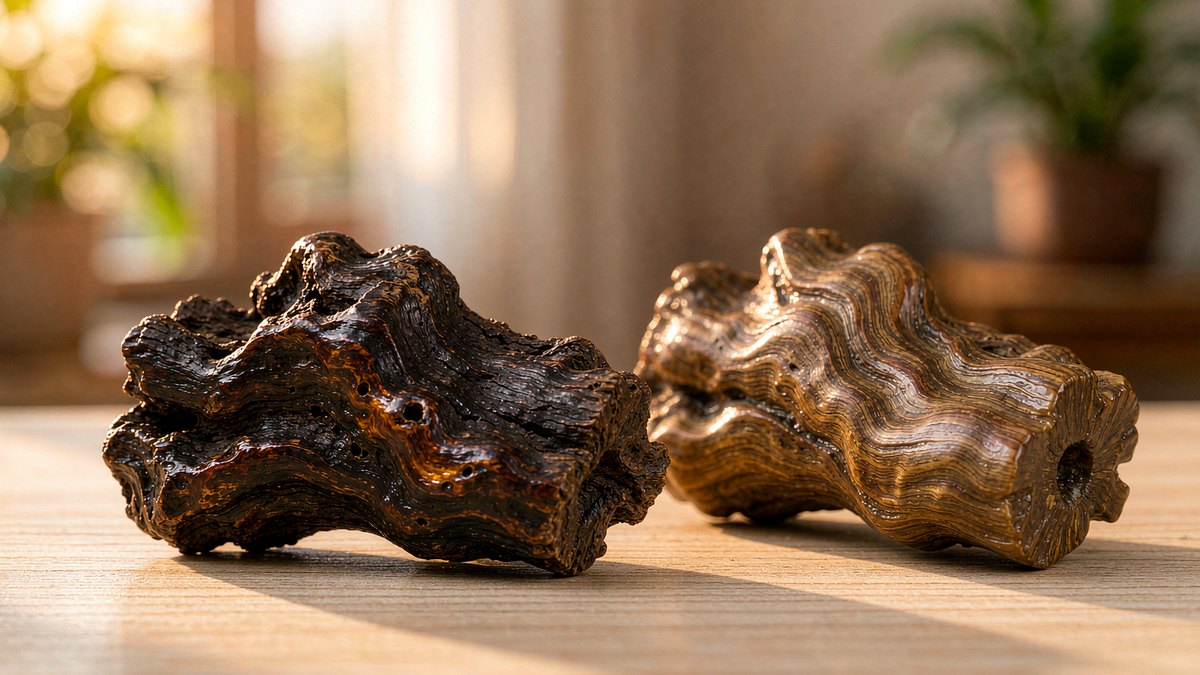
Agarwood oil lines refer to the dark linear or patchy patterns formed when resin secreted by the agarwood tree after injury interweaves and deposits with wood fibers. They are not the natural color of the wood but the result of resin permeating and condensing in tissues such as vessels and rays. When resin accumulation reaches a certain density, the wood darkens, forming visible 'oil lines.' Understanding the essence of oil lines is the first step into the Agarwood Encyclopedia knowledge system.
The formation of oil lines generally goes through three stages: injury induction, resin secretion and diffusion, and oxidation and solidification. After physical damage, insect attack, or fungal infection, the agarwood tree activates defense mechanisms to secrete resin; the resin spreads along wood vessels and gradually infiltrates surrounding tissues; over time, volatile components in the resin oxidize and polymerize, darkening and solidifying to form stable oil lines. This process is influenced by tree species, formation method, environment, and time, resulting in significant morphological differences in oil lines from different origins.
2. Morphology and Observation Points of Oil Lines
Observing oil lines requires attention to five dimensions: color, thickness, density, direction, and distribution. In color, oil lines range from light brown to dark brown; generally, the darker and more contrasting, the higher the resin concentration. In thickness, oil lines can be as fine as hair or as thick as veins, but thicker is not always better—judgment should combine the ratio of wood to resin. In density, dense and continuous oil lines often indicate more complete resin formation. In direction, natural oil lines extend along the wood grain with branches, gradients, and irregular edges; in distribution, natural formation often shows local aggregation rather than uniform coverage.
When observing, use natural light with a magnifying glass, avoiding direct strong light that may distort colors. Also note whether the transition between oil lines and wood is natural: natural agarwood oil lines usually have gradual transitions at the edges, while artificial dyeing or high-pressure injection often shows hard boundaries and colors floating on the surface. Mastering these morphological features helps build systematic identification logic in the Identification Pillar Page.
3. Relationship Between Oil Lines, Quality, and Origin
Oil line morphology is closely related to agarwood quality but is not the sole criterion. Generally, clear, dense, dark oil lines with strong contrast to the wood indicate higher resin content and often richer aroma. However, quality evaluation also requires considering aroma, density, taste, and origin characteristics. For example, Hoi An agarwood often has fine, dense oil lines, while Singaporean agarwood tends to have bold, rough lines; kyara shows a special soft-thread state distinct from ordinary agarwood. For detailed analysis of kyara oil characteristics, refer to the Kyara Pillar Page.
Regarding origin, the thickness, color, and distribution patterns of oil lines can serve as auxiliary indicators but cannot determine origin alone. Agarwood from different regions has distinct oil line features due to tree species, climate, and formation methods, requiring comprehensive judgment combined with aroma style and microstructure. Enthusiasts are advised to refer to the Chinese Fragrance Studies · Agarwood Identification section, comparing physical samples and professional atlases to gradually accumulate experience.
4. Application and Common Misconceptions in Identification
In agarwood identification, oil lines are important visual evidence, but common misconceptions must be avoided. Misconception 1: The blacker the oil lines, the better. In fact, uniformly black and fully covered lines may indicate artificial dyeing or oil injection. Misconception 2: Thick oil lines mean more resin. Thickness and resin concentration are not linearly related; density and aroma must be considered. Misconception 3: Presence of oil lines means natural agarwood. Artificial compression, drawing, and other methods can create similar patterns; comprehensive verification through microstructure, aroma, and burning performance is necessary.
The correct identification method combines oil line observation with aroma evaluation, density testing, and microscopic examination. Natural agarwood oil lines under magnification show resin filling vessels with natural luster and three-dimensionality, while artificially treated products often have dull colors and overly regular distribution. Through systematic learning and practice, enthusiasts can gradually improve sensitivity to oil lines and more accurately understand agarwood.
Conclusion
Oil lines are the visual imprint of agarwood's resin formation process and an important clue for authenticity and quality assessment. Understanding oil lines requires grasping their formation, mastering observation methods, combining origin and quality characteristics, and avoiding single standards. Enthusiasts are encouraged to start with oil lines, gradually deepen their knowledge of the agarwood encyclopedia system, and accumulate experience through physical comparison and aroma evaluation to truly understand agarwood.
(This is industry observation and popular-science summary, not investment advice. Buy agarwood through legal channels with traceable, testable sources.)
Compiled for general knowledge; traditional references are cultural notes, not medical advice.
常见问题
What Are Agarwood Oil Lines是什么?
Agarwood oil lines are dark patterns formed by resin intertwined with wood fibers, serving as a key visual indicator for authenticity, quality, and origin. This article explains oil lines from definition, formation, morphology, and identification applications to help enthusiasts build a systematic observation method.
沉香怎么选购?
选购沉香应认准可溯源、可检测的渠道,按用途选择形态(线香 / 手串 / 原料),不盲目追高、不轻信「野生」「沉水」等夸大宣传;优先选择带检测报告与来源凭证的商品。
沉香如何保养?
沉香怕潮、怕串味、怕暴晒,应密封、避光、阴凉存放,不同产区分开保存;长期不用的香材定期通风检查,防霉防虫。
如何鉴别沉香的真假?
鉴别沉香需综合感官与辅助手段:天然沉香香气清雅、持久、凉甜交织,燃烧烟气清白而非刺鼻;可结合 GC-MS 色谱检测特征成分(色酮、倍半萜)。建议通过可信渠道与可溯源凭证降低风险。
不同产区沉香有什么区别?
各产区因气候、树种与结香方式差异,香韵各具特色(如海南清雅、越南甜凉、印尼醇厚),是沉香分级与定价的重要参考维度。
沉香价格行情如何?
沉香行情随结香程度、产区、形态分化明显,顶级收藏与入门消费两端活跃;建议以合法、可检测渠道的实际成交为参考,勿轻信单一报价。
沉香与香道文化有什么关系?
沉香是东亚香道文化的核心媒介,从礼佛、文人雅集到当代生活美学,承载「静心、慢享」的东方审美,理解文化背景有助于读懂沉香价值。
沉香有健康功效吗?
传统上沉香被用于舒缓、助眠等场景,但证据等级与用量需谨慎看待;把「传统用法」与「科学证据」分开表述,具体以专业指导为准。
参考资料
You may also like
评论区
评论匿名可浏览,登录后可发表;提交后先审后显。
评论加载中…