First Year of Agarwood: A Beginner's Shortcut-Free Roadmap
In the first year, agarwood beginners should follow a 'learn before you buy, progress from shallow to deep' path: start by understanding the definition and classification of agarwood, build olfactory memory with small samples, then gradually learn identification points and market common sense, avoiding blind pursuit of high prices or tall tales. This article provides an actionable annual plan to help beginners avoid detours.
Step 1: Build a Cognitive Framework—Understand What Agarwood Is First
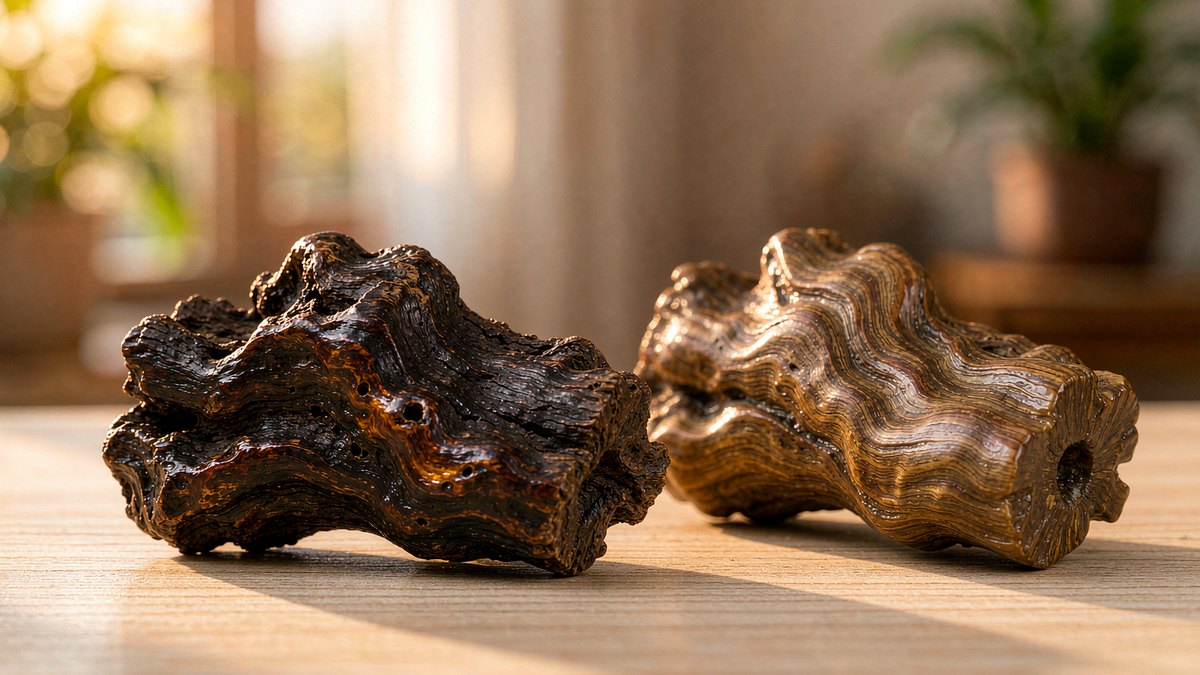
The first lesson for beginners is not 'buying' but 'learning.' Agarwood is a solid resinous deposit formed when trees of the Aquilaria genus (Thymelaeaceae) are wounded and secrete resin over long-term aging. Its value is determined by oil content, aroma performance, regional characteristics, and formation method. Start by reading the Agarwood Encyclopedia to systematically understand its formation, classification (living formation, dead formation, fallen formation, insect-induced, etc.), and common producing regions, and distinguish 'agarwood' from 'kyara'—kyara is a special category with soft threads, high oil, and complex aroma; refer to the Kyara Pillar Page for a preliminary impression. The goal at this stage is to form a correct conceptual map and avoid being misled by marketing jargon such as 'sinking,' 'black oil,' or 'old material.'
Step 2: Build Olfactory Memory with Small Samples
The core of agarwood appreciation is aroma, and olfactory memory can only be built through actual smelling. Beginners need not rush to buy expensive materials; instead, start with small amounts of chips or incense from different regions and grades through trusted channels, using 'comparative smelling' to feel the differences: for example, the fresh sweetness of the Hoi An system versus the mellow richness of the Singapore system, the coolness of living formation versus the warmth of dead formation. It is recommended to smell only one type at a time, record the changes in top, middle, and base notes, and note the difference between burning and electronic heating. At this stage, combine the basic methods in Chinese Fragrance Studies · Agarwood Identification to learn how to make preliminary judgments through aroma, texture, and density, but do not pursue 'instant authentication.'
Step 3: Master Basic Identification and Market Common Sense, Buy Cautiously
After gaining some olfactory memory, proceed to identification and purchasing. Beginners should focus on: first, observe texture (whether oil lines are natural); second, weigh density (sinking is only one indicator); third, smell aroma (whether natural and lasting); fourth, ask about source (whether region and formation method are reasonable). Also understand common counterfeiting methods such as high-pressure oil injection, dyeing, chemical soaking, and splicing, and remember the market rule: 'Cheap goods are rarely good, and high prices are not necessarily genuine.' In the first year, keep your budget within affordable limits, prioritize reputable merchants and channels with return policies, and avoid impulsive buying at auctions or livestreams. For more systematic identification knowledge, refer to the Identification Pillar Page and gradually build your own judgment standards.
Step 4: Set an Annual Learning Plan and Collection Rhythm
The goal of the first year is to 'avoid detours,' not to 'collect all regions.' You can follow this rhythm: months 1-3 focus on theoretical learning and aroma enlightenment; months 4-6 begin comparative smelling of small samples to establish personal aroma preferences; months 7-9 learn identification points and try to acquire 1-2 entry-level pieces; months 10-12 review and summarize, clarifying your collection direction (e.g., incense, bracelets, carvings, or raw materials). Also consider joining fragrance communities and attending offline incense-tasting events; exchanging with peers can accelerate growth. Remember: agarwood learning is a long-term process; only by building a solid foundation in the first year can you progress从容ly afterward.
(This is industry observation and popular-science summary, not investment advice. Buy agarwood through legal channels with traceable, testable sources.)
Compiled for general knowledge; traditional references are cultural notes, not medical advice.
常见问题
First Year of Agarwood是什么?
In the first year, agarwood beginners should follow a 'learn before you buy, progress from shallow to deep' path: start by understanding the definition and classification of agarwood, build olfactory memory with small samples, then gradually learn identification points and market common sense, avoiding blind pursuit of high prices or tall tales. This article provides an actionable annual plan to help beginners avoid detours.
沉香怎么选购?
选购沉香应认准可溯源、可检测的渠道,按用途选择形态(线香 / 手串 / 原料),不盲目追高、不轻信「野生」「沉水」等夸大宣传;优先选择带检测报告与来源凭证的商品。
沉香如何保养?
沉香怕潮、怕串味、怕暴晒,应密封、避光、阴凉存放,不同产区分开保存;长期不用的香材定期通风检查,防霉防虫。
如何鉴别沉香的真假?
鉴别沉香需综合感官与辅助手段:天然沉香香气清雅、持久、凉甜交织,燃烧烟气清白而非刺鼻;可结合 GC-MS 色谱检测特征成分(色酮、倍半萜)。建议通过可信渠道与可溯源凭证降低风险。
不同产区沉香有什么区别?
各产区因气候、树种与结香方式差异,香韵各具特色(如海南清雅、越南甜凉、印尼醇厚),是沉香分级与定价的重要参考维度。
沉香价格行情如何?
沉香行情随结香程度、产区、形态分化明显,顶级收藏与入门消费两端活跃;建议以合法、可检测渠道的实际成交为参考,勿轻信单一报价。
沉香与香道文化有什么关系?
沉香是东亚香道文化的核心媒介,从礼佛、文人雅集到当代生活美学,承载「静心、慢享」的东方审美,理解文化背景有助于读懂沉香价值。
沉香有健康功效吗?
传统上沉香被用于舒缓、助眠等场景,但证据等级与用量需谨慎看待;把「传统用法」与「科学证据」分开表述,具体以专业指导为准。
参考资料
You may also like
评论区
评论匿名可浏览,登录后可发表;提交后先审后显。
评论加载中…