
Seven Sins of Agarwood Counterfeiting and a Pitfall Avoidance Checklist
Agarwood counterfeiting methods are endless. This article summarizes seven common counterfeiting techniques (seven sins) and provides a practical pitfall avoidance checklist to help incense lovers identify fake agarwood from multiple dimensions such as appearance, aroma, and hand feel, avoiding being deceived.
1. The Seven Sins of Agarwood Counterfeiting: Common Techniques Revealed
The agarwood market is a mix of good and bad, and counterfeiting methods are constantly upgrading. Here are seven of the most common counterfeiting techniques, which can be called the "seven sins":
1. High-pressure oil injection: Inferior wood or white wood is injected with chemical essence and oil under high pressure to imitate the appearance and aroma of agarwood. This type of fake agarwood often has uniform color, unnatural oil lines, and a pungent aroma that does not last.
2. Dyeing: Ordinary wood is dyed dark with chemical dyes to pass off as high-oil agarwood. Dyed agarwood has a dull color and easily fades when exposed to water or friction.
3. Chemical soaking: Wood is soaked in chemical liquid to increase weight and aroma. This fake agarwood has a strong but chemical smell, causing dizziness after prolonged inhalation.
- Splicing and pressing: Broken agarwood or white wood is pressed and spliced with glue to make large pieces of agarwood. There are obvious glue marks or discontinuous textures at the splicing points.
- Passing off the fake as genuine: Other aromatic woods (such as flower agarwood, crocodile wood) are used to impersonate agarwood. These woods have similar textures but different aroma and density.
- Artificial drilling and oil filling: Holes are drilled in the wood and filled with oil to disguise natural resin formation. The oil lines around the holes are unnatural, and the weight distribution is uneven.
- False origin: Ordinary agarwood is passed off as famous origins like Hui'an or Sin Chew, or even labeled as Kyara. Origin fraud is often accompanied by inflated prices.
Understanding these counterfeiting methods is the first step to avoiding pitfalls. For more basic knowledge of agarwood, please refer to the Agarwood Encyclopedia.
2. Pitfall Avoidance Checklist: Five Steps to Identify Fake Agarwood
Faced with a dazzling array of agarwood products, how to avoid pitfalls? The following five steps help you quickly identify:
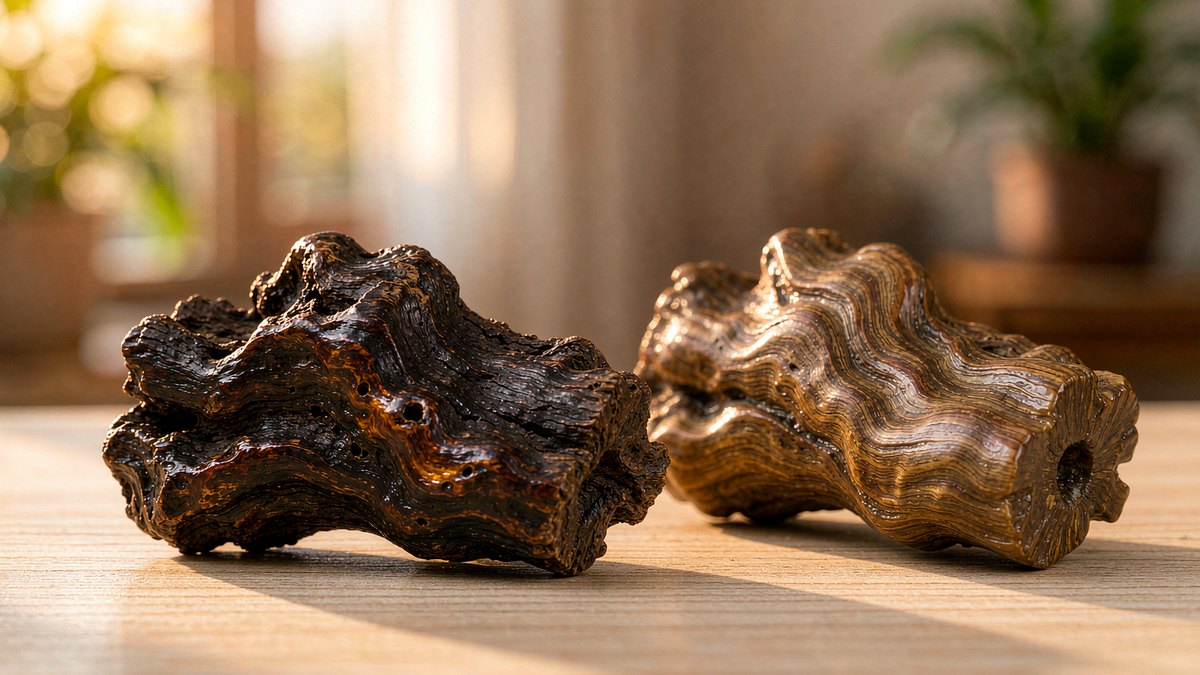
1. Look at appearance: Natural agarwood has uneven oil line distribution, varying color depths, and pores on the surface. Fake agarwood often has uniform color, dull oil lines, or overly obvious oil spots.
2. Smell the aroma: Natural agarwood has a fresh and natural aroma with rich layers, and is not greasy after long smelling. Fake agarwood has a strong and pungent aroma with a chemical or essence smell, and can cause dizziness after prolonged smelling.
3. Touch the hand feel: Natural agarwood feels warm and moist, not sticky. Fake agarwood with oil injection or chemical soaking often feels sticky or overly smooth.
4. Weigh: Natural agarwood density varies with oil content, but it is not abnormally heavy. High-pressure oil-injected fake agarwood often weighs more than natural agarwood of the same volume.
5. Water test: Natural agarwood, when placed in water, has uneven oil distribution, with some parts sinking and some floating. Fake agarwood may sink or float entirely, and oil slicks may appear on the water surface.
For high-end agarwood such as Kyara, identification is more difficult. It is recommended to refer to the detailed identification methods in the Kyara Pillar Page.
3. Advanced Identification: Professional Tools and Techniques
For experienced incense lovers, some tools and techniques can be used for further identification:
1. Magnifying glass observation: Observe the surface pores and oil lines of agarwood with a magnifying glass. Natural agarwood has clear pores and natural oil lines; fake agarwood has blurred or filled pores.
2. Heating test: Bring a hot needle close to the agarwood. Natural agarwood emits a natural aroma; fake agarwood may emit black smoke or a pungent odor.
3. Ultraviolet lamp: Some dyed or oil-injected agarwood will show fluorescence under ultraviolet light.
4. Professional appraisal: For high-value agarwood, it is recommended to send it to a professional institution for appraisal. For more identification knowledge, please visit the Identification Pillar Page.
In addition, Chinese incense culture also has rich identification experience, which can be referred to in Chinese Incense Culture · Agarwood Identification.
4. Conclusion: Rational Consumption, Stay Away from Fake Agarwood
Although there are many counterfeiting methods for agarwood, as long as you master basic identification knowledge and maintain a rational consumption attitude, you can effectively avoid pitfalls. It is recommended to buy from reputable merchants, ask for appraisal certificates, and continuously learn about agarwood. Remember: natural agarwood has a natural aroma, uneven appearance, and a warm and moist hand feel; fake agarwood is often too perfect or has a pungent aroma. Learn more and observe more to truly know incense.
(This is industry observation and popular-science summary, not investment advice. Buy agarwood through legal channels with traceable, testable sources.)
Compiled for general knowledge; traditional references are cultural notes, not medical advice.
常见问题
Seven Sins of Agarwood Counterfeiting and a Pitfall Avoidance Checklist是什么?
Agarwood counterfeiting methods are endless. This article summarizes seven common counterfeiting techniques (seven sins) and provides a practical pitfall avoidance checklist to help incense lovers identify fake agarwood from multiple dimensions such as appearance, aroma, and hand feel, avoiding being deceived.
沉香怎么选购?
选购沉香应认准可溯源、可检测的渠道,按用途选择形态(线香 / 手串 / 原料),不盲目追高、不轻信「野生」「沉水」等夸大宣传;优先选择带检测报告与来源凭证的商品。
沉香如何保养?
沉香怕潮、怕串味、怕暴晒,应密封、避光、阴凉存放,不同产区分开保存;长期不用的香材定期通风检查,防霉防虫。
如何鉴别沉香的真假?
鉴别沉香需综合感官与辅助手段:天然沉香香气清雅、持久、凉甜交织,燃烧烟气清白而非刺鼻;可结合 GC-MS 色谱检测特征成分(色酮、倍半萜)。建议通过可信渠道与可溯源凭证降低风险。
不同产区沉香有什么区别?
各产区因气候、树种与结香方式差异,香韵各具特色(如海南清雅、越南甜凉、印尼醇厚),是沉香分级与定价的重要参考维度。
沉香价格行情如何?
沉香行情随结香程度、产区、形态分化明显,顶级收藏与入门消费两端活跃;建议以合法、可检测渠道的实际成交为参考,勿轻信单一报价。
沉香与香道文化有什么关系?
沉香是东亚香道文化的核心媒介,从礼佛、文人雅集到当代生活美学,承载「静心、慢享」的东方审美,理解文化背景有助于读懂沉香价值。
沉香有健康功效吗?
传统上沉香被用于舒缓、助眠等场景,但证据等级与用量需谨慎看待;把「传统用法」与「科学证据」分开表述,具体以专业指导为准。
参考资料
You may also like
评论区
评论匿名可浏览,登录后可发表;提交后先审后显。
评论加载中…