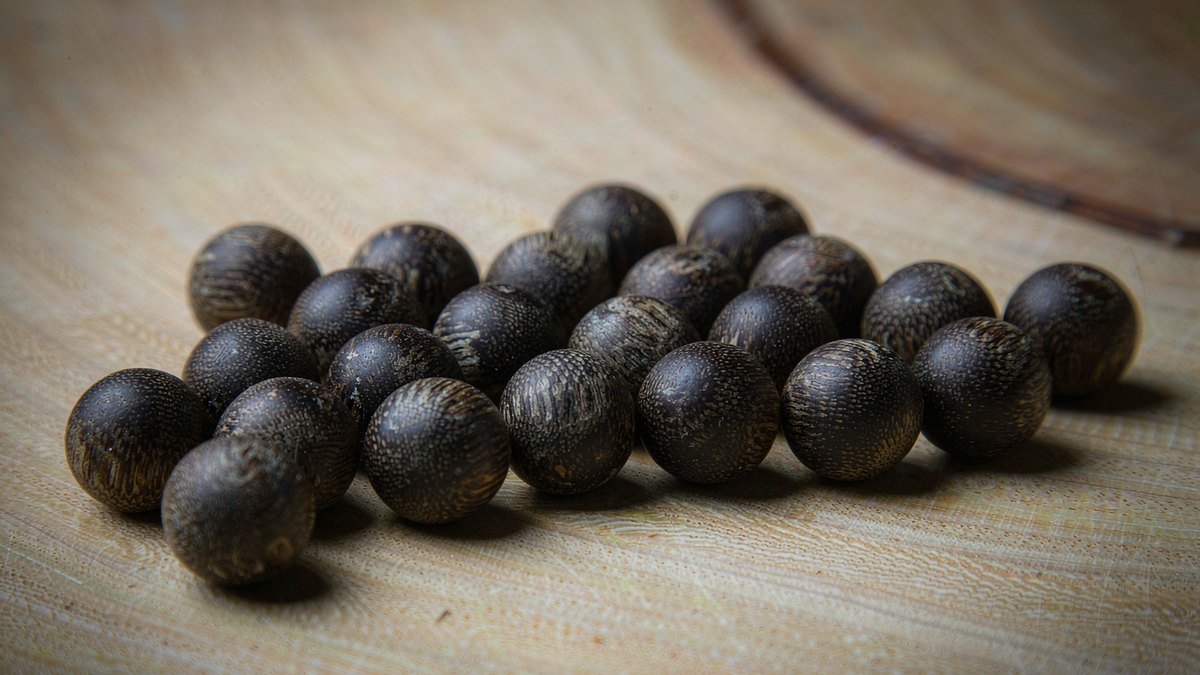
What Are Agarwood Oil Lines: Understanding Oil Lines to Understand Agarwood
Agarwood oil lines are dark streaks formed by resin deposition in the wood, serving as a key indicator for authenticity, quality, and origin. This article explains the definition, formation, morphology, and identification points of oil lines to help enthusiasts read agarwood through its oil lines.
1. Definition and Formation Mechanism of Oil Lines
Agarwood oil lines refer to the dark linear or patchy patterns formed after the resin secreted by the agarwood tree accumulates, infiltrates, and solidifies in tissues such as vessels and rays of the xylem. They are not the wood fibers themselves but the product of resin combined with wood fibers. When resin deposits densely in specific tissues, visible 'oil lines' form; the thicker and denser the deposit, the clearer the oil lines and generally the higher the agarwood quality. Understanding the formation of oil lines is the first step into the Agarwood Encyclopedia system.
The formation of oil lines is closely related to the agarwood formation mechanism: after injury, insect attack, or fungal infection, the tree secretes resin for self-protection. The resin flows and coagulates in vessels, accumulating over years or even decades to eventually form oil lines. Therefore, the morphology, density, and distribution of oil lines directly reflect the duration, site, and tree species of agarwood formation.
2. Morphological Classification of Oil Lines and Quality Correlation
Based on morphology, oil lines can be classified as linear, patchy, sheet-like, and star-like. Linear oil lines are common in phloem rays, appearing as fine parallel lines; patchy and sheet-like oil lines often appear in areas with longer agarwood formation, where resin is dense and dark; star-like oil lines are common in newly formed or resin-poor areas. The thicker, denser, and darker the oil lines, the higher the resin content and usually the higher the agarwood grade. In the Kyara Pillar Page, Kyara's oil lines often appear as highly dense sheets or paste, an important sign of its quality.
Moreover, the distribution of oil lines is influenced by tree species and origin. For example, oil lines of the Hui'an family are often fine and delicate, while those of the Sin Chew family are often coarse. By observing oil lines, one can preliminarily judge the origin and formation method of agarwood, which is an important part of fragrance identification.
3. How to Identify Authenticity and Quality of Agarwood Through Oil Lines
Natural agarwood oil lines are natural and irregular, often interspersed with wood fibers, and vary in color depth with natural transitions. In contrast, artificially treated agarwood (e.g., high-pressure oil injection, dyeing) often has oil lines that are too uniform, rigid, or superficially colored, lacking layering. In the Identification Pillar Page, oil line observation is a fundamental and key step.
During identification, a magnifying glass can be used to observe the microstructure of oil lines: natural oil lines appear infiltrated in vessels and tightly combined with surrounding wood; artificial oil lines may fill gaps with stiff boundaries. Meanwhile, methods such as smelling and sinking tests can be combined for comprehensive judgment. For more systematic methods, refer to the Chinese Fragrance Studies · Agarwood Identification topic.
4. Conclusion: Oil Lines Are the 'Fingerprint' of Agarwood
Oil lines are a faithful record of the agarwood formation process, like the 'fingerprint' of agarwood, carrying information about tree species, environment, time, and formation method. Understanding oil lines not only helps distinguish authenticity and evaluate quality but also deepens the appreciation of the beauty of agarwood formation. Enthusiasts are advised to observe and compare more in practice, combine theoretical knowledge, and gradually improve their discernment.
(This is industry observation and popular-science summary, not investment advice. Buy agarwood through legal channels with traceable, testable sources.)
Compiled for general knowledge; traditional references are cultural notes, not medical advice.
常见问题
What Are Agarwood Oil Lines是什么?
Agarwood oil lines are dark streaks formed by resin deposition in the wood, serving as a key indicator for authenticity, quality, and origin. This article explains the definition, formation, morphology, and identification points of oil lines to help enthusiasts read agarwood through its oil lines.
沉香怎么选购?
选购沉香应认准可溯源、可检测的渠道,按用途选择形态(线香 / 手串 / 原料),不盲目追高、不轻信「野生」「沉水」等夸大宣传。
沉香如何保养?
沉香怕潮、怕串味、怕暴晒,应密封、避光、阴凉存放,不同产区分开保存;长期不用的香材定期通风检查,防霉防虫。
You may also like
评论区
评论匿名可浏览,登录后可发表;提交后先审后显。
评论加载中…