
A Journey Through Agarwood Origins: The Flavor Codes of Vietnam's Hoi An and Nha Trang
Hoi An and Nha Trang are two classic agarwood-producing regions in Vietnam. Hoi An agarwood is known for its elegant, sweet-cool floral-fruity notes, while Nha Trang agarwood is famous for its rich honey sweetness and penetrating coolness. This article analyzes the flavor codes of both regions from geography, resin formation, and aroma layers, and briefly discusses identification points.
1. Hoi An and Nha Trang: Two Geographic Coordinates of Vietnamese Agarwood
Vietnam's agarwood production is concentrated in the central narrow strip, with Hoi An and Nha Trang being two of the most representative origins. Hoi An is located in Quang Nam Province, downstream of the Thu Bon River, with a humid climate and slightly acidic soil. The agarwood trees are mostly Aquilaria crassna, and resin formation occurs in a relatively mild environment. Nha Trang is in Khanh Hoa Province, backed by the Truong Son Mountains and facing the South China Sea, with distinct dry and wet seasons and rocky forest terrain. Agarwood trees here form resin slowly in harsher conditions, resulting in denser oil accumulation. These geographical and climatic differences directly shape the distinct aroma profiles of the two regions.
2. Hoi An Agarwood: Elegant, Sweet-Cool Floral-Fruity Aroma
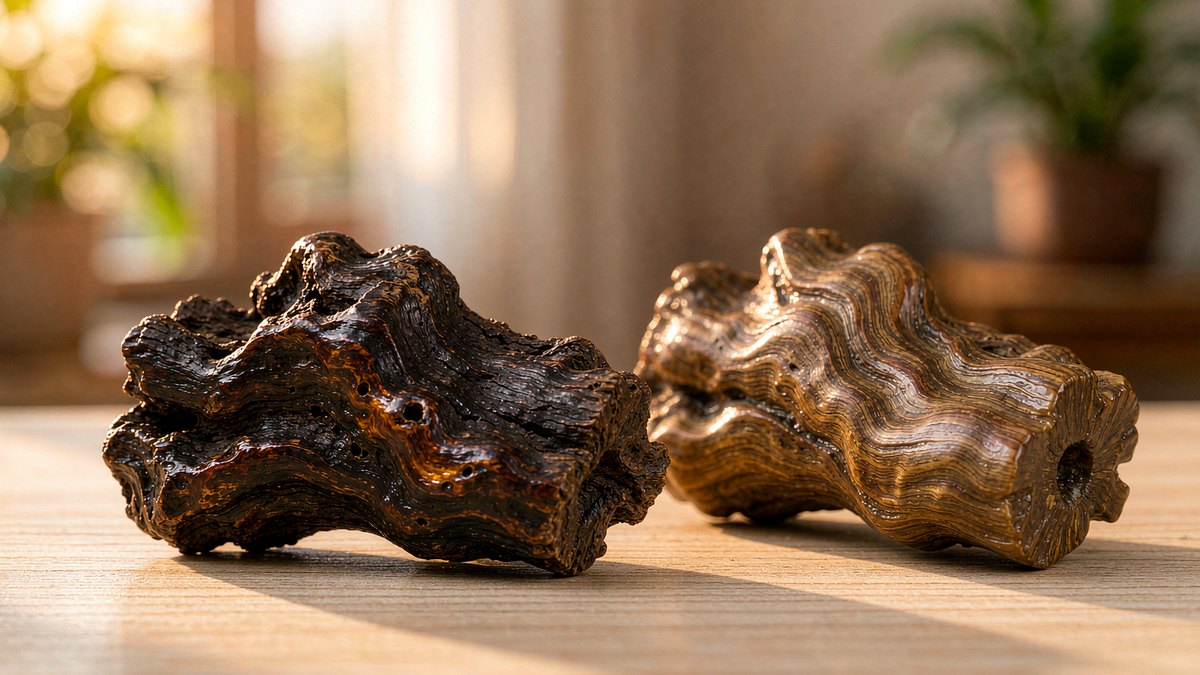
Hoi An agarwood is often regarded as a representative of the "Hoi An family," with a main aroma of clear sweetness, coolness, and floral-fruity notes. When smelled raw, it has a faint honey sweetness and green grass scent; when heated, it gradually releases soft floral notes like orchid and peach, with a cool finish. Hoi An agarwood has relatively fine oil lines, colors ranging from yellowish-brown to dark brown, and a relatively soft texture, suitable for making incense sticks, powder, and daily appreciation. Due to early development, wild resources are scarce, and most Hoi An agarwood on the market comes from plantations or recycled old materials, so attention should be paid to distinguishing age and resin formation methods when collecting. For a systematic understanding of agarwood classification and resin formation mechanisms, please refer to the Agarwood Encyclopedia.
3. Nha Trang Agarwood: Rich Honey Sweetness and Penetrating Coolness
Nha Trang agarwood is famous for its "rich honey sweetness and penetrating coolness." Its aroma is powerful; when heated, it quickly releases caramel and honey-like sweetness with a clear minty coolness, and the tail note carries a faint woody and milky scent. Nha Trang agarwood usually has high oil content, thick and dark oil lines, a hard texture, and a high proportion of sinking grades, making it a popular material for high-end bracelets and carvings. Among the Nha Trang production areas, the mountains of Khanh Hoa Province are the most renowned; some old materials, due to long resin formation time and full oil aging, have more complex aroma layers. To learn more about the connection between Nha Trang agarwood and Kyara and their grade classification, please see the Kyara Pillar Page.
4. Identification Points of the Flavor Codes
To identify Hoi An and Nha Trang agarwood, one can start from three aspects: aroma, oil, and texture. Hoi An agarwood has an elegant aroma and soft coolness, with fine but lighter-colored oil lines; Nha Trang agarwood has a strong aroma and penetrating coolness, with thick black oil lines and a hard texture. It should be noted that some agarwood from both regions may show crossover characteristics due to special resin formation environments, so judgment should not rely on a single indicator. It is recommended to combine raw smelling, heating, microscopic observation of oil structure, and other multi-dimensional methods, and refer to the systematic identification process in the Identification Pillar Page. For beginners, one can first learn traditional identification experience from the Chinese Fragrance Studies · Agarwood Identification column, then combine with physical comparison to gradually build one's own aroma memory library.
Conclusion
Hoi An and Nha Trang, one soft and one strong, represent the two poles of Vietnamese agarwood's charm. Hoi An is known for its elegant floral-fruity aroma, while Nha Trang wins with its rich honey sweetness and coolness. Understanding the producing environment and resin formation characteristics is key to decoding the flavor codes of agarwood. The path of fragrance appreciation lies in smelling more, comparing more, and thinking more, so as to recognize the traces of terroir and time in the aroma.
(This is industry observation and popular-science summary, not investment advice. Buy agarwood through legal channels with traceable, testable sources.)
Compiled for general knowledge; traditional references are cultural notes, not medical advice.
常见问题
A Journey Through Agarwood Origins是什么?
Hoi An and Nha Trang are two classic agarwood-producing regions in Vietnam. Hoi An agarwood is known for its elegant, sweet-cool floral-fruity notes, while Nha Trang agarwood is famous for its rich honey sweetness and penetrating coolness. This article analyzes the flavor codes of both regions from geography, resin formation, and aroma layers, and briefly discusses identification points.
沉香怎么选购?
选购沉香应认准可溯源、可检测的渠道,按用途选择形态(线香 / 手串 / 原料),不盲目追高、不轻信「野生」「沉水」等夸大宣传。
沉香如何保养?
沉香怕潮、怕串味、怕暴晒,应密封、避光、阴凉存放,不同产区分开保存;长期不用的香材定期通风检查,防霉防虫。
You may also like
评论区
评论匿名可浏览,登录后可发表;提交后先审后显。
评论加载中…