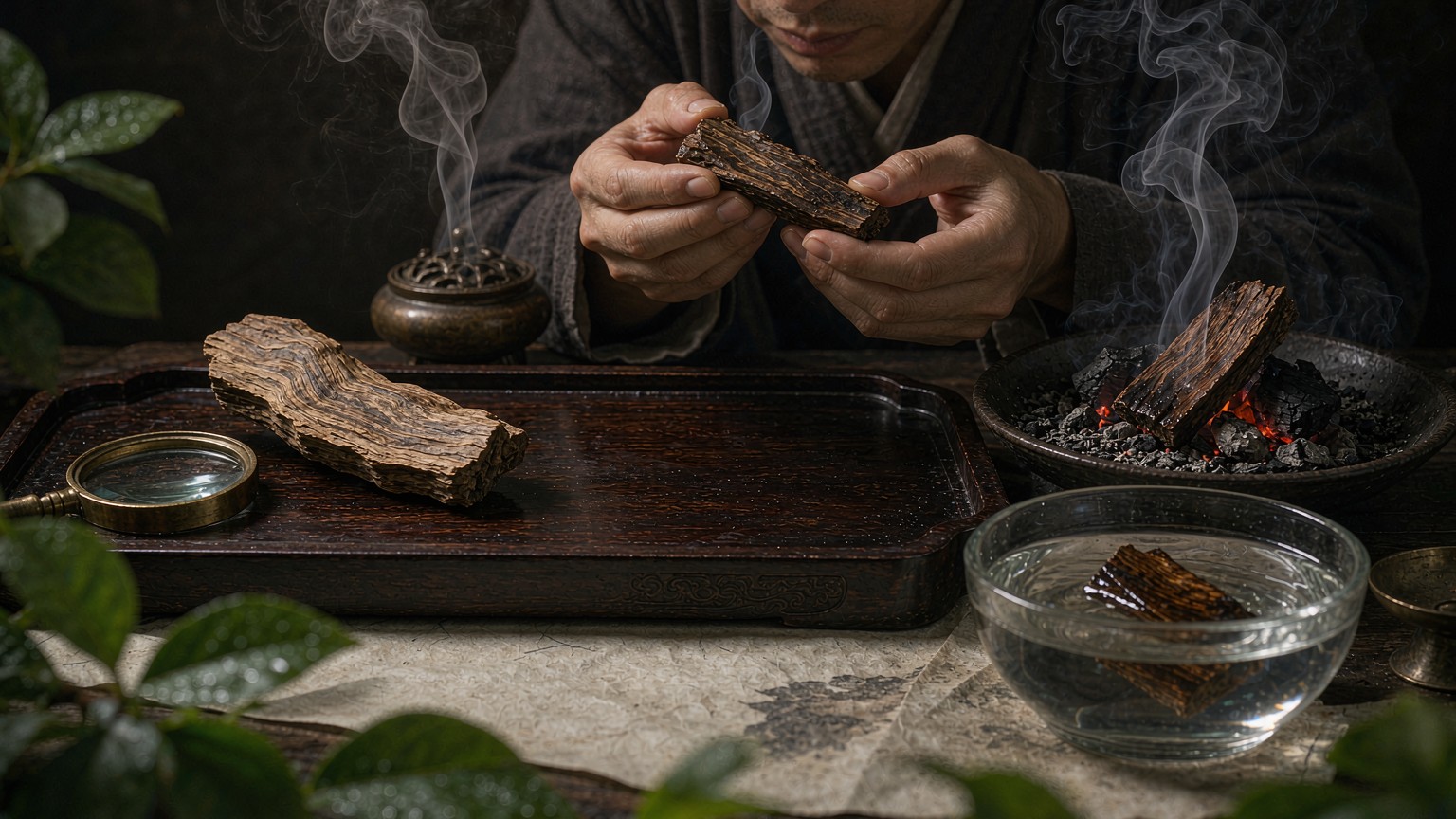
Incense Medicine in Ancient Texts: From Bencao Gangmu to Xiang Cheng
This article explores records of agarwood and other aromatic medicines in ancient Chinese texts such as Bencao Gangmu and Xiang Cheng, revealing the traditional wisdom of the unity of incense and medicine, and discussing their contemporary health and cultural value.
The Unity of Incense and Medicine: Agarwood Wisdom in Ancient Texts
In the vast corpus of traditional Chinese medical classics, aromatic medicines hold a unique position. Li Shizhen's Bencao Gangmu (Compendium of Materia Medica) from the Ming Dynasty lists agarwood under the wood section, detailing its effects such as 'treating upper heat and lower cold, qi counterflow and asthma, and intestinal deficiency constipation,' and emphasizing the identification point that 'chewed sweet ones are neutral in nature, while pungent ones are warm.' Zhou Jiazhou's Xiang Cheng (The Book of Incense) compiles the essence of incense practices from previous dynasties, not only collecting incense formulas but also analyzing aromatic medicines from the perspective of flavor and meridian entry. Together, these two classics construct the theoretical framework of the unity of incense and medicine—aroma can not only delight the spirit but also regulate qi movement and promote health. For a systematic understanding of agarwood's position in traditional medicine, readers may refer to our Agarwood Encyclopedia, which provides more detailed sorting of ancient records.
Agarwood in Bencao Gangmu: Medicinal Properties and Applications
Li Shizhen recorded in Bencao Gangmu: 'Agarwood, flavor pungent, slightly warm, non-toxic. It mainly treats wind edema and toxic swelling, removes evil qi, stops cholera and sudden turmoil, heart and abdominal pain, and intestinal deficiency constipation.' He particularly pointed out that agarwood can 'descend qi,' having good effects on asthma and hiccups caused by qi counterflow. The book also includes several formulas containing agarwood, such as the 'Agarwood Qi-Descending Decoction' for treating cold vomiting. Notably, Li Shizhen emphasized the relationship between agarwood quality and medicinal efficacy: 'Hainan ones are neutral in nature and sweet in taste; Jiaozhi ones are warm in nature and pungent in taste.' This identification approach is still used today. To master the identification points of agarwood in ancient texts, one may refer to the Identification Pillar Page, where ancient experience is verified with modern technology.
The Incense Compendium of Xiang Cheng: From Formulas to Aromatic Medicine Theory
Zhou Jiazhou's Xiang Cheng from the Ming Dynasty is hailed as an encyclopedia of incense studies, with twenty-eight volumes covering incense names, products, events, and formulas. The book not only details the origins and properties of aromatic medicines such as agarwood, sandalwood, and borneol but also closely integrates them with traditional Chinese medical theory. For example, in the 'Aromatic Medicine Section,' Zhou Jiazhou quotes Rihua Zi Bencao stating that agarwood 'regulates the middle, tonifies the five viscera, benefits essence and strengthens yang, warms the waist and knees,' and provides specific usage. In addition, Xiang Cheng records formulas like 'Agarwood Drink' for treating disharmony of the spleen and stomach. For readers who wish to delve deeper into incense theory, our Chinese Incense Studies · Agarwood Identification column provides more original texts and interpretations from ancient books, helping to understand the application context of aromatic medicine.
From Ancient Texts to Modern Times: Inheritance and Verification of Aromatic Medicine Value
The ancients' understanding of aromatic medicine was not mysticism but based on long-term practice. Modern research has also confirmed that sesquiterpenoids in agarwood have sedative and anti-inflammatory effects, coinciding with the 'descending qi' record in Bencao Gangmu. However, the exaggerated descriptions of agarwood 'curing all diseases' in ancient texts should be viewed rationally. Contemporary incense studies emphasize rational use, such as regulating emotions through incense and using agarwood as medicine under medical advice. To learn about the unique medicinal properties of kyara, the top-grade agarwood, please refer to the Kyara Pillar Page, which provides a special analysis of kyara's effects recorded in ancient texts. In summary, from Bencao Gangmu to Xiang Cheng, aromatic medicine culture carries the wisdom of the ancients and deserves continued exploration from a scientific perspective.
(This is industry observation and popular-science summary, not investment advice. Buy agarwood through legal channels with traceable, testable sources.)
Compiled for general knowledge; traditional references are cultural notes, not medical advice.
常见问题
Incense Medicine in Ancient Texts是什么?
This article explores records of agarwood and other aromatic medicines in ancient Chinese texts such as Bencao Gangmu and Xiang Cheng, revealing the traditional wisdom of the unity of incense and medicine, and discussing their contemporary health and cultural value.
沉香怎么选购?
选购沉香应认准可溯源、可检测的渠道,按用途选择形态(线香 / 手串 / 原料),不盲目追高、不轻信「野生」「沉水」等夸大宣传。
沉香如何保养?
沉香怕潮、怕串味、怕暴晒,应密封、避光、阴凉存放,不同产区分开保存;长期不用的香材定期通风检查,防霉防虫。
You may also like



评论区
评论匿名可浏览,登录后可发表;提交后先审后显。
评论加载中…