Agarwood Resin Formation Principles and Artificial Induction Techniques: How Trees 'Wound' Themselves into Fragrance
Source:收稿桥投稿· 2026-10-27· 伍佰艺编辑部· 3 views
Many people assume agarwood is the 'core material at the heart of the tree.' In fact, the opposite is true—agarwood is a 'scar substance' that a tree secretes for self-repair after being injured. Only by understanding the principles of resin formation can one understand why wild agarwood is scarce, why artificial resin formation can fill the gap, and why the [2025 Pharmacopoeia](2025-yaodian-chenxiang-jiedu) writes 'agarwood tetraol ≥0.10%' into its standards. This article moves from biology to industry.
1. Agarwood Is Not Wood—It Is 'the Tree's Self-Repair Substance After Injury'
Agarwood comes from trees of the Aquilaria genus in the Thymelaeaceae family. The heartwood of a healthy living tree is nearly odorless and pale in color; when the tree suffers physical trauma, insect damage, disease, or fungal infection, it activates defense mechanisms, secreting protective substances (sesquiterpenes, chromones, etc.) around the wound, which gradually accumulate, polymerize, and darken, ultimately forming the oil-rich 'resin-formed' portion.
> Key point: without 'injury,' there is no 'fragrance.' The reason natural wild agarwood is scarce is precisely that the probability of naturally forming good resin is extremely low and the cycle is extremely long (often measured in decades).
2. Natural Resin Formation: Insect Damage, Wind Breakage, Lightning Strikes, Fungal Infection
Common natural triggers of resin formation:
| Trigger | Characteristics |
|---|---|
| Insect/ant damage | Resin tends to form around insect tunnels, often appearing as irregular 'insect leakage' |
| Wind breakage/broken branches | Resin forms at healed break points, often seen as 'board ends' and 'cut openings' |
| Lightning strike/fire | Localized injury leads to resin formation; low yield but often of special quality |
| Fungal infection | Participation of specific fungi can significantly improve resin quality and characteristic components |
The role of fungi is especially critical: research shows that certain resin-inducing fungi can induce trees to synthesize large amounts of sesquiterpenes and chromones—this also provides the biological basis for artificial 'mushroom/inoculation' resin formation.
3. Evolution of Artificial Resin Formation Techniques
To meet demand and protect wild resources, artificial resin formation techniques have gradually matured:
1. Physical wounding method (cutting, drilling, nailing, burning): simulates natural injury; simple to operate, but resin quality and consistency vary;
2. Fungal inoculation method (inoculating mushroom/fungal liquid into wounds): targeted induction of resin formation; quality and characteristic components closer to premium natural agarwood—currently a research and application focus;
3. Chemical/physical assistance (resin-forming solutions, climate regulation): supplementary means; must guard against abuse affecting safety and compliance.
> Trend: from 'relying on nature' to 'scientific resin formation,' artificial planting plus inoculation is becoming the mainstream supply and also underpins the independent 'domestic plantation' market segment (see this site's [two-column market report](kalimantan-chenxiang-quanjie)).
4. Resin Quality: Why 'Alcohol Compounds' Are the Key (Linking to Pharmacopoeia Standards)
Not all 'exuded oil' counts as good agarwood. Quality is determined by the degree of accumulation of characteristic components—which is exactly why the Pharmacopoeia uses chemical indicators as a gatekeeper:
- **Agarwood tetraol (characteristic agarwood alcohol component) ≥0.10%**: the signature component threshold;
- **Extractives ≥10.0%**: the total soluble matter threshold;
- **HPLC characteristic chromatogram**: used to authenticate and identify origin characteristics.
If the process is proper, artificial resin formation can fully meet or even exceed these indicators; conversely, material relying only on crude wounding with a short resin-forming period will have insufficient component accumulation and thus low value.
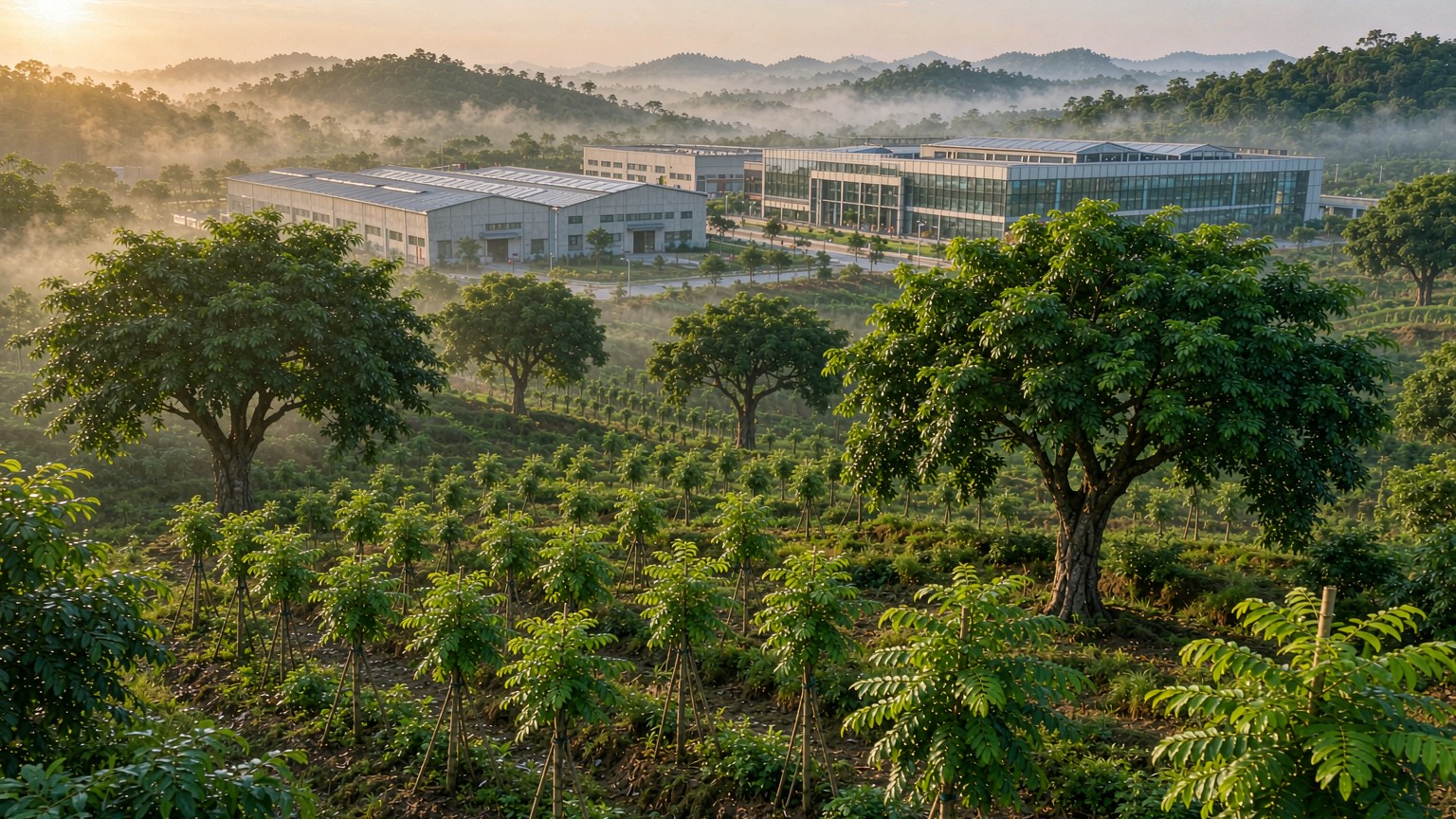
5. Industry Perspective: Guangdong's 700,000 Mu of Plantations and the 'Domestic Plantation' Segment
In recent years, multiple locations in South China have promoted large-scale agarwood planting (public reports indicate Guangdong's plantation scale has reached the hundreds of thousands of mu level), bringing two changes:
- **Supply structure change**: plantation material has become the mainstream source for daily incense appreciation, incense sticks, and blended incense, with steadier prices and traceability;
- **Market segment differentiation**: the market naturally separates '**domestic plantation**' (plantation segment, Xinhua Index segment) from '**foreign raw materials and traditional Aquilaria sinensis**' (scarcity/collectible segment); the former emphasizes supply and cost-effectiveness, the latter emphasizes scarcity and collectible premium.
This is also the fundamental reason why [how to choose agarwood incense sticks](chenxiang-xianxiang-zenme-xuan) emphasizes 'know the segment before buying.'
6. Wild vs. Plantation: The Divide Between Scarcity and Collectible Value
- **Wild/traditional Aquilaria sinensis**: extremely low yield, uncontrollable resin formation, scarce old material—corresponds to collection and auction logic (see the auction anchor points in the [Qinan feature](qinan-zhuanti));
- **Plantation material**: controllable, mass-producible, compliance-friendly—corresponds to mass consumption and industry logic;
- The two are not opposites: plantations ensure supply, while wild (and traditional precious varieties) preserve scarcity, together forming a complete market.
7. FAQ
Q1: Is artificial resin formation 'counterfeiting'?
No. Artificial resin formation is still the genuine resin product of real agarwood trees; compliant planting and inoculation-based resin formation are the proper path for the industry. Only passing off non-Aquilaria wood or chemical soaking counts as counterfeiting (see [identification of six types of fakes](chenxiang-jiahuo-liulei-jianding)).
Q2: Can artificial agarwood meet Pharmacopoeia standards?
Yes, with proper processing. The key lies in resin-forming time, fungal strains, and accumulation of characteristic components; final judgment is based on testing.
Q3: Why is wild agarwood still so expensive?
Scarcity + irreproducible old-material characteristics + collectible cultural premium determine its 'collectible segment' positioning.
Q4: How can ordinary consumers distinguish them?
For daily purposes, rely on channels and test reports; to go deeper, return to the [origin atlas](brunei-chenxiang-quanjie) and [Pharmacopoeia standards](2025-yaodian-chenxiang-jiedu) to build a judgment framework.
Data Sources and Notes
This article is a popular science piece on resin formation principles and industry; biological conclusions reference mainstream research on resin formation in Aquilaria of the Thymelaeaceae family; Pharmacopoeia indicators follow the [interpretation of the agarwood section of the 2025 Pharmacopoeia](2025-yaodian-chenxiang-jiedu); industry data such as plantation area follow public reports, with no specific figures fabricated.
Compiled from industry information; not trading or investment advice.
常见问题
Agarwood Resin Formation Principles and Artificial Induction Techniques是什么?
Agarwood is not heartwood but a 'scar substance' a tree secretes to heal itself after injury. Understanding resin formation explains why wild agarwood is scarce, how artificial induction fills the gap, and why the 2025 Pharmacopoeia sets agarwood tetraol at ≥0.10%.
沉香价格行情如何?
沉香行情随结香程度、产区、形态分化明显,顶级收藏与入门消费两端活跃;建议以合法、可检测渠道的实际成交为参考,勿轻信单一报价。
沉香怎么选购?
选购沉香应认准可溯源、可检测的渠道,按用途选择形态(线香 / 手串 / 原料),不盲目追高、不轻信「野生」「沉水」等夸大宣传;优先选择带检测报告与来源凭证的商品。
沉香如何保养?
沉香怕潮、怕串味、怕暴晒,应密封、避光、阴凉存放,不同产区分开保存;长期不用的香材定期通风检查,防霉防虫。
如何鉴别沉香的真假?
鉴别沉香需综合感官与辅助手段:天然沉香香气清雅、持久、凉甜交织,燃烧烟气清白而非刺鼻;可结合 GC-MS 色谱检测特征成分(色酮、倍半萜)。建议通过可信渠道与可溯源凭证降低风险。
不同产区沉香有什么区别?
各产区因气候、树种与结香方式差异,香韵各具特色(如海南清雅、越南甜凉、印尼醇厚),是沉香分级与定价的重要参考维度。
沉香与香道文化有什么关系?
沉香是东亚香道文化的核心媒介,从礼佛、文人雅集到当代生活美学,承载「静心、慢享」的东方审美,理解文化背景有助于读懂沉香价值。
沉香有健康功效吗?
传统上沉香被用于舒缓、助眠等场景,但证据等级与用量需谨慎看待;把「传统用法」与「科学证据」分开表述,具体以专业指导为准。
参考资料
Related reading


Related Agarwood Picks
While reading, you might also like these compliant cultivated-agarwood products.
Visit Mall
评论区
评论匿名可浏览,登录后可发表;提交后先审后显。
评论加载中…
Check related market data
Want the reference price for this category? Compare on the market page.
Go to market