A Review of Major Chemical Constituents in Agarwood: Where Does the Aroma Come From
A Review of Major Chemical Constituents in Agarwood: Where Does the Aroma Come From
One-sentence conclusion: The aroma of agarwood comes mainly from two major classes of compounds in the resin—volatile sesquiterpenes (responsible for the "smell" you perceive) and 2-(2-phenylethyl)chromones (the characteristic constituents of agarwood, contributing to the aromatic base and layering). Their content and ratio determine the quality and style of the aroma profile.
I. How Agarwood Is "Formed"
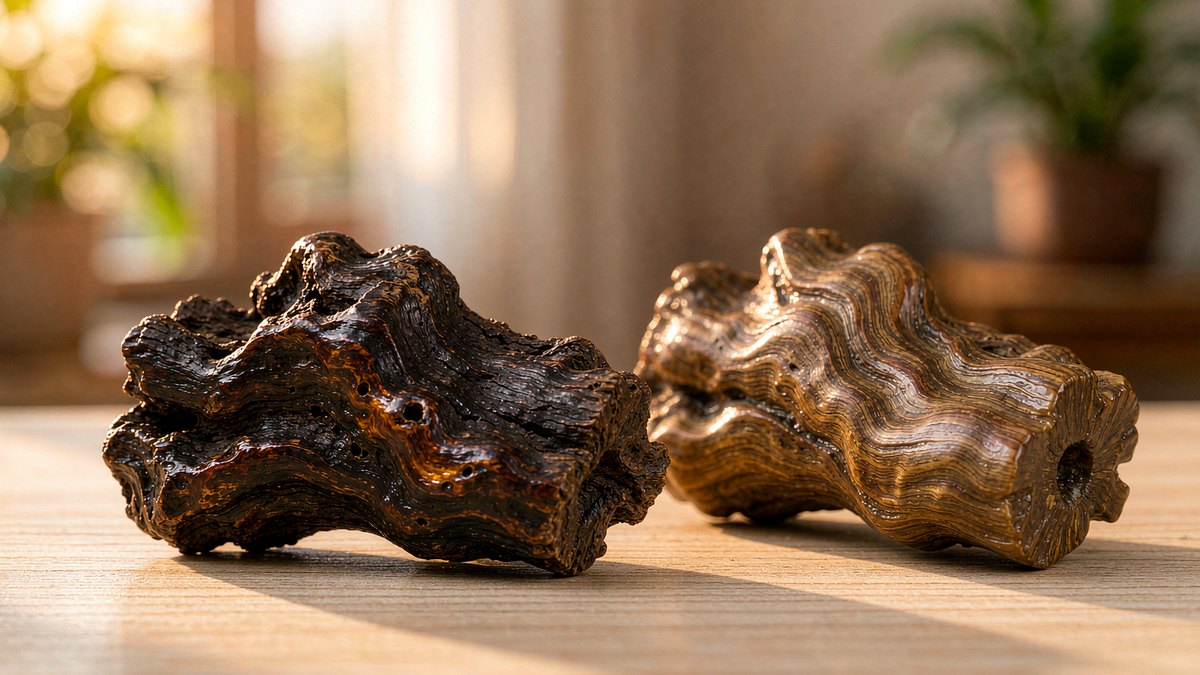
Agarwood is not a type of wood per se, but the product of resin secreted by trees of the Thymelaeaceae family (Aquilaria sinensis, etc.) after injury, which then undergoes long-term aging and integration with wood fibers. Healthy Aquilaria trees have almost no noticeable aroma; only under stimuli such as fungal infection, insect attack, or lightning strike do the trees activate defense mechanisms and secrete resin, which accumulates over years to form the "fragrance."
This also explains why the mode of resin formation (living-tree formation, mature-tree formation, insect-bored, fallen) affects the aroma style—different injury and aging pathways produce different compound profiles.
II. Two Major Classes of Core Constituents
1. Sesquiterpenes
Highly volatile, they are the "spearhead" of the aroma:
- Common examples include agarospirol, jinkoh-eremol, and others;
- They contribute cooling, medicinal, and woody olfactory characteristics;
- The sesquiterpene composition of agarwood from different origins differs markedly, providing the research basis for chemically distinguishing the "Hui'an" and "Xingzhou" style families.
2. 2-(2-Phenylethyl)chromones (PEACs)
The most characteristic constituent family of agarwood:
- Structurally characterized by a chromone skeleton linked to a phenylethyl group; more than one hundred derivatives have been identified;
- Mostly semi-volatile, they contribute more to the "middle and base notes" and the lingering quality of the aroma;
- Studies have found that their polymers correlate strongly with the degree of resin formation in agarwood, and they are often used as one of the indicators for chemical identification.
Simply put: sesquiterpenes govern "how airy it is," chromones govern "how full-bodied it is." Premium agarwood typically has both excellent content of both classes and a harmonious ratio.
III. Practical Applications of Constituent Research
| Application Area | Basis | Current Status |
|---|---|---|
| Authenticity testing | Counterfeit products made by oil soaking or oil compression show significant differences in constituent profiles from natural agarwood | Gas chromatography-mass spectrometry (GC-MS) testing has been applied in industry testing institutions |
| Origin tracing | Constituent fingerprints differ across production regions | Many research-stage results exist; standardized discrimination is still being refined |
| Grade evaluation | Total volatile oil and characteristic constituent content correlate with sensory evaluation | Can serve as an auxiliary indicator but cannot yet replace sensory evaluation |
It is worth noting that constituent testing is becoming a hard tool against "techno-agarwood"—artificial fragrance blends can mimic the sensory experience temporarily, but it is difficult to reproduce the complete profile of hundreds of compounds found in natural agarwood.
IV. Frequently Asked Questions
Q: Does high oil content mean good constituents? Not entirely. Materials with high content but an incomplete characteristic constituent profile may have an aroma that is "intense but dull." Premium agarwood emphasizes profile completeness and harmonious ratios, which is why some high-oil materials perform only mediocrely in aroma.
Q: What is special about qinan constituents? Research shows that qinan differs significantly from ordinary agarwood in the types of chromone derivatives and volatile oil components, and its "soft and glutinous" texture is related to the resin-wood binding state. The underlying mechanisms are still under intensive study.
Q: Do everyday enthusiasts need to understand constituents? You don't need to become a chemist, but knowing the basic fact that "aroma = compounds" is very useful: it means aroma cannot be fully described by images and text. Smelling a sample before buying is always the first principle.
V. Summary
The fragrance of agarwood is essentially a chemical code left by the tree's defense response. Research on the two major classes of constituents—sesquiterpenes and chromones—is providing scientific support for authenticity testing, origin tracing, and grade evaluation. For consumers, the more the industry moves toward "letting data speak," the more trustworthy agarwood from legitimate channels that is testable and has documentation becomes.
This article is compiled from publicly available research materials for educational sharing only and does not constitute any medicinal or trading advice. Most agarwood-related tree species are CITES Appendix species; please ensure legal sourcing when purchasing.
Related reading: What is the difference between sinking grade and floating grade | Four-step method for identifying agarwood: look, smell, touch, burn
Compiled for general knowledge; traditional references are cultural notes, not medical advice.
常见问题
A Review of Major Chemical Constituents in Agarwood是什么?
Why does agarwood smell the way it does? This review summarizes the two core resin constituents—sesquiterpenes and 2-(2-phenylethyl)chromones—and their relationship to aroma profile, authenticity testing, and origin tracing.
沉香怎么选购?
选购沉香应认准可溯源、可检测的渠道,按用途选择形态(线香 / 手串 / 原料),不盲目追高、不轻信「野生」「沉水」等夸大宣传;优先选择带检测报告与来源凭证的商品。
沉香如何保养?
沉香怕潮、怕串味、怕暴晒,应密封、避光、阴凉存放,不同产区分开保存;长期不用的香材定期通风检查,防霉防虫。
如何鉴别沉香的真假?
鉴别沉香需综合感官与辅助手段:天然沉香香气清雅、持久、凉甜交织,燃烧烟气清白而非刺鼻;可结合 GC-MS 色谱检测特征成分(色酮、倍半萜)。建议通过可信渠道与可溯源凭证降低风险。
不同产区沉香有什么区别?
各产区因气候、树种与结香方式差异,香韵各具特色(如海南清雅、越南甜凉、印尼醇厚),是沉香分级与定价的重要参考维度。
沉香价格行情如何?
沉香行情随结香程度、产区、形态分化明显,顶级收藏与入门消费两端活跃;建议以合法、可检测渠道的实际成交为参考,勿轻信单一报价。
沉香与香道文化有什么关系?
沉香是东亚香道文化的核心媒介,从礼佛、文人雅集到当代生活美学,承载「静心、慢享」的东方审美,理解文化背景有助于读懂沉香价值。
沉香有健康功效吗?
传统上沉香被用于舒缓、助眠等场景,但证据等级与用量需谨慎看待;把「传统用法」与「科学证据」分开表述,具体以专业指导为准。
参考资料
You may also like
评论区
评论匿名可浏览,登录后可发表;提交后先审后显。
评论加载中…