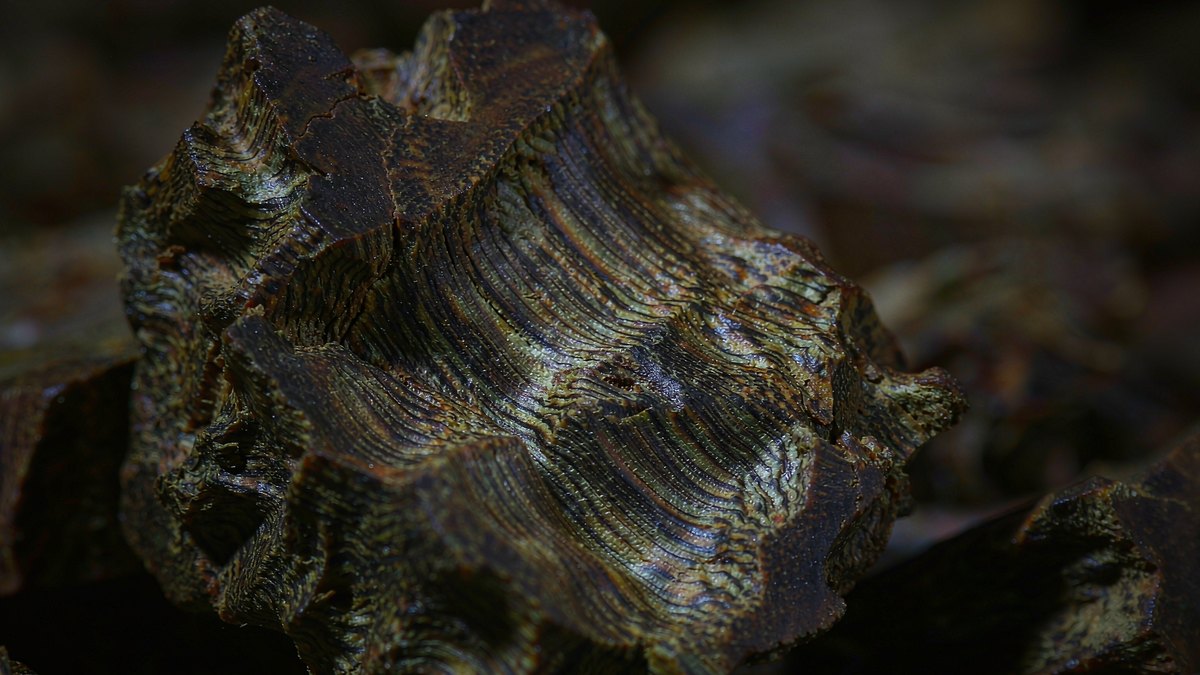
Tianxiang Zhuan Establishes Hainan Agarwood's Millennial Status as the Finest Incense
"Much incense comes from this mountain, surpassing all under heaven." This line comes from Tianxiang Zhuan by Ding Wei of the Northern Song dynasty. The "mountain" referred to in the book is Limu Mountain in Hainan. The meaning is: among the world's agarwood, that produced at Limu Mountain is the finest. This sentence was written nearly a thousand years ago. It is not a literary exaggeration, but a judgment given by a chancellor who had been banished to Hainan after living in Yazhou for three years.

Tianxiang Zhuan is the first monograph in the history of Chinese incense studies to systematically discuss Hainan agarwood. It is included in the Chen Family Incense Manual collected in the Complete Library of the Four Treasuries and has been transmitted to the present day. Later writers such as Fan Chengda and Li Shizhen, when writing about agarwood, could not avoid the foundation laid by Ding Wei.
I. A man banished to the ends of the earth. Ding Wei did not have a good reputation in history. He served as a senior official through three reigns, was twice appointed chancellor, and was enfeoffed as Duke of Jin. He sidelined Kou Zhun, colluded with eunuchs, and drew much criticism at court. After the death of Emperor Zhenzong of Song, he served as mausoleum commissioner, responsible for building the imperial tomb. The eunuch Lei Yungong arbitrarily moved the tomb's location; when the matter was exposed, Lei was executed, and Ding Wei was implicated, dismissed from the chancellorship, and demoted.

In the first year of Qianxing of the Northern Song (1022), the fifty-seven-year-old Ding Wei was escorted to Yazhou. Yazhou, at the southernmost tip of Hainan Island, was then a place of exile for serious offenders. From a chancellor with power over all under heaven to a mere eighth-rank clerk in Yazhou—such a fall would be hard for most to bear. But after arriving in Hainan, Ding Wei did not collapse.
II. In Yazhou, he truly encountered agarwood for the first time. Ding Wei's connection with agarwood was in fact early. In his early years he served as Fujian transport commissioner, responsible for producing tribute tea. Song dynasty tribute tea often included aromatic medicines; borneol, musk, sandalwood, and agarwood could all be added to tea. This experience gave him an initial understanding of incense. Later he rose step by step, long residing in the court, and participated in important state rituals.
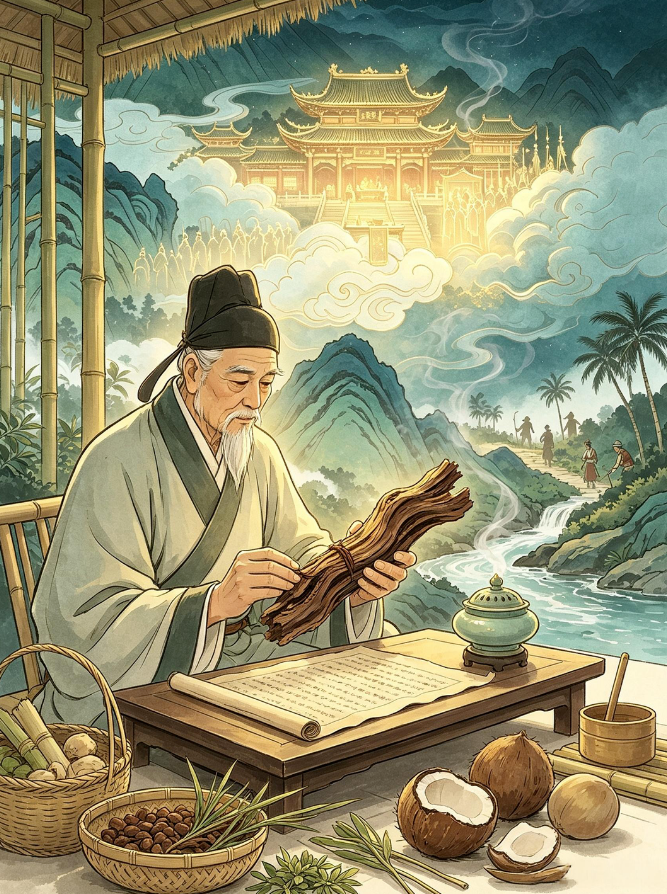
Emperor Zhenzong of Song revered Daoism; in the palace, sacrifices, Daoist rites, and offerings were almost without a day of rest, and precious incense never ceased. As a close minister, Ding Wei had seen all kinds of incense use, and his understanding of agarwood far exceeded that of ordinary people. But he had never been to the places where incense was produced. Being banished to Hainan instead became his first opportunity to personally come into contact with the original producing area of agarwood.
In Tianxiang Zhuan he wrote: "I had long heard that Hainan produces abundant incense; when I first ordered it purchased in the neighborhoods, not one in ten was fake." The meaning is: I had long heard that Hainan produces much incense; when people were sent to buy it in the market, not one piece in ten was counterfeit.
III. What is written in Tianxiang Zhuan. Tianxiang Zhuan is not long, only a little over two thousand characters, but its content is extremely solid. Ding Wei did several things in the text.
First, he sorted out the history of incense use in China. He began from high antiquity, wrote of the sacrifices of the three dynasties, Daoist incense burning, Buddhist incense offerings, and then the palace incense rituals of Emperor Zhenzong's time. This was the first time anyone had systematically clarified the historical thread of incense use in China.
Second, he compared the quality of agarwood from various places. He clearly stated that Hainan agarwood far surpassed the products of Leizhou, Huazhou, Gaozhou, and other places. The reason was that people in those places were eager for profit and rushed to harvest agarwood before it had matured. The Li people of Hainan, by contrast, "did not recklessly cut or fell out of season," and gathered only after the agarwood had naturally matured.
Third, he classified Hainan agarwood. Ding Wei divided agarwood into the "four names and twelve forms." The "four names" are four grades: chen, zhan, shengjie, and huangshu. The "twelve forms" are classifications based on outward appearance.
This was the first time in history that anyone had carried out such a detailed grading of agarwood. He also proposed a concept still in use today: raw incense and mature incense. That which forms naturally is called "mature incense"; that which is artificially induced is called "raw incense." Ding Wei held that mature incense is superior to raw incense.
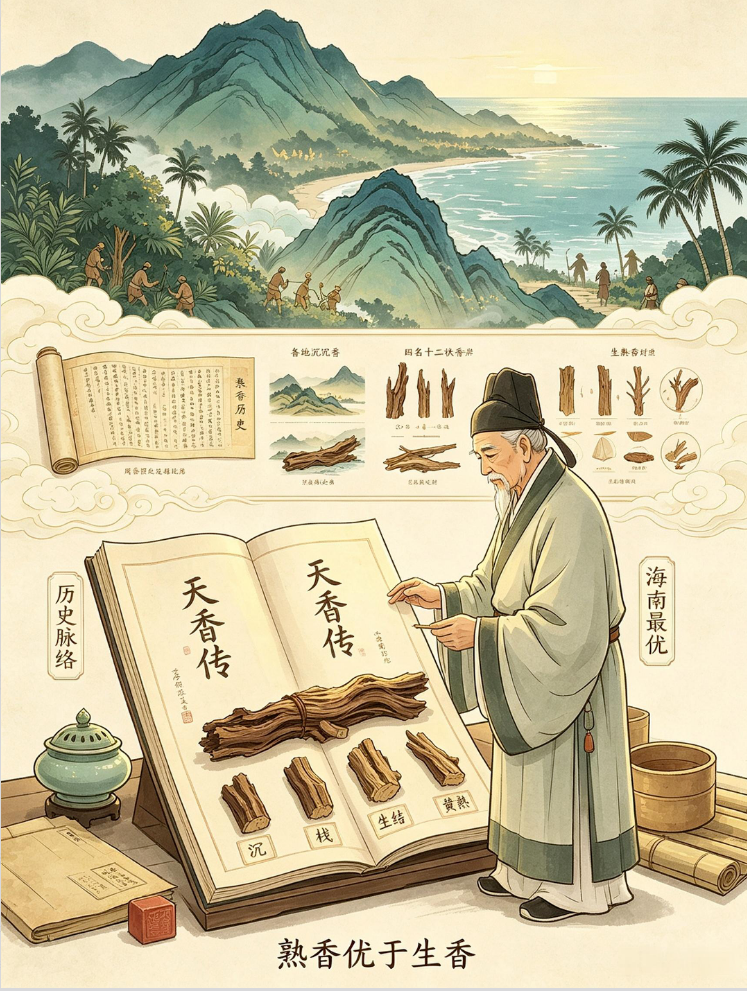
IV. "Much incense comes from this mountain, surpassing all under heaven." The most famous sentence in Tianxiang Zhuan concerns Limu Mountain. Ding Wei wrote: "In the territory of Qiongguan, Limu Mountain is the chief; the four divisions' territories all rest at the mountain's foot; much incense comes from this mountain, surpassing all under heaven." The meaning is: among Hainan's agarwood, that produced at Limu Mountain is the finest, first in the world. The weight of this statement was extremely great at the time. Because Song dynasty palace incense use relied heavily on imports from Southeast Asia. But Ding Wei clearly stated that the quality of imported incense "does not match even the middle and lower grades of Hainan."

In other words, the finest agarwood of Southeast Asia, in Ding Wei's eyes, could not compare even with Hainan's middle and lower grades. This judgment was not Ding Wei's personal preference. Fan Chengda of the Southern Song also said something similar in Guihai Yuxheng Zhi, holding that Hainan agarwood's "fragrance is clear and refined"; burn one censer and the whole room is fragrant, and even when burned to the end there is no burnt smell.
Li Shizhen in Bencao Gangmu wrote even more directly: "Champa is not the equal of Chenla, Chenla is not the equal of the Hainan Li caves. Among the Li caves, that from the eastern cave of Limu Mountain in Wan'an is the finest in the world, called Hainan chen, a single piece worth ten thousand coins." Ding Wei was the first to push Hainan agarwood to the position of "surpassing all under heaven." Later, Fan Chengda and Li Shizhen continued to add weight on the foundation laid by Ding Wei.
V. Amid hardship, the pleasure of the incense censer only increased his diligence. When Ding Wei wrote Tianxiang Zhuan, his state of mind was complex. One sentence in the text explains his condition at the time very well: "Amid hardship, there is not a single worldly care. Only on long bright days, when the vast sky displays its signs, the pleasure of the incense censer only increases my diligence." Translated, this means: amid hardship, my heart was instead free of the entanglements of mundane affairs. On days when the weather was fine, gazing at the stars through the long night, my interest in lighting the censer and savoring incense was instead stronger than before.
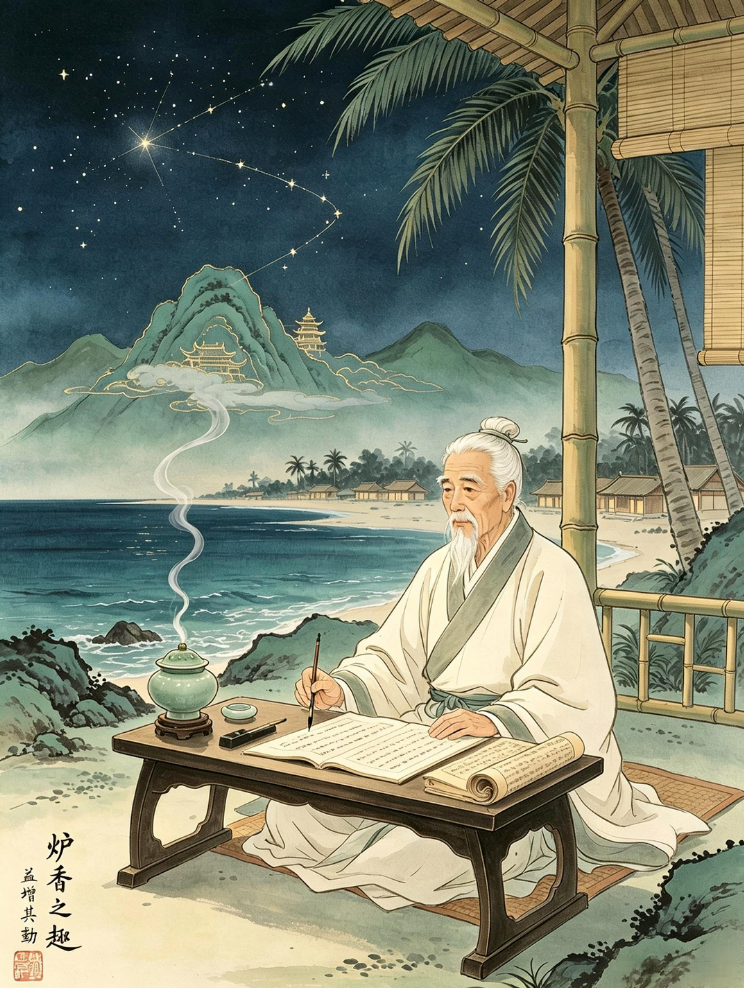
A disappointed man banished to the ends of the earth found settlement in agarwood. Ding Wei's merits and faults will be judged by history. But during his three years in Hainan, he left this land's agarwood its most solemn record. After Tianxiang Zhuan, the status of Hainan agarwood was never shaken again.
This article was compiled by "Chenxiang Net"; original source: https://www.chenxiang123.com/tianxiangzhuan-hainan-chenxiang-qiannian-xiangshou/
Compiled for general knowledge; traditional references are cultural notes, not medical advice.
Frequently Asked Questions
What is Tianxiang Zhuan Establishes Hainan Agarwood's Millennial Status as the Finest Incense?
"Much incense comes from this mountain, surpassing all under heaven." This line from Ding Wei's Northern Song text Tianxiang Zhuan refers to Limu Mountain in Hainan, asserting that Hainan agarwood ranks first in the world.
How should I choose agarwood?
Buy from traceable, testable channels and match the form (incense, beads, raw wood) to your use. Avoid exaggerated claims such as "wild" or "sinking grade" without proof, and prefer products with lab reports and origin documentation.
How should agarwood be stored and maintained?
Agarwood dislikes moisture, odours and direct sunlight. Keep it sealed, dark and cool, store different origins separately, and air and inspect long-stored pieces periodically against mould and insects.
How can I tell real agarwood from fake?
Authentication combines sensory checks with technical ones: natural agarwood has a clean, long-lasting, cool-sweet scent and burns with pale, non-pungent smoke. GC-MS analysis of characteristic compounds (chromones, sesquiterpenes) adds objective confirmation. Buying through traceable channels with certificates lowers the risk.
How do agarwood origins differ?
Climate, tree species and resin-induction methods give each origin a distinct scent profile — for example Hainan tends to be clean and elegant, Vietnam sweet and cool, Indonesia deep and full. Origin is a key factor in grading and pricing.
What is the current agarwood market like?
Prices diverge sharply by resin density, origin and form, with both top-end collectibles and entry-level consumer products active. Use actual transactions from legal, testable channels as reference rather than a single quotation.
What is the relationship between agarwood and incense culture?
Agarwood is the core medium of East Asian incense culture, spanning temple offerings, literati gatherings and contemporary lifestyle aesthetics. Understanding this cultural background helps explain its value.
Does agarwood have health benefits?
Traditionally agarwood has been used for calming and sleep-related rituals, but evidence quality and dosage need careful reading. Keep traditional use and scientific evidence clearly separated and follow professional guidance.
参考资料
You may also like
评论区
评论匿名可浏览,登录后可发表;提交后先审后显。
评论加载中…