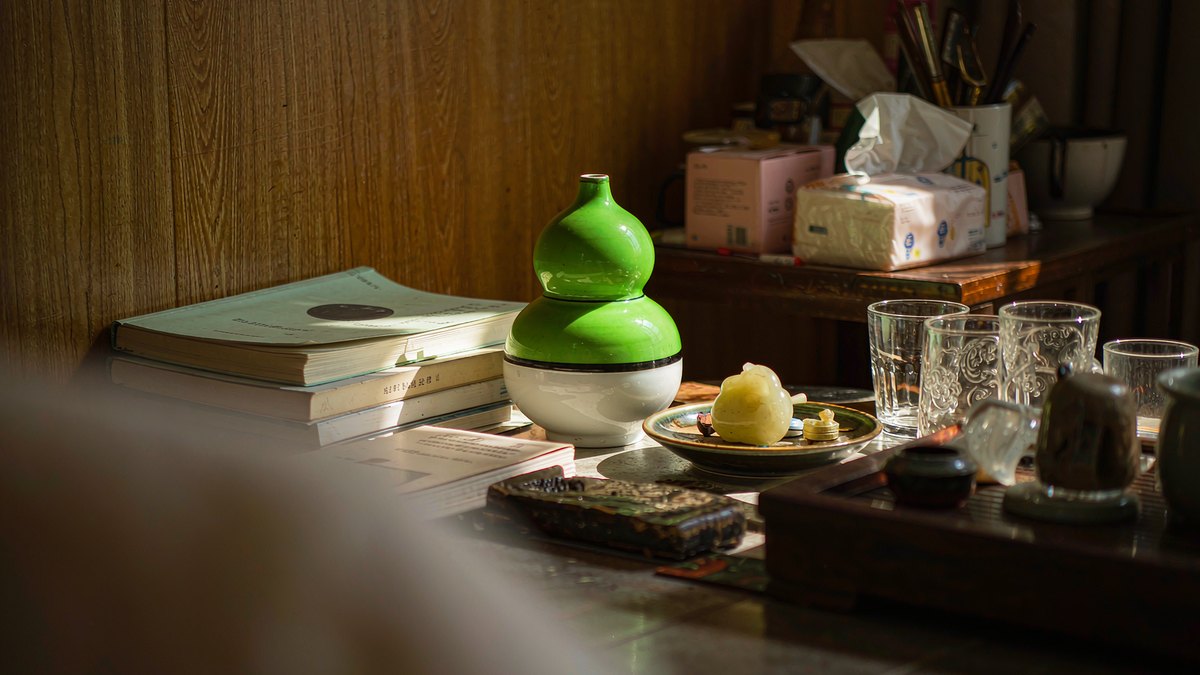
Hainan Agarwood — The Legend of the Heavenly Fragrance
Hainan Agarwood — The Legend of the Heavenly Fragrance
In the Limu Mountain area of Hainan Tropical Rainforest National Park, the morning sun shines upon the vast sea of trees, and the warm monsoon from the ocean "carries" in moist air. In the mountains, several Hainan White-Wood incense trees (Hainan agarwood trees) stand on the gentle slope; when their fruits split open, the hanging seeds sway in the wind like beautiful pearl earrings. In this tropical rainforest of towering trees, these gray-brown-"coated," not-very-tall trees look unremarkable, yet the spice they yield is "first under heaven," "a piece worth ten thousand coins."
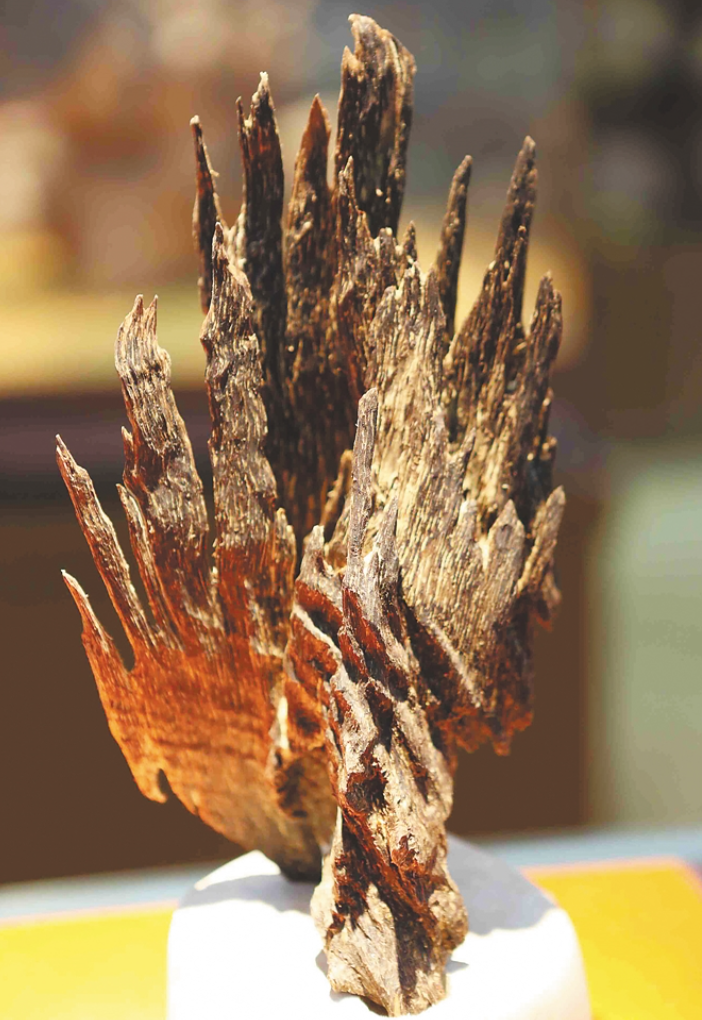
Sedate and restrained in quality, with a clear and lively aroma carrying the fragrance of flowers and herbs and a nutty scent... Hainan agarwood has enjoyed a lofty reputation since its first appearance, universally acknowledged as the foremost of all incenses. When it left the island and went out into the world, meeting countless hearts that understood and loved incense through the flowing years, it wrote the romantic legend of Chinese incense culture.
Hainan Agarwood — The Road to Fame
The ancients held that incense is "that which is born by gathering the pure yang qi of heaven and earth." By that measure, the tropical island of Hainan is by nature a "fragrance island." Yet because Hainan Island lies isolated beyond the sea and long lagged in development through history, the "incense" produced on the island was at first silent.
The great curtain of history slowly lifts: in the first year of Yuanfeng of the Western Han (110 BCE), Emperor Wu of Han destroyed the Nanyue kingdom and established nine commanderies including Zhuya and Dan'er, bringing the Lingnan region into the map of the central dynasty; these then-remote lands were precisely the natural agarwood-producing areas. As Hainan Island's ties with the Central Plains strengthened, the seed was quietly sown for Hainan agarwood's "debut."
Yet the development of many things does not proceed in a straight line. After the central regime took Hainan under its jurisdiction, Hainan agarwood still did not at first enter the purview of the ruling class. So it was that decades later, when Jia Juanzhi proposed "abolishing the Zhuya commandery," he declared ruefully that "it is not only Zhuya that has pearls, rhinoceros horn, and hawksbill — to abandon it is no great loss," and not one word mentioned Hainan agarwood.
Thereafter, leafing through ancient works such as the Three Kingdoms-era "Record of Strange Things of the Southern Regions," the Jin-era "Appearance of Flora of the South," the Southern Dynasties "Record of Nanyue," and the Tang-era "Curious Things Beyond the Lingnan Table," one finds that when they speak of agarwood they mention only producing areas such as Nanzhou, Jiaozhi, and Guangguan's Luozhou — still no trace of Hainan agarwood.
Only at the beginning of the Song, when Yue Shi repeatedly mentioned Hainan agarwood in the geographical compendium "Taiping Huanyu Ji" — "Qiongzhou yields boiled agarwood, yellow-cooked agarwood, and the like"; "Changhua commandery of Danzhou... boiled agarwood comes from the deep ravines" — did this island treasure begin to be known to the public.
The first person to push Hainan agarwood to its pinnacle was Ding Wei, a chancellor of the Northern Song. During his tenure in the capital, Ding Wei frequently came into contact with agarwood and was once granted incense by the emperor as a reward, giving him great authority in appraising it. "In the land of Qiongguan, Limu Mountain is chief, and its four districts all lean on the mountain's foot; most incense comes from this mountain, first under heaven," he wrote. While exiled to Yazhou (present-day Sanya, Hainan), drawing on what he had learned from field investigation, he composed the famous "Record of the Heavenly Fragrance" (Tianxiang Zhuan), comparing Hainan agarwood to "heavenly fragrance" — in effect granting Hainan agarwood the status of the world's foremost incense.
He tells a story in the book: he heard from Hainan locals that a merchant ship from Dashi (present-day Arab regions) once paused at Hainan Island after a typhoon, and the Dashi men held an incense contest with the Hainan people. In the end the Hainan agarwood's "smoke was dim and far, as if drawing in the eastern sea; rich and full, like lacquer congealed on a silk ribbon; its fragrant qi especially enduring and improving with time," while the Dashi merchant's agarwood was "lush yet not rising, dry and light, barren and scorched" — the difference was immediate. This story shows the superlative quality of Hainan agarwood and reflects Ding Wei's recognition and esteem for it.
If Ding Wei's "Record of the Heavenly Fragrance" established Hainan agarwood's preeminent position, then Su Shi was the one who endowed it with spiritual and cultural value. In the second month of the fifth year of Shaosheng (1098), Su Shi, exiled to Danzhou in Hainan, sent his brother Su Zhe a piece of agarwood mountain-form to celebrate his sixtieth birthday; sent with it was Su Shi's "Ode to the Agarwood Mountain-Form." In this ode, with resplendent, brocade-like prose, Su Shi lavishly praised Hainan agarwood: "Moreover, the strange product of Danzhou and Yazhou is truly extraordinary and unmatched. It is as firm as gold and as smooth as jade; it has the bones of a crane and the sinews of a dragon. Its sap is so abundant within that a single grasp weighs in catties." At the time, the two brothers were both in exile, one in Leizhou and one in Danzhou; Su Shi, through the Hainan agarwood born in barren land yet of outstanding quality, encouraged his brother in similar adversity, urging him, taking the agarwood mountain-form as a mirror, to be a gentleman of firm stance and transcendent spirit. The fragrance of incense and the character of man thus echo each other; inspired by Hainan agarwood, the Eastern Slope "rode things to roam the heart," raising the appreciation of incense to a new height of self-cultivation, moral clarity, and the comprehension of the Way.
Superior in quality, and with several luminaries "speaking for it," Hainan agarwood's fame rose swiftly and its price climbed accordingly. The Southern Song's Zhou Qufei, in "Answers Beyond the Lingnan Table," said: "(Agarwood) is rare in Hainan; a provincial commoner would trade one ox to the Li ravines for a load of incense, and upon returning and sorting it, would obtain sinker-grade in one or two out of ten; at that time the price of incense equaled that of white silver." The Ming medical scholar Li Shizhen, in "Compendium of Materia Medica," quoted a fine line from Cai Tao's "Chats from Tiewei Mountain" (son of the Northern Song's Cai Jing) to settle the matter for Hainan agarwood: "Zhancheng (Vietnam) is not as good as Zhenla (Cambodia); Zhenla is not as good as the Li ravines of Hainan. Among the Li ravines, that from the eastern ravine of Limu Mountain in Wan'an is supreme under heaven — called Hainan sinker, a piece worth ten thousand coins."
Hainan Agarwood — Tribute and Trade
With Hainan agarwood's superlative quality, "leaving the island" was a matter of course. Local gazetteers such as the Zhengde-era "Records of Qiongtai" record that as early as the Tang, Hainan agarwood was already listed as tributary goods; among the items Danzhou presented then were "gold, sugar, incense." Through the Ming and Qing, Hainan agarwood remained tributary. For example, the Daoguang-era "Records of Qiongzhou Prefecture · Administrative Treatises · Appended Local Tribute" records: "Ming (tribute): elk hide, assorted hide, feathers, raw lacquer, kingfisher feathers, agarwood... Present dynasty (Qing tribute): gold, silver... agarwood — each year a quota of forty catties of agarwood is to be prepared, the governor-general issuing forty taels of silver, entrusted to Qiong prefecture for procurement."
After Hainan agarwood, as tribute, was transported to the capital, it became a precious incense used by imperial family members and high officials. In the Song, the court had already established an Incense and Medicine Bureau to provide incense services; by the Qing, the palace had a dedicated agency managing agarwood and had formed a complete incense-use system. According to the "Collected Archives of the Qing Palace Workshops" and "Accounts of Disbursement," the Qing palace issued monthly allotments of agarwood that the Empress Dowager, the Empress, and others could receive — such as "Empress Dowager Ci'an, monthly middle-grade agarwood four taels; Empress Dowager Cixi, monthly middle-grade agarwood four taels." Beyond individual issues, some important palaces also received monthly agarwood — for instance, "(Xuantong era) the Hall of Imperial Ancestors, monthly upper-grade agarwood four catties twelve taels two qian nine fen; the Hall of the Heavenly Vault, monthly middle-grade agarwood three taels." Thus one sees that the palace's customary use of agarwood continued unchanged until the late Qing.
"Who shall I burn the night incense for? I gaze toward the water-sinking smoke curling"; "When lying down I burn the sunken incense; the incense is gone but the wine not yet." After the Song, burning incense became fashionable in government offices, temples, and the dwellings of literati, and society's demand for incense surged; agarwood circulated and traded widely among the people as a commodity.
From Ding Wei's words that "the Li people all farm and work, and do not monopolize incense-gathering for profit," to Su Shi's saying that "Hainan has much barren field, and the custom is to trade in incense," and on to Qing-era incense buyers penetrating the central and western mountains of Hainan, hiring "incense lads" (locals skilled in gathering) to choose a day to enter the mountains and collect — from the relevant historical records one can roughly see that from Song to Qing, Hainan agarwood trade gradually became normalized, forming a fairly complete industrial chain.
Not only did incense buyers come to Qiong to harvest agarwood; Hainan merchants also went north to sell it. The "Ming Veritable Records" records an incident of the early Ming: "A Qiongzhou maritime merchant drowned while carrying incense goods toward Nanjing; the authorities inspected his cargo and proposed a ten-percent tax, but Taizu ordered the tax remitted and had the fellow merchants sell the dead man's goods on his behalf, returning the proceeds to his family." This shows that Hainan agarwood sold in the capital once drew the attention of Ming Taizu, Zhu Yuanzhang.
In the Tang and Song, the Maritime Silk Road was also called the "Road of Incense and Medicine." Especially in the Song, ships specialized in transporting spices (colloquially "incense junks") appeared, and spices once occupied the top share of import-export cargo. Although no written record has yet been found listing Hainan agarwood as a foreign-trade good, many experts believe that, as the most famous spice of the time, Hainan agarwood very likely was exported overseas together with tea, ceramics, and the like.

The book "Research on Hainan Agarwood Culture" introduces that the ancient Maritime Silk Road passing through Hainan had two main international routes: one was Southeast Asia–Hainan–Guangzhou or Quanzhou, through which Guangdong, Fujian, and Zhejiang produced goods such as porcelain and copper coins were largely exported to overseas states, while pearls and aromatic medicines were chiefly imported from Southeast Asia; the second was Hainan exporting its locally produced agarwood, brown sugar, and hawksbill, via Xiamen–Fuzhou–Ningbo (carrying local porcelain, silk, and cloth) to Nagasaki, Japan, and importing cotton goods from Japan in return.
Hainan Agarwood — The Burden of Fame
Its excessive value and excessive praise inevitably made Hainan agarwood bear the burden of its fame. Driven by the huge commercial interest of "incense priced equal to white silver" and "a piece worth ten thousand coins," wave after wave of incense-gatherers entered the mountains to harvest recklessly, sharply reducing Hainan agarwood resources.
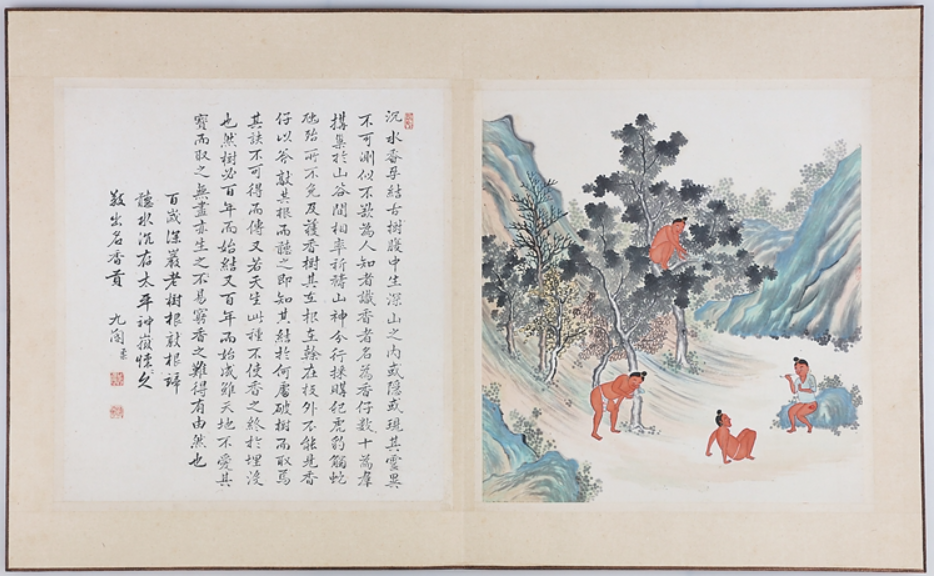
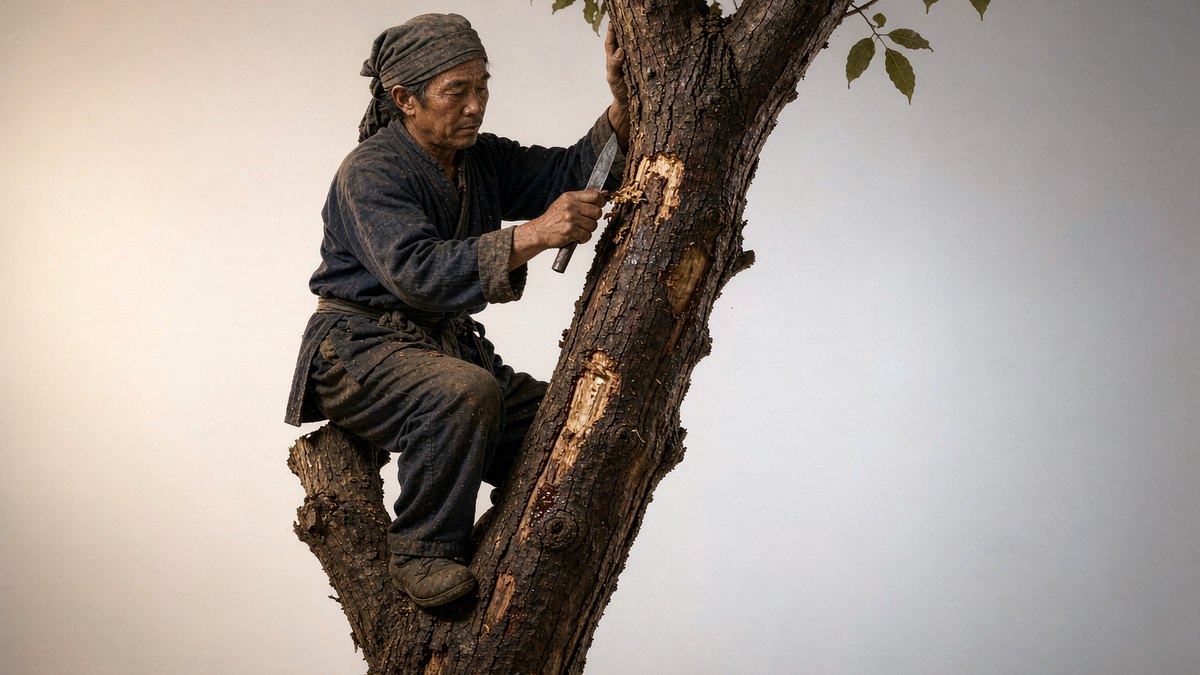
Agarwood itself is a mixture of woody and oleoresinous components formed when a fragrant tree, under natural forces such as lightning strikes, wind damage, and insect infestation, is wounded and repairs itself — its yield is limited. To obtain agarwood, people groped toward intervention. The Song-era Zeng Zao, in "Classified Tales," said: "Agarwood wood abounds along the coastal prefectures of Lingnan... When mountain folk see a tree's crooked or slanted branch, they must cut a notch with a knife; over the years rainwater soaks in and incense forms, which is then sawn off; scraping away the white wood, the incense forms mottled spots, also called partridge-spot — the finest sinker. In Qiong, Ya, and other prefectures it is commonly called horn-sinker, taken from the water, suited to fumigation."
During his residence in Danzhou, Su Shi found that local officials over-harvested and used agarwood, and wrote "Harmonizing Tao Yuanming's Nine Ancient Poems, No. 6" to interrogate and criticize them. "They burn agarwood as courtyard torches, mixing in jiajian powder. How is that like a wisp of faint fire, its smoke curling in a clear song? The greedy know no fullness or hunger, and crave even pepper. The two madmen Zhu and Liu fell like wind-blown blossoms. They meant to drain the pond to catch the fish — but what of next year?" He stated plainly that burning agarwood and jiajian powder as torchlight in the courtyard was too lavish and wasteful, and criticized Zhu Chuping (who served as Qionggan pacification envoy in the Northern Song) and Liu Yi as greedy and ignorant, scouring for agarwood like blossoms blown down by the wind; this drain-the-pond style of harvesting would soon exhaust the agarwood.
Over-harvesting in the Ming and Qing brought Hainan agarwood close to exhaustion. Chen Guangliang, author of "Research on Hainan Economic History," examining notes by Qing-era Qu Dajun and others, found that in the Ming and Qing not only were there harvesting groups of dozens or even over a hundred people, but each incense-gathering expedition would camp in the mountains, laboring "for ten days to months on end"; though the mountains were high and forests deep, rife with miasma and pestilence, they reckoned it not; the prosperity of the incense industry directly caused forest-clearing for roads and tree-felling, destroying the natural ecology.
Qu Dajun, in "New Tales of Guangdong," said: "All who gather incense must go into the deep mountains and dense shade, in groups of dozens; some obtain it in a day or two, some return empty-handed after half a month." This shows that as early as the beginning of the Qing, agarwood in Hainan's forests was already hard to find. In the seventh year of Kangxi (1668), Zhang Zhuoshi, then prefect of Yazhou, having personally endured the hardship of agarwood procurement and witnessed the various evils caused by over-harvesting, earnestly petitioned the court to request exemption from presenting agarwood.
His appeal did not receive sufficient attention. During the Qianlong reign, unrest once broke out in Hainan's Li-inhabited areas over the presentation of agarwood as tribute. The "Draft History of the Qing" records: "Qiongzhou's civil and military officials went into the Li ravines to take agarwood and huali wood, provoking conflict. Shi Lin and the provincial judge Xiao Yongzao, and the provincial commander Yin Huaxing, had not the least awareness beforehand, and the Li unrest having occurred the previous year, they delayed a full year before memorializing — covering up and deceiving; request severe punishment." To put an end to local officials, gentry, and unscrupulous merchants impersonating the government to procure agarwood and line their own pockets, Xiao Yingzhi, prefect of Qiongzhou, erected a prohibition stele in Shuitou Village, Shilu Town, Changjiang, requiring that none "enter the Li [areas] to forcibly take tribute incense and the like," on pain of heavy penalty.
Hainan Agarwood — A New Chapter of the Incense Road
Since the Reform and Opening, and especially since the establishment of the province and special economic zone, relevant Hainan departments have continuously strengthened protection of wild White-Wood incense trees. At present, the White-Wood incense tree has been listed as a national second-class key protected wild plant, and in 2000 was included in the "IUCN Red List of Threatened Plants." Entering the 21st century, Hainan has promoted the planting of White-Wood artificial forests across its cities and counties, and research institutions have bred several fine varieties such as "Reke No. 1 agarwood" and "Reke No. 2 agarwood." At present, Hainan's agarwood production and processing is mainly of cultivated incense; after years of accumulation, a fairly scientific and mature modern agarwood production system has formed, opening a "incense road" that keeps pace with the times.
At the planting base of the Hainan Agarwood and Jiangzhen Incense Research and Development Center in Yunlong Town, Qiongshan District, Haikou, some 300,000 agarwood trees grow, of which about 250,000 are the Qinan variety. Hu Huadong, chairman of the center, previously traded in Beijing and had come to Hainan several times to purchase agarwood. In 2016, optimistic about Hainan's natural conditions and policy environment for developing the agarwood industry, he came to Yunlong to invest and start a business.
Beyond the planting area, the center also has an agarwood science exhibition hall, agarwood solar-greenhouses, an agarwood essential-oil production workshop, an agarwood tea production workshop, an incense-stick workshop, and an RV camp. "Based on agarwood cultivation, we also develop the secondary and tertiary industries; visitors can come here to tour, learn the cultivation and processing of agarwood, study agarwood knowledge, and can also stay at our agarwood hotel in downtown Haikou," Hu Huadong explained. The center is a shared farm recognized by government departments, covering more than 1,100 mu; it has researched and produced more than 30 agarwood-related products, mainly sold to cities such as Beijing, Shanghai, and Guangzhou in China, as well as to relevant countries in East Asia and the Middle East.
The center adopts a "enterprise + base + cooperative + farmer" development model, driving farmers in nearby villages to plant agarwood trees, while also creating a batch of jobs — more than 50 villagers work at the base long-term.
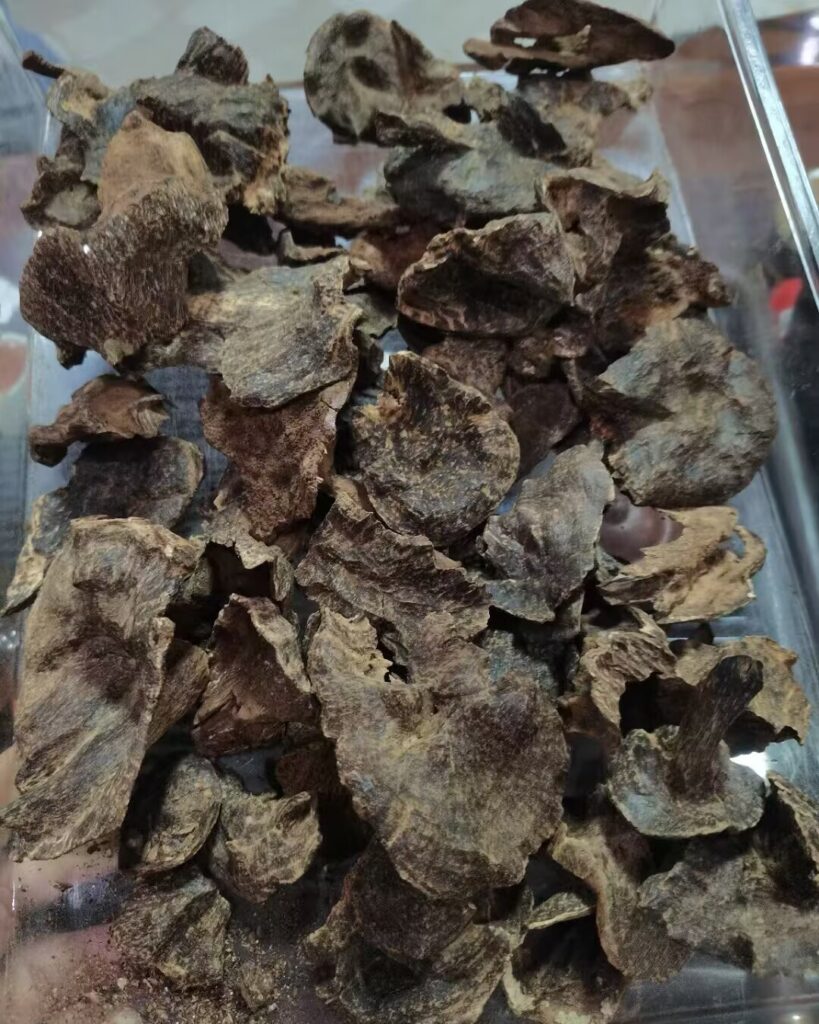
At present, multiple agarwood planting and processing bases are distributed across Hainan's Tunchang, Danzhou, Haikou, Qiongzhong, and other cities and counties. By the end of 2023, the province's planted area of agarwood trees had reached nearly 150,000 mu.
In 2022, the Eighth Party Congress of Hainan listed "agarwood" as one of the province's key "six trees." Not long after, two geographical-indication certification marks — "Hainan Agarwood (incense)" and "Hainan Agarwood (Chinese medicinal material)" — were successfully registered, marking an important step in Hainan agarwood brand building.
According to the goal set out in the "Hainan Province Agarwood Full-Industry-Chain Innovation Development Plan (2023–2030)," Hainan will build an international high-quality agarwood raw-material base, an international agarwood deep-processing base, an international agarwood R&D center, and an international agarwood trade center, striving by 2030 to reach a planted area of 180,000 mu of agarwood province-wide, an agarwood output of 600 tons, and an output value exceeding 5 billion yuan.
More than 400 years after the "Compendium of Materia Medica" appeared, the Hainan agarwood that was "a piece worth ten thousand coins" is growing, in another form, into a "cash tree."
This article is aggregated and compiled by "Agarwood Net"; original source: https://www.chenxiang123.com/hainanchenxiang-tianxiangchuanqi/
Compiled for general knowledge; traditional references are cultural notes, not medical advice.
Frequently Asked Questions
What is Hainan Agarwood — The Legend of the Heavenly Fragrance?
In the Limu Mountain area of Hainan Tropical Rainforest National Park, morning light falls on the vast forest; the warm monsoon from the sea "carries" in moist air. Several Hainan White-Wood incense trees stand on the slope, their seeds swaying like pearl earrings. Though plain to look at, the spice they bear is "first under heaven, a piece worth ten thousand coins." The article traces Hainan agarwood's road to fame — from Ding Wei's "Record of the Heavenly Fragrance" and Su Shi's "Ode to the Agarwood Mountain" to its tribute and trade along the Maritime Silk Road, the burden of its fame, and its renewed path in the modern era.
How should I choose agarwood?
Buy from traceable, testable channels and match the form (incense, beads, raw wood) to your use. Avoid exaggerated claims such as "wild" or "sinking grade" without proof, and prefer products with lab reports and origin documentation.
How should agarwood be stored and maintained?
Agarwood dislikes moisture, odours and direct sunlight. Keep it sealed, dark and cool, store different origins separately, and air and inspect long-stored pieces periodically against mould and insects.
How can I tell real agarwood from fake?
Authentication combines sensory checks with technical ones: natural agarwood has a clean, long-lasting, cool-sweet scent and burns with pale, non-pungent smoke. GC-MS analysis of characteristic compounds (chromones, sesquiterpenes) adds objective confirmation. Buying through traceable channels with certificates lowers the risk.
How do agarwood origins differ?
Climate, tree species and resin-induction methods give each origin a distinct scent profile — for example Hainan tends to be clean and elegant, Vietnam sweet and cool, Indonesia deep and full. Origin is a key factor in grading and pricing.
What is the current agarwood market like?
Prices diverge sharply by resin density, origin and form, with both top-end collectibles and entry-level consumer products active. Use actual transactions from legal, testable channels as reference rather than a single quotation.
What is the relationship between agarwood and incense culture?
Agarwood is the core medium of East Asian incense culture, spanning temple offerings, literati gatherings and contemporary lifestyle aesthetics. Understanding this cultural background helps explain its value.
Does agarwood have health benefits?
Traditionally agarwood has been used for calming and sleep-related rituals, but evidence quality and dosage need careful reading. Keep traditional use and scientific evidence clearly separated and follow professional guidance.
参考资料
You may also like
评论区
评论匿名可浏览,登录后可发表;提交后先审后显。
评论加载中…