Hainan Agarwood: The 'Qiongzhi Tianxiang' Priced Above Gold
Hainan agarwood is celebrated as "Qiongzhi Tianxiang" and priced above gold. Like butterflies drawn to flowers and trees turning toward the sun, the Chinese fondness for fragrance seems innate. Whether writing before a desk, sitting quietly with a book, or laying out a tea mat, incense almost always adds to the occasion. When the ancients spoke of incense, they often cited "chen, tan, long, she" (agarwood, sandalwood, borneol, musk)—and ranking first among these is agarwood.

Agarwood in China is mainly distributed across Hainan Island and the Guangdong-Guangxi region. As early as the Song dynasty, the price of agarwood sold from the Li villages of Hainan to the Central Plains had already been driven up to "a piece worth ten thousand coins," which shows the quality of Hainan agarwood.
Through centuries of accumulation and centuries of renown, Hainan agarwood—hailed as "Qiongzhi Tianxiang"—has been pushed to its peak again and again, giving rise to countless exquisite and moving incense stories.
A thousand years of curling incense: the custom of burning incense originates from sacrificial rites. As early as the Neolithic Age, people had begun seeking aromatic plants, burning wood to raise smoke in order to announce sacrifices to heaven and earth—this was called "liao ji" (the burning sacrifice).
Before the Qin and Han dynasties, the incense people used was mostly herbaceous native spices such as galangal, magnolia flower buds, and cogongrass root; besides serving the gods, these were also used for wearing, boiling soups, making pastes, and brewing wine. By the Han and Tang periods, the overland and maritime Silk Roads opened successively, and resinous and oily spices from the Western Regions and Southeast Asian countries—frankincense, borneol, agarwood, and storax—began entering the Central Plains, enriching Chinese olfactory and gustatory experience.
Compared with herbaceous native spices, resinous spices have richer and longer-lasting aromas. Among the many resinous incenses, agarwood was the most esteemed.
"Zhao Feiyan was empress; her younger sister at Zhaoyang Hall sent Feiyan a letter saying: 'On this auspicious day, my honored sister has grandly received the great investiture; I respectfully present thirty-five gifts to express my joyful heart… qingmuxiang, chenshuixiang.'" The Western Han anecdotal collection Xijing Zaji records the gift list Zhao Hede sent to congratulate her sister Zhao Feiyan on becoming empress; among the thirty-five congratulatory gifts, "chen (sinking) shui xiang" appears prominently.

That agarwood could serve as a gift among the imperial clan and noble relatives shows that agarwood already held extraordinary status in people's minds at the time. Thereafter, from the Wei-Jin and Northern-Southern dynasties through the Sui and Tang, agarwood rose to fame under the impetus of Daoist, Buddhist, and metaphysical schools of thought and the literati class, and the same wisp of incense was appreciated for different charms—Buddhism regarded agarwood as an important offering, Daoism held that agarwood could aid cultivation, medical texts listed agarwood as a superior medicinal material, and literati brought it into poetry, leaving famous lines such as "In the Boshan censer agarwood fire burns, twin smokes as one rise to the purple clouds" and "Sinking-water fine timber, food for the cypress treasure; Boshan smoke warm, jade tower spring."
Enduring for thousands of years without decline, what exactly is agarwood capable of? Before answering this question, one concept must first be clarified: what is agarwood?
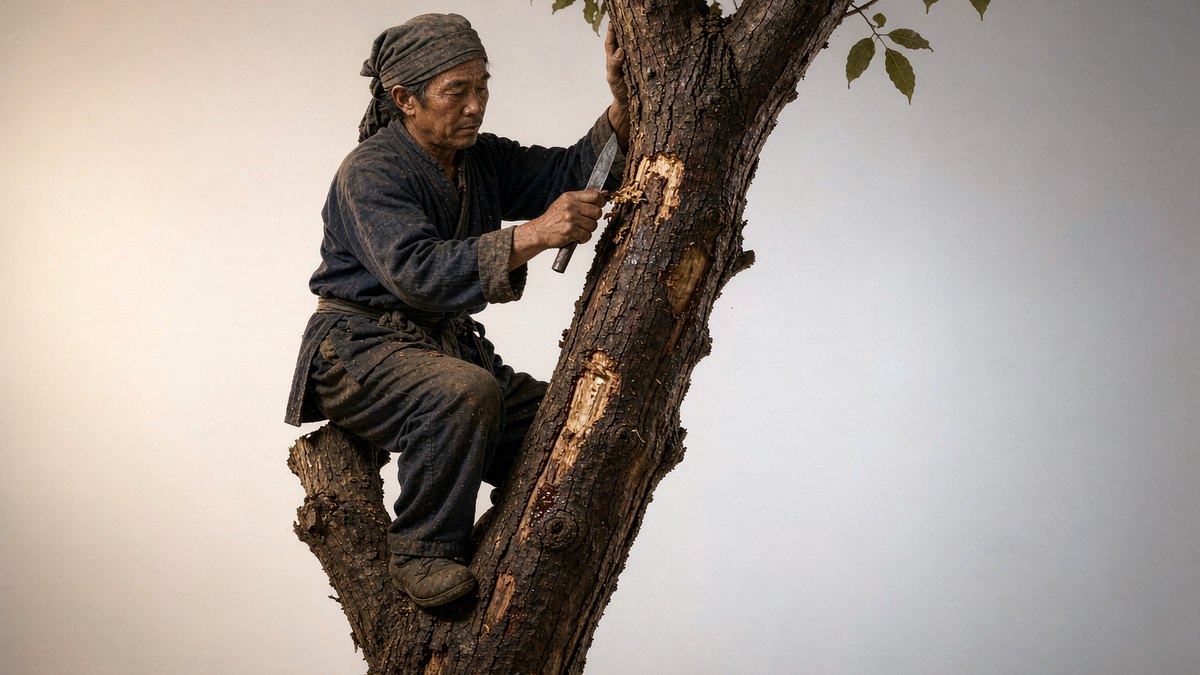
"As the name suggests, it is an incense that can sink in water," said Wei Xiwang, president of the Haikou Agarwood Association. Unlike other incenses, agarwood is not the name of a tree species; rather, it is a mixture containing woody and resinous components formed when trees of the Aquilaria genus in the Thymelaeaceae family are wounded by natural lightning strikes, axe cuts, insect damage, or fungal infection, and the wounded site forms it to repair itself.
Aquilaria trees are mainly distributed in Southeast Asia. In China, the Guangdong-Guangxi region, the Yunnan-Guizhou region, and Hainan Island mainly produce Aquilaria sinensis (also known as Guanxiang tree or baimuxiang); Vietnam, Cambodia, Myanmar, and other places mainly have Aquilaria crassna; and Indonesia, Brunei, Malaysia, and surrounding areas mainly have Aquilaria malaccensis.
Agarwood differs not only by origin and tree species; the incense produced by the same tree under different circumstances also differs considerably in product name and quality.
"For mixiang, one first cuts its roots; after years, the outer bark rots, and the hard black center and nodes, when placed in water, sink—this is called chenxiang; next, those that do not sink and float level with the water surface are called zhanxiang." The Eastern Han Jiaozhou Yiwu Zhi by Yang Fu offered a preliminary classification of the incense formed by Aquilaria trees, holding that only those that "sink when placed in water" deserve to be called "chenxiang." This is largely consistent with the account by Wan Zhen of Wu in the Three Kingdoms period in Nanzhou Yiwu Zhi, showing that more than a thousand years ago people already knew how to distinguish the quality of different types of agarwood.
By the Northern Song, Ding Wei's Tianxiang Zhuan provided the first systematic discussion of agarwood, proposing the concept of "four names and twelve forms." The four names are shengjie (living formation), shujie (mature formation), chenshuixiang (sinking-grade incense), and zhanxiang (floating-grade incense); the twelve forms include yilou (ant leakage), chonglou (insect leakage), daojia (fallen frame), qinggui (green cassia), huangshuxiang (yellow-ripe incense), shuxinge (heart-wood grid), dinggai (top cover), baotou (wrapped head), xiaodouli (small bamboo hat), jiguxiang (chicken-bone incense), matixiang (horse-hoof incense), and diaokou (hanging mouth).
"Among these, shuxinge is agarwood formed at the heart of the tree—what we commonly call qinan, the finest incense product," Wei Xiwang said. Whether chenxiang or zhanxiang, the process of resin formation usually lasts decades or even centuries—like an oyster turning illness into a pearl, or a phoenix reborn from ashes.
For this very reason, agarwood has since ancient times been associated with rarity and preciousness, and naturally commands an extraordinary price.
A piece worth ten thousand coins: Hainan chen. The Tang Xinxiu Bencao states: chenxiang, qinggui, jigu, mati, and jianxiang all come from the same tree and are produced in the countries of Tianzhu. Thus, in the view of some ancients, agarwood was an imported product. Consulting other ancient texts—the Three Kingdoms Nanzhou Yiwu Zhi, the Jin Nanfang Caomuzhuang, the Southern Dynasties Nanyue Zhi, and the Tang Lingbiao Luyi—when agarwood is discussed, only producing areas such as Nanzhou, Jiaozhi, and Guangguang Luozhou are mentioned, with no trace of Hainan.
By the early Song, records such as "Qiongzhou produces jianchen and huangshu and other incenses" and "Danzhou Changhua Commandery… jianchenxiang comes from deep grottoes" appeared in the Taiping Huanyu Ji, and only then did Hainan agarwood begin to lift its veil. Once Du Fu appeared on the scene, this aromatic product from a remote and desolate frontier outshone all others. To truly appreciate the value of Hainan agarwood, one must mention a person: Ding Wei, who served as chancellor of the Northern Song.
In his early years, Ding Wei served as a transport commissioner supervising the manufacture of tribute tea; his experience of incorporating incense into tea gave him considerable knowledge of incense. Later, having long worked in the palace, he witnessed many countries presenting aromatic medicines as tribute, so his understanding of incense was of the highest order. Even such a "high-level expert" who had smelled countless incenses could not help praising Hainan agarwood as "heavenly incense," and during his exile to Yazhou he wrote Tianxiang Zhuan, stating bluntly that "Lei, Hua, Gao, and Dou are also incense-producing places in China, but compared with Hainan, the difference in quality is not even close." Here "mou" means "equal, on par," and "bu mou shen yi" means they cannot be mentioned in the same breath.
Decades later, Su Shi, exiled to Hainan, likewise well understood the wonders of agarwood. On his younger brother Su Zhe's birthday, he not only sent a piece of agarwood shaped like a rockery as a congratulatory gift but also wrote the famous Ode to the Agarwood Mountain in brilliant prose, praising Hainan agarwood as "truly transcendent and unmatched" and "firm as gold yet moist as jade, with crane-like bone and dragon-like sinew."
The two above were not the only ones to lavish praise on Hainan agarwood. From the Song, Yuan, Ming, and Qing dynasties to the Republic of China period, words of praise for Hainan agarwood abound in official histories, literati notes, and poetry—for example, the Northern Song Bencao Yanyi says, "The finest chen is found only in Qiong and Ya prefectures," and the Southern Song Guihai Yuheng Zhi says, "Only Hainan agarwood is supreme."

Because of the uniqueness and high quality of Hainan agarwood, to distinguish it from agarwood of other origins, people also call Hainan agarwood "Yaxiang" or "Qiongzhi." By the Ming dynasty, Li Shizhen in the Bencao Gangmu quoted a fine line by Cai Tao, son of Cai Jing, pushing the reputation of Hainan agarwood to its zenith: "Champa (present-day Vietnam) is not equal to Chenla (present-day Cambodia), and Chenla is not equal to the Li villages of Hainan. Among the Li villages, that from the eastern grottoes of Limu Mountain in Wan'an is peerless under heaven; it is called Hainan chen, a piece worth ten thousand coins."
From obscurity to a piece worth ten thousand coins, the "price tag" of Hainan agarwood rose repeatedly, as can be glimpsed from trade and tribute records. Ding Wei said, "The Li people all devote themselves to farming and do not monopolize incense gathering… yet they gather it at certain times and sell it to designated buyers," showing that in the early Song, people in the Li settlement areas of Hainan treated agarwood gathering only as a sideline, with relatively fixed selling times and buyers. By the mid-Song, "provincial residents traded cattle with the Li; one ox bought one load of incense, and after returning and sorting it themselves, they obtained no more than one or two tenths of sinking-grade," indicating that incense gathering had become a regular economic activity for the Li people.
Of the incense gathered by the Li people, aside from part being purchased by merchants, more was taken by the court as "local tribute." The Ming Wanli Danzhou Zhi · Tugong records: "(Tang) tribute: gold, sugar, incense." The Qing Kangxi Lehui Xianzhi · Tugong records: "(Qing tribute) fish-line glue, tea buds, agarwood." The Qing Guangxu Lingao Xianzhi · Fuyi Lei · Tugong records: "Jiajing… in the final years, incense materials were again levied; in the early Longqing era, it was stopped." In the various local gazetteers of Hainan, records of agarwood being submitted as tribute are found in many places.
During the Qianlong reign of the Qing, some local officials and gentry even took risks, impersonating government procurement of tribute goods solely to seize fine agarwood, so that the then Qiongzhou prefect Xiao Yingzhi had to erect a prohibition stele in Shuitou Village, Shilu Town, Changjiang, requiring that no one "enter the Li areas without authorization to extort tribute incense and other materials," with severe punishment for violators.
The influx of merchants, together with the court's heavy levies, led to over-harvesting of Hainan agarwood. The more it was gathered, the fewer the fine pieces naturally became. As a result, the "price tag" of Hainan agarwood grew ever more precious.
The ancient and modern uses of agarwood
Agarwood has many uses, and its most essential yet most abstract use can be summed up in one word: "fragrance."
"The aroma is clear and gentle," "the qi is clear and long-lasting," "the qi is all clear and pure," "the qi is especially clear and gentle like a lotus," "the fragrant qi is particularly long-lasting and ever better," "it has no sudden fierce outburst, but endless curling richness"… From various texts such as the Guihai Yuheng Zhi, Tianxiang Zhuan, and Ode to the Agarwood Mountain, it is easy to see that the fragrance of Hainan agarwood has since ancient times been known for being "clear and gentle" and "elegant." This clear fragrance is deep and cool, with sweetness intermingled with floral notes, and was sought after by Song dynasty literati.
It was also from that time that incense burning, together with tea whisking, flower arranging, and hanging paintings, became an indispensable embellishment of literati spiritual and cultural life—some even exclaimed, "Without incense, how can one gather?"
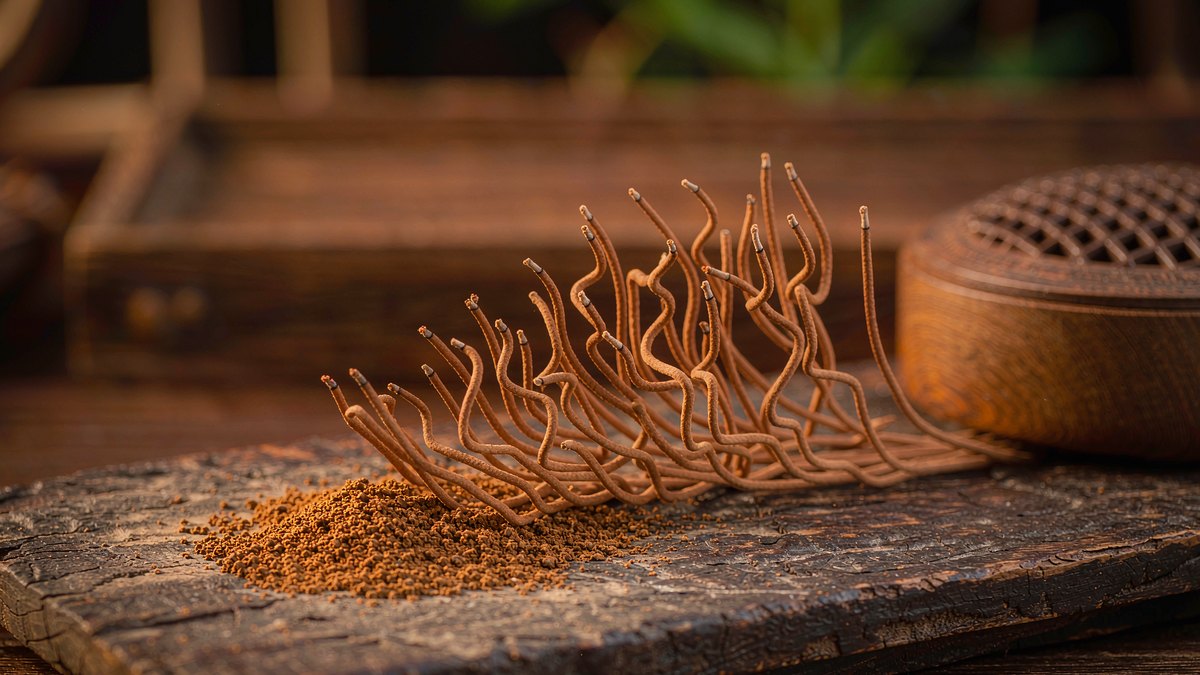
People made implements for incense and, through implements, entered the Way, producing a series of incense-related objects such as incense tubes, reclining censers, and hand censers; incense-making techniques also advanced, and the variety of incense products grew—stick incense with bamboo or wood cores, spiral-shaped coil incense, and tower-shaped hanging incense, among others.
The Song people, who played endless tricks with agarwood, even used it in tea. At that time, agarwood cooked water was one of the most popular after-meal drinks at banquets. The Southern Song Shilin Guangji records the specific preparation method: "Take a clean tile, heat it in the stove until slightly red, and place it on flat ground. Roast a small piece of incense and cover it with a bottle. When the fragrance is nearly exhausted, quickly pour boiling water into the bottle and seal the lid tightly." The reason for such elaborate effort was, first, that agarwood is truly a splendid thing lingering between the nasal passages and taste buds, and second, that the ancients believed agarwood had health-preserving effects such as "preserving harmony and guarding qi" and "dispersing stagnant qi."
Regarding the health-preserving and medicinal value of agarwood, an earlier record appears in the Southern Dynasties Tao Hongjing's Mingyi Bielu. The book states: "Chenxiang, xunluxiang, jishexiang, huoxiang, zhantangxiang, and fengxiang are all slightly warm, and all treat wind-water toxic swelling and remove evil qi." Later texts such as the Bencao Beiyao and Bencao Gangmu also recorded the medicinal effects of agarwood.
To this day, a large body of modern research confirms that agarwood has medicinal value. More than ten years ago, Dr. Dai Haofu and others at the Institute of Tropical Bioscience and Biotechnology, Chinese Academy of Tropical Agricultural Sciences, found through research that two classes of compounds—sesquiterpenes and 2-(2-phenylethyl)chromones—appear simultaneously in agarwood, which is the decisive basis for identifying agarwood. At present, enterprises and relevant institutions in Hainan have developed agarwood-containing health products or medicines with effects such as strengthening the stomach, resisting depression, and aiding sleep.
Of course, whether for worshipping gods, honoring Buddhas, appreciating fragrance, or use as medicine, over the past centuries agarwood did not truly reach ordinary people because of its scarcity. Only in recent years, with the maturation of artificial cultivation and artificial resin-induction techniques, has agarwood "flown into the homes of ordinary people," and its range of applications has grown ever broader.
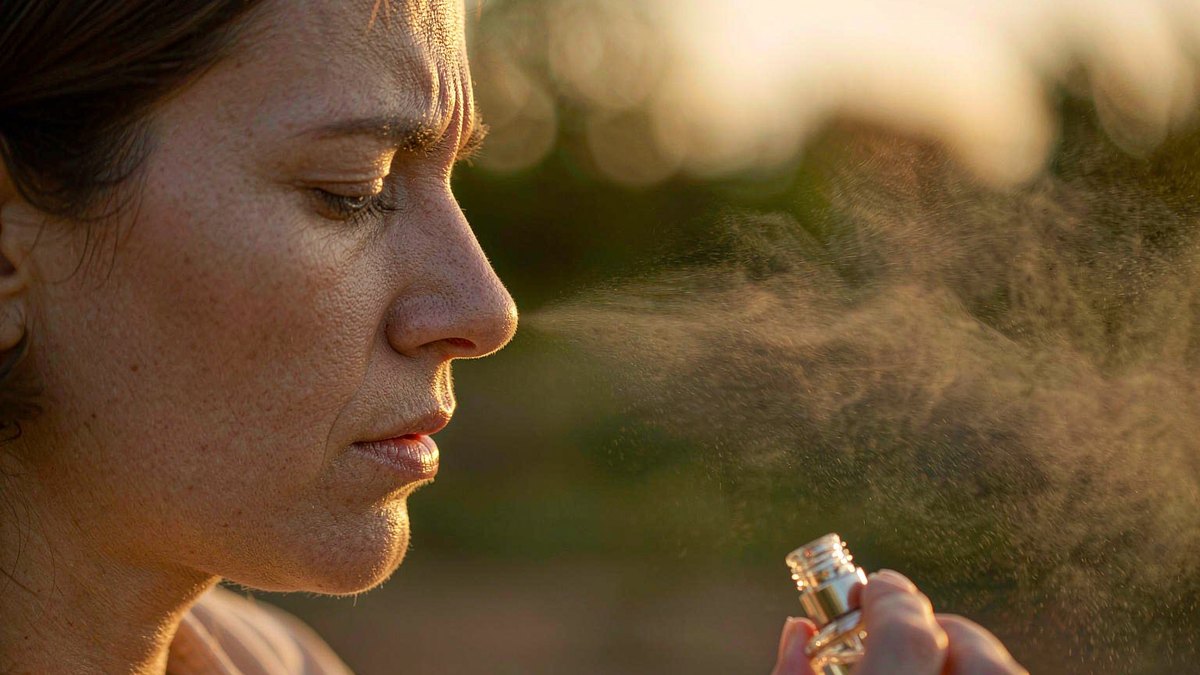
Agarwood essential oil, agarwood masks, agarwood eye masks, agarwood perfume, agarwood ornaments, agarwood bracelets, agarwood tea… Today in Hainan, the agarwood processing industry chain has linked together more than 200 agarwood products in four categories: incense products, craft collectibles, food and medicine, and daily chemical products.
At present, artificially cultivated Aquilaria sinensis trees are found in Ledong, Changjiang, Danzhou, Tunchang, Qionghai, and other places in Hainan. As of June 2025, the total artificial planting area of Aquilaria sinensis across the province reached 500,000 mu. Yet it must be acknowledged that the linkage among Hainan agarwood's primary, secondary, and tertiary industries is weak, and its potential remains to be tapped. At present, the province's research institutions and enterprises are tackling key problems in breeding new agarwood varieties, formulating market norms and product standards, and developing new products, while exploring deeper integration of agarwood industry development with cultural tourism development and rural revitalization, so as to further open up the downstream of the industry chain.
As early as 2018, the Hainan Provincial Department of Science and Technology issued the Hainan Agarwood Industry Development Plan, proposing that by 2025 the province's agarwood planting scale reach 200,000 mu and the annual artificial resin-induction area reach 5,000 mu. At present, Hainan's agarwood planting scale has already far exceeded 500,000 mu. The report of the Eighth Hainan Provincial Party Congress proposed further advancing the article on Hainan's "six trees", making them "money trees" for the people of Hainan. Agarwood is listed as one of the "six trees," which means this aromatic product that is "peerless under heaven" has once again stood at the forefront.
Agarwood trivia: What is Hainan agarwood?
The tree species that produces agarwood in China is Aquilaria sinensis of the Thymelaeaceae family. This tree was historically widely distributed in Guangdong, Guangxi, Hainan Island, and other places, and is now listed as a national second-class protected plant.
Hainan agarwood Aquilaria sinensis is an evergreen tree, reaching 5 to 16 meters in height at maturity, with grayish-brown to grayish-black bark, pale yellow wood, and leaves ovate or obovate to oblong. It flowers in spring and summer, with umbel-like, yellow-green flowers.

Four names: shengjie (living formation), shujie (mature formation), chenshuixiang (sinking-grade incense), zhanxiang (floating-grade incense)
Twelve forms: yilou (ant leakage), chonglou (insect leakage), daojia (fallen frame), qinggui (green cassia), huangshuxiang (yellow-ripe incense), shuxinge (heart-wood grid), dinggai (top cover), baotou (wrapped head), xiaodouli (small bamboo hat), jiguxiang (chicken-bone incense), matixiang (horse-hoof incense), diaokou (hanging mouth).
This article was compiled by "Chenxiang Net"; original source: https://www.chenxiang123.com/hainan-chenxia
Compiled for general knowledge; traditional references are cultural notes, not medical advice.
Frequently Asked Questions
What is Hainan Agarwood?
Hainan agarwood, celebrated as 'Qiongzhi Tianxiang,' has been valued above gold since the Song dynasty, when it fetched 'a piece worth ten thousand coins.' This article traces its history, botany, and modern industry.
How should I choose agarwood?
Buy from traceable, testable channels and match the form (incense, beads, raw wood) to your use. Avoid exaggerated claims such as "wild" or "sinking grade" without proof, and prefer products with lab reports and origin documentation.
How should agarwood be stored and maintained?
Agarwood dislikes moisture, odours and direct sunlight. Keep it sealed, dark and cool, store different origins separately, and air and inspect long-stored pieces periodically against mould and insects.
How can I tell real agarwood from fake?
Authentication combines sensory checks with technical ones: natural agarwood has a clean, long-lasting, cool-sweet scent and burns with pale, non-pungent smoke. GC-MS analysis of characteristic compounds (chromones, sesquiterpenes) adds objective confirmation. Buying through traceable channels with certificates lowers the risk.
How do agarwood origins differ?
Climate, tree species and resin-induction methods give each origin a distinct scent profile — for example Hainan tends to be clean and elegant, Vietnam sweet and cool, Indonesia deep and full. Origin is a key factor in grading and pricing.
What is the current agarwood market like?
Prices diverge sharply by resin density, origin and form, with both top-end collectibles and entry-level consumer products active. Use actual transactions from legal, testable channels as reference rather than a single quotation.
What is the relationship between agarwood and incense culture?
Agarwood is the core medium of East Asian incense culture, spanning temple offerings, literati gatherings and contemporary lifestyle aesthetics. Understanding this cultural background helps explain its value.
Does agarwood have health benefits?
Traditionally agarwood has been used for calming and sleep-related rituals, but evidence quality and dosage need careful reading. Keep traditional use and scientific evidence clearly separated and follow professional guidance.
参考资料
You may also like
评论区
评论匿名可浏览,登录后可发表;提交后先审后显。
评论加载中…