Guan Maoyou: A Frontline Agarwood Farmer Harvesting for the People, Writing an Agarwood Life
Guan Maoyou, inheritor of the Maoming intangible cultural heritage agarwood project, is a native of Dashuipo Village, Guanzhu, born into an agarwood family; at age 8 he followed his elders up the mountains to harvest wild agarwood. Out of his love for agarwood, he has devoted his entire life to the agarwood cause. After attaining his own understanding of the true essence of agarwood, he immediately invested heavily in agarwood cultivation and research, becoming a globally renowned authority in the agarwood world.

In 2005 he proposed revising the extractive substance standards for agarwood in the Pharmacopoeia of the People's Republic of China, which was adopted, making him the "first agarwood farmer" to rewrite the pharmacopoeia. In 2011, he was appointed as agarwood research technical consultant and visiting professor by the Chinese Academy of Tropical Agricultural Sciences and the Chinese Academy of Tropical Plant Sciences. In 2018, he was appointed by the National Forestry and Grassland Administration's National Innovation Alliance for the Agarwood Industry as an expert of the Expert Committee of the National Innovation Alliance for the Agarwood Industry. That same year, he participated in the formulation of national forestry agarwood standards and established cooperation with the Research Institute of Tropical Forestry of the Chinese Academy of Forestry to set up a new agarwood variety R&D and demonstration base; he also received a nomination for "Kind-hearted Maoming · Most Beautiful Craftsman" that year. In 2021, his agarwood cultivation base was awarded "Qinan Agarwood Standardized Breeding and Cultivation Demonstration Base of the Research Institute of Tropical Forestry, Chinese Academy of Forestry" and "Popular Science Education Base of the Precious Tree Species Branch of the Chinese Society of Forestry." In 2022 he was named an inheritor of the Guangdong Provincial intangible cultural heritage agarwood project. He received little formal education, yet carries a halo of honors. Recently, Chenxiang Net interviewed him.

A lawsuit led him to devote himself to comprehensive agarwood research
In his early years, Guan Maoyou went to Lushan, Henan to sell agarwood. Because there were no unified standards at the time for distinguishing authentic from fake agarwood or for assessing agarwood quality, both he and his goods suffered, and he became entangled in a lawsuit. From then on he began to reflect, putting agarwood research and cultivation first and making money second. At the time, China lacked scientific management methods for the agarwood market, there were no standardized unified criteria for agarwood evaluation, and the ranks of agarwood researchers were uneven—even experts and scholars in this field were mostly latecomers. To make up for the ignorant behavior of past greed-driven harvesting and felling of agarwood trees that brought wild agarwood to the brink of extinction, he voluntarily withdrew from the front lines of the bulk agarwood purchasing and trading market, cultivated himself, and returned to the mountains to reclaim land and plant agarwood trees, devoting himself to comprehensive agarwood research. Guan Maoyou's family had for several generations been engaged in harvesting and processing wild agarwood; now he also combines seedling cultivation and sales, planting technology and management, and agarwood collection and appreciation, with profound attainments that draw many agarwood lovers at home and abroad to learn from and exchange with him.

Years ago, Guan Maoyou saw that a premium qinan agarwood variety faced the threat of extinction, so he studied at home how to cultivate it. The hardships of gathering agarwood in the mountains since childhood gave him unyielding perseverance, and his love for agarwood gave him a tireless spirit of learning. He not only experimented with his own agarwood trees but also bought different varieties of agarwood trees elsewhere for research and trials; when he hit technical bottlenecks, he hired university professors and experts for guidance. Through continuous exploration, he finally invented a cultivation method for green qinan agarwood tree cutting propagation and applied for a national patent in 2016. Rather than hoarding this cultivation method, which cost considerable funds, manpower, and material resources, Guan Maoyou selflessly passed it on to others, driving villagers to grow agarwood and prosper, while also ensuring the safe conservation of this variety's germplasm resources.

"What makes him so good at agarwood is above all his love for it—agarwood is like his life, and whenever he talks about agarwood you can see the light in his eyes. Especially to save a variety on the brink of extinction, he invented a cultivation method and applied for a national patent, and he taught it to others without charging a cent—that is what I admire most," said Ms. Wu, an incense master who has worked with Guan Maoyou for many years, during the interview.
Making the spirit of agarwood dedication his faith
Walking into the home of Guan Maoyou at the cooperation base of the Research Institute of Tropical Forestry, Chinese Academy of Forestry, in Guanzhu Town, Dianbai District, one immediately sees the spacious living room lined along the walls with agarwood crafts. The agarwood crafts of various shapes and the faint agarwood fragrance instantly make one feel as if standing in a small agarwood museum.

A hollowed-out agarwood ornament about 70 cm long caught the reporter's eye, with dozens of holes of various sizes across the whole piece. "Don't underestimate this craft—without superb skill it really can't be made; in some places a little too much force and it breaks." The harvested agarwood must first be sterilized, then the white wood and decayed material removed with traditional tools, while preserving the agarwood's original shape and not damaging its oils; moreover, to achieve good oils one must seize the right timing and judge dryness and humidity, processing carefully layer by layer—it cannot be done all at once like peeling fruit. Processing agarwood requires not only superb, practiced skill but also great patience; often a single piece takes one or two months, or even half a year to a year, a arduous and lengthy process that is precisely why agarwood is so precious.
The value of the craftsman's spirit lies in striving for perfection, in persistence and pursuit of craftsmanship and fine products—professional, focused, meticulous, and tireless. The craftsman's spirit is also a spirit of pursuing the ultimate; though its benefits may seem small, it benefits the world for a long time.

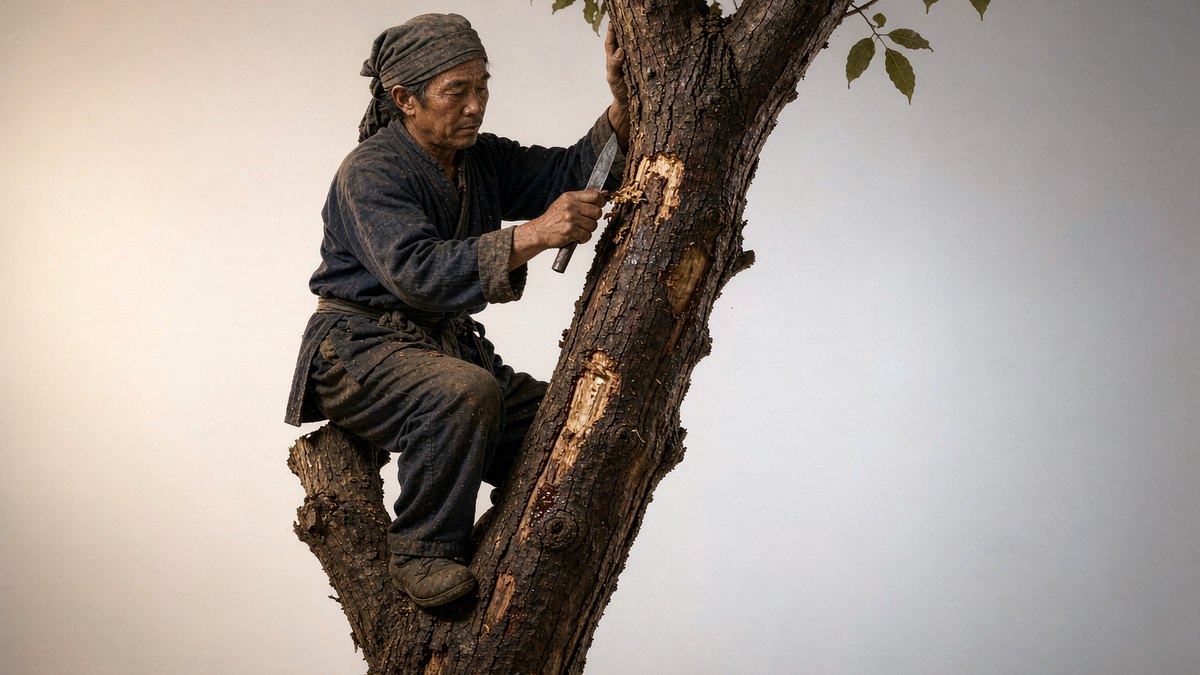
"The spirit of agarwood dedication is the essence of agarwood," Guan Maoyou told the reporter during the interview, saying he takes the spirit of agarwood dedication as his spiritual faith. When humans cut agarwood trees with knives or burn them with fire, the agarwood tree, in the process of being harmed, does only one thing: self-repair. In that process of self-repair it undergoes nirvana-like rebirth, transforming the essence of white wood into agarwood, which can be made into incense and used as medicine to heal humans.

Guan Maoyou earnestly practices the spirit of agarwood dedication, devoting his life's energy to the agarwood industry. He uses his love for agarwood and the spirit of agarwood dedication to educate his children, hoping they will inherit the arduous striving spirit of a "frontline agarwood farmer" and the concept of harvesting agarwood for the people—everything for agarwood, everything so that agarwood can better serve the people, improve health, and improve lives. On the one hand, he established a rural cooperative to continuously expand the area of high-quality agarwood seedling bases, involving more farmers; on the other hand, he is invited to major agarwood exhibitions to spread agarwood culture. He has repeatedly received honors such as "High-Quality Agarwood Enterprise," "Trustworthy Business Unit," "Outstanding Exhibitor," and "Major Agarwood Culture Dissemination Award."

Today, Guan Maoyou devotes himself wholeheartedly to agarwood germplasm cultivation, high-end collection, and promoting agarwood culture, doing his modest part for the development of the agarwood industry, striving to contribute more high-quality agarwood resources to society so that more people can participate, know, and use agarwood—harvesting agarwood for the people, writing an agarwood life.
This article was compiled by "Chenxiang Net"; original source: https://www.chenxiang123.com/guanmaoyou-shuxie-chenxiang-rensheng/
Compiled for general knowledge; traditional references are cultural notes, not medical advice.
Frequently Asked Questions
What is Guan Maoyou?
Guan Maoyou, inheritor of the Maoming intangible cultural heritage agarwood project, was born into an agarwood family in Dashuipo Village, Guanzhu, and began harvesting wild agarwood with his elders at age 8. Driven by his love for agarwood, he has devoted his life to the industry.
How should I choose agarwood?
Buy from traceable, testable channels and match the form (incense, beads, raw wood) to your use. Avoid exaggerated claims such as "wild" or "sinking grade" without proof, and prefer products with lab reports and origin documentation.
How should agarwood be stored and maintained?
Agarwood dislikes moisture, odours and direct sunlight. Keep it sealed, dark and cool, store different origins separately, and air and inspect long-stored pieces periodically against mould and insects.
How can I tell real agarwood from fake?
Authentication combines sensory checks with technical ones: natural agarwood has a clean, long-lasting, cool-sweet scent and burns with pale, non-pungent smoke. GC-MS analysis of characteristic compounds (chromones, sesquiterpenes) adds objective confirmation. Buying through traceable channels with certificates lowers the risk.
How do agarwood origins differ?
Climate, tree species and resin-induction methods give each origin a distinct scent profile — for example Hainan tends to be clean and elegant, Vietnam sweet and cool, Indonesia deep and full. Origin is a key factor in grading and pricing.
What is the current agarwood market like?
Prices diverge sharply by resin density, origin and form, with both top-end collectibles and entry-level consumer products active. Use actual transactions from legal, testable channels as reference rather than a single quotation.
What is the relationship between agarwood and incense culture?
Agarwood is the core medium of East Asian incense culture, spanning temple offerings, literati gatherings and contemporary lifestyle aesthetics. Understanding this cultural background helps explain its value.
Does agarwood have health benefits?
Traditionally agarwood has been used for calming and sleep-related rituals, but evidence quality and dosage need careful reading. Keep traditional use and scientific evidence clearly separated and follow professional guidance.
参考资料
You may also like
评论区
评论匿名可浏览,登录后可发表;提交后先审后显。
评论加载中…