Agarwood Tree vs. Agarwood Wood vs. Agarwood: Key Differences
More and more people are getting into agarwood, yet many enthusiasts cannot distinguish the agarwood tree, agarwood wood, and agarwood. This leads to mistaking one for another and even to reckless cutting that damages natural resources. Let us now clarify the differences between the agarwood tree, agarwood wood, and agarwood.
I. Agarwood Tree, Agarwood Wood, Agarwood
Conceptually, the agarwood tree, agarwood wood, and agarwood are three distinct things.

Both agarwood and agarwood wood are parts of the agarwood tree. An agarwood tree has agarwood wood, but not necessarily agarwood; an agarwood tree without agarwood has limited value.
1. Agarwood Tree
The agarwood tree is a tree of the genus Aquilaria in the family Thymelaeaceae, also known as Aquilaria sinensis, yaxiang tree, tu chenxiang, or nü'er xiang. It generally grows 5–15 meters tall, with dark gray, smooth bark and tough fibers.


In China, the agarwood tree is mainly distributed in Hainan, Guangdong, Guangxi, Taiwan, and other places. It is now listed as a national second-class protected endangered tree species, and the World Wildlife Conservation Association has also listed it as a world endangered plant under the protection of the Convention on International Trade.
2. Agarwood Wood
Agarwood wood is the dried woody part of the agarwood tree; it is a timber, a spice, and a traditional Chinese medicine. Under a magnifying glass it appears granular and loose, and when cut with a knife it flakes off as powder. Agarwood wood is the portion of woody fiber in the agarwood tree that has not undergone resin formation.

3. Agarwood
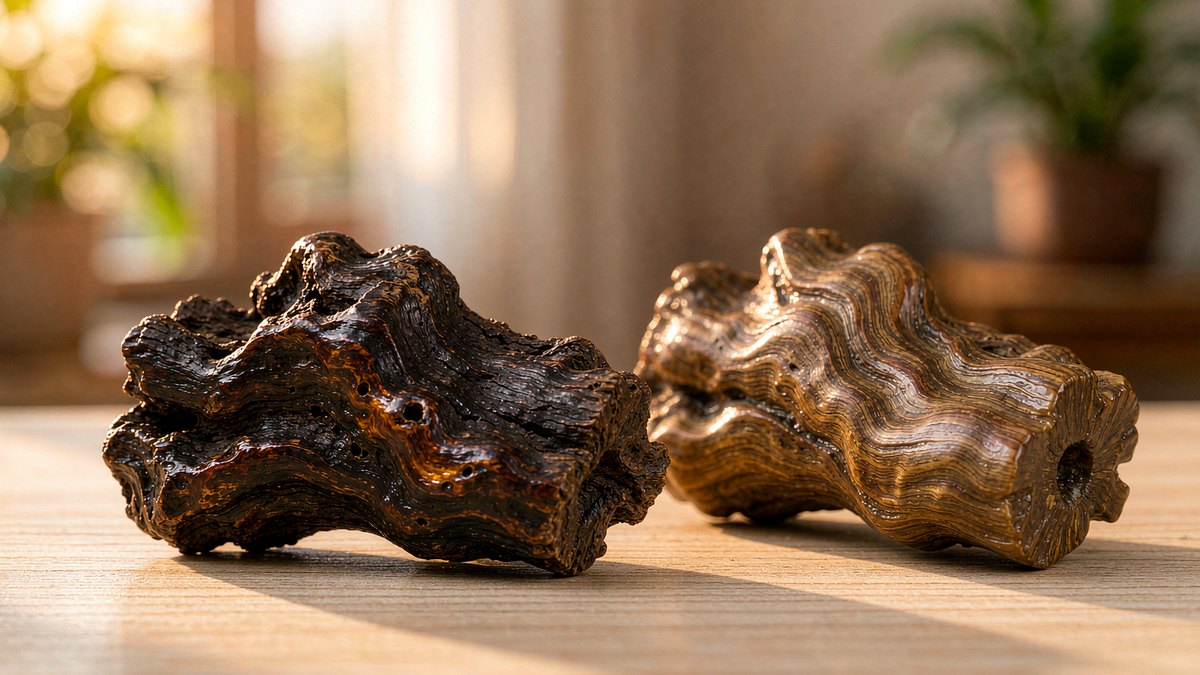
Agarwood is not a type of wood; rather, it is a solid condensate “formed” by the agarwood tree after external wounding and fungal infection, mixing fungal, oily (resin), and woody components, and forming on the bark, branches, and roots of the agarwood tree.

Only a wounded agarwood tree can condense agarwood.
After the agarwood tree suffers wounds from lightning strikes, strong winds, artificial felling, ant and insect borings, or bird and animal pecking, 21 kinds of fungi such as Huanglü Mo'er invade; the agarwood tree activates its own immune system and secretes special resin to resist the penetration of fungi and bacteria, and these oily substances are agarwood.
The agarwood in the agarwood tree needs a long time to mature before top-grade quality can form—several years to more than ten years, even hundreds or thousands of years.
II. Origin of the Name Agarwood
Agarwood is dark brown, carries a pleasant fragrance, and its resinous mass condenses into lumps that sink when placed in water; hence it is called “chenxiang,” also known as “chenshui xiang” or “shui chenxiang,” written in ancient times as “shenxiang” (shen being the same as chen). In the ancient phrase “chen, tan, long, she,” the “chen” refers to agarwood. Agarwood is also known as qiongzhi, baimuxiang, chenshui xiang, er xiang, shang chen, nü'er xiang, Lingnan chen dao xiang, and so on.

III. Qualities of Agarwood
Agarwood is likened to the diamond among plants and has been ranked first among all fragrances since ancient times. Its aroma is elegant and precious and rare; gathering the spiritual energy of yin and yang and the five elements of heaven and earth, it is refined into a pure yang entity and is praised as the only fragrance capable of connecting the three realms. Its aroma cannot be synthesized artificially to this day, which makes it all the more precious and wondrous.
To protect native agarwood, the national and Guangdong provincial forestry departments have included it in the China Plant Red Data Book and the Atlas of Rare and Endangered Plants of Guangdong Province.
This article was compiled by “Chenxiang Net”; original source: https://www.chenxiang123.com/chenxiangshu-chenxiangmu-chenxiang/
Compiled for general knowledge; traditional references are cultural notes, not medical advice.
Frequently Asked Questions
What is Agarwood Tree vs. Agarwood Wood vs. Agarwood?
More people are getting into agarwood, yet many enthusiasts still confuse the agarwood tree, agarwood wood, and agarwood itself—sometimes mistaking one for another or even damaging natural resources. Here we clarify the differences.
How should I choose agarwood?
Buy from traceable, testable channels and match the form (incense, beads, raw wood) to your use. Avoid exaggerated claims such as "wild" or "sinking grade" without proof, and prefer products with lab reports and origin documentation.
How should agarwood be stored and maintained?
Agarwood dislikes moisture, odours and direct sunlight. Keep it sealed, dark and cool, store different origins separately, and air and inspect long-stored pieces periodically against mould and insects.
How can I tell real agarwood from fake?
Authentication combines sensory checks with technical ones: natural agarwood has a clean, long-lasting, cool-sweet scent and burns with pale, non-pungent smoke. GC-MS analysis of characteristic compounds (chromones, sesquiterpenes) adds objective confirmation. Buying through traceable channels with certificates lowers the risk.
How do agarwood origins differ?
Climate, tree species and resin-induction methods give each origin a distinct scent profile — for example Hainan tends to be clean and elegant, Vietnam sweet and cool, Indonesia deep and full. Origin is a key factor in grading and pricing.
What is the current agarwood market like?
Prices diverge sharply by resin density, origin and form, with both top-end collectibles and entry-level consumer products active. Use actual transactions from legal, testable channels as reference rather than a single quotation.
What is the relationship between agarwood and incense culture?
Agarwood is the core medium of East Asian incense culture, spanning temple offerings, literati gatherings and contemporary lifestyle aesthetics. Understanding this cultural background helps explain its value.
Does agarwood have health benefits?
Traditionally agarwood has been used for calming and sleep-related rituals, but evidence quality and dosage need careful reading. Keep traditional use and scientific evidence clearly separated and follow professional guidance.
参考资料
You may also like
评论区
评论匿名可浏览,登录后可发表;提交后先审后显。
评论加载中…