Agarwood and a Community with a Shared Future for Mankind
On July 11, 2026, the founding conference of the Community with a Shared Future for Mankind Foundation was held in Hong Kong. Ms. Wang Jing, Chairwoman of the Foundation, delivered a keynote address. The establishment of the Foundation brings the governance philosophy of the "Harmony of the Great Way" onto a broader stage of practice.
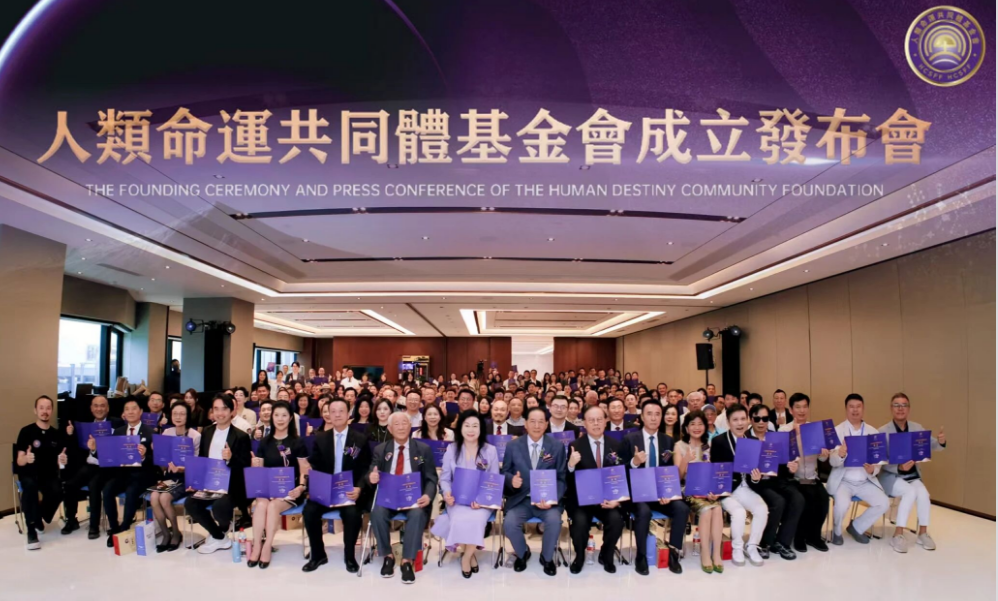
Jointly initiated by multiple foundations and charitable institutions from mainland China, Hong Kong, Macao, Taiwan and overseas, it gathers benevolent forces worldwide to tackle global challenges together, and steadfastly advances the building of a community with a shared future for mankind through the strength of civil society and public welfare.
As an important vehicle for the social practice of the community with a shared future for mankind concept, the agarwood industry will gain more systematic support.
Is agarwood a niche hobby or a mass-market industry?
How large can the agarwood industry become? Can it become the flagship project of "lucid waters and lush mountains are invaluable assets"? These questions puzzle not only the general public but also many within the industry.
The agarwood industry is at a critical stage of development and currently lacks systematic industrial development concepts to support it.
In this period of cognitive uncertainty, even practitioners who have worked in the industry for many years can be troubled by various superficial phenomena.
In terms of major development stages, China's agarwood industry is still in its initial exploratory phase.
Advancing the development of the agarwood industry requires down-to-earth efforts within the grand narrative of building a community with a shared future for mankind.
The hit drama "A Letter to Grandma" will further deepen exchanges with Southeast Asia. CCTV's major humanities documentary "Seeking Fragrance in China" has begun filming, giving a high-level start to making the world fall in love with fine Chinese agarwood.
When we see through and fully understand the future of agarwood, we can seize opportunities and use future growth to solve present problems—for example, the issues of land space and transformational development in Lingnan villages.
I attempt to sketch an outline for the development of the agarwood industry and to present the basis for achieving a future agarwood industry worth one trillion or ten trillion yuan. This still requires continuously building consensus.
I. Rural Revitalization Starts with a Single Tree
The agarwood industry has brought tremendous change to Shatong Village, Guanzhu Town, Dianbai, Maoming.
When talking about the people and events of Shatong Village in the past, the first reaction of villagers is poverty. To escape poverty, going out to collect agarwood was a way out.
Starting in the 1980s and 1990s, there were many stories of Dianbai people collecting and trading agarwood. Among them, Shatong Village is the most representative village.
Thirty years ago, Shatong Village was an ordinary small mountain village hidden in the hills of western Guangdong. The hills were untended barren slopes, and the fields grew only lychee and longan, with harvests dependent on the weather and meager incomes. Young adults carried their luggage away to work, leaving only the elderly, women and children behind. Mud roads were impassable on rainy days, the village collective economy was weak year-round, and most villagers could find no path to prosperity.
Today, walking into Shatong Village, the hills are covered with agarwood trees, agarwood shops line the streets, livestreams run day and night, and tourists wander through the groves. It has become the norm for ordinary farming households to earn over 100,000 yuan a year from the agarwood industry, more than 20,000 nearby residents have found employment through agarwood, and the total industrial value of the entire area keeps climbing.
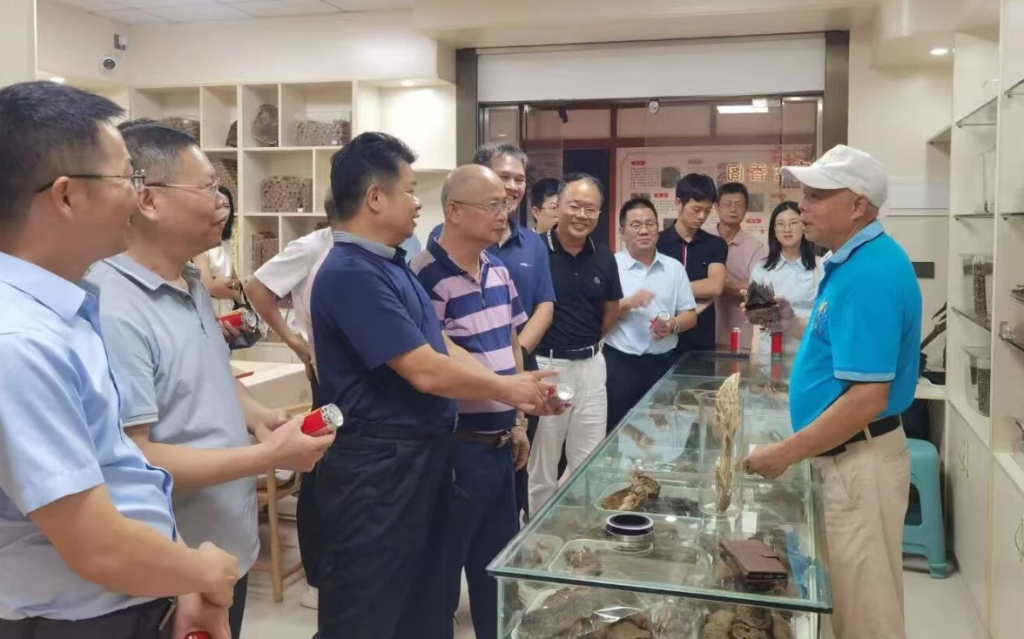
The turning point began with qinan grafting technology. In 2013, Shatong pioneered qinan grafting and seedling technology, shortening the time for resin formation in agarwood trees: three years of planting plus three years of drilling to induce resin formation yields fragrance products with a good experience. Once the news spread, every household was moved to act, planting agarwood trees on barren hillsides, in the gaps of lychee and longan orchards, and on vacant land around homes.
2017 to 2020 was an explosive period of grassroots development, when speculation in seedlings was frenzied. By 2022, the agarwood industry received great attention from the government, and together with the accumulated momentum of private forces, Shatong Village drove Guanzhu Town to form a distinctive agarwood industry.
As the industry flourished, agarwood became a unique scenery of Shatong. The village raised funds to build an agarwood culture center, create an agarwood museum and a handmade incense experience workshop, renovate a one-kilometer riverside style street, pave greenways and beautify the river channel, and open fragrance-cuisine restaurants and agarwood-themed homestays. An incense-opening festival is held every year, drawing tourists from all over who stroll through ten thousand mu of fragrant groves, personally experience agarwood collection and incense making, and take home agarwood souvenirs.
Although there have always been differing voices in the industry about easy-resin-forming agarwood species, an industry that drives rural revitalization has indeed taken shape in Shatong Village. In 2024, I visited Guanzhu Shatong and exchanged views with local agarwood industry leaders and relevant government personnel, proposing several considerations for ensuring the industry's sustainable development: First, state-owned capital needs to enter to ensure a stable guiding force; second, cultivate several leading enterprises with future listing potential to build a basic foundation for the industry's healthy development; third, explore a reasonable development ratio between traditional Aquilaria sinensis and "qinan fragrance" (easy-resin-forming varieties), balancing short-term returns with long-term industrial development.
The agarwood industry in Shatong first drives the village's own residents and local migrant workers, then attracts outside capital, promoting the formation of an industrial cluster effect integrating primary, secondary and tertiary industries.
The agarwood industry development experience formed in Shatong Village is now spilling over.
The Shatong Village phenomenon is only the beginning. Even Xiangjiling Village in Huzhou, Zhejiang, where climatic conditions make agarwood cultivation impossible, is building an "Oriental Fragrance Capital."
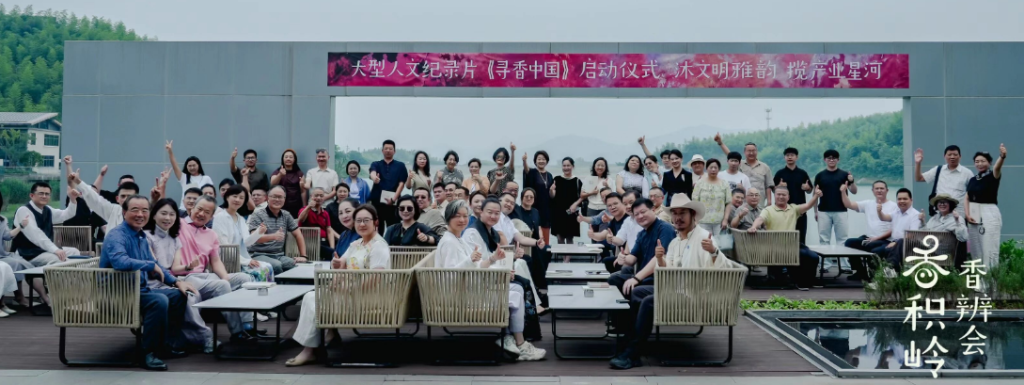
CCTV's major humanities documentary "Seeking Fragrance in China" was launched in Xiangjiling Village, Shili Fangfei, Huzhou.
Mr. Zheng Yumin, advisor to the Zhejiang General Chamber of Commerce, delivered a keynote speech in which he proposed that while making chips, we must also value fragrance chips, drawing on the model and experience of Yiwu to build the fragrance industry from nothing, give play to market factors, and promote the formation of a fragrance industry cluster.
Starting from a single tree and using the agarwood industry to drive rural revitalization offers boundless imagination and development space. Agarwood does not compete with grain for land and can be intercropped on hills and under orchards, covering all groups including the elderly, women and returning youth, forming a full-chain employment model of "primary planting, secondary processing, tertiary cultural tourism, and e-commerce export," absorbing surplus rural labor, narrowing the urban-rural income gap, and stabilizing the foundation of grassroots livelihoods.
II. The Basis for Agarwood as a Trillion-Yuan Industry
Many places in Lingnan are vigorously promoting the development of the agarwood industry. Over recent decades, a great deal of practice and exploration has been carried out, including the contributions of many agarwood farmers and early investors.
Many agarwood trees still stand silently on the hills, telling of past hardships, yet this power accumulated over time is now erupting, forming growth that outpaces many industries.
Is there any agricultural industry that, over decades or even longer, does not collapse as output rises but instead becomes more prosperous? The answer lies in the cultural genes of the Chinese nation spanning thousands of years.
Agarwood took a full thousand years to move from aristocratic and niche circles to the mass market.
Only when China's agarwood plantation area exceeded two million mu did agarwood truly enter public view. From legend to the opportunity to experience it, artificial cultivation has provided the industrial foundation.
Agarwood culture went from a thousand years of prosperity to comprehensive decline, and now, through the development of the agarwood industry, is once again demonstrating its influence on world culture. In a sense, the revival of the fragrance industry is also an important symbol of the great rejuvenation of the Chinese nation.
Agarwood has leapt from culture to a tangible industry. So where does the trillion-yuan output value of agarwood come from?
Musk said that by 2040 there will be 10 billion robots worldwide. It is estimated that the energy consumption over the full life cycle of each robot, from production to use, requires planting 160 trees to achieve carbon neutrality.
This means that adding 10 billion robots would require planting 1.6 trillion more trees. If 1% of them were agarwood trees, that would be 16 billion trees; at an output value of 500 yuan per agarwood tree, that would be 8 trillion yuan. Here a new question arises: does humanity need that many agarwood products? Is there that much land to plant them? Could overplanting make each tree worth even less than 500 yuan?
The answers to this series of questions are precisely where the conceptual system for agarwood industry development lies; we need to view agarwood development from multiple dimensions.
Comparing planting data for tea and eucalyptus: China's tea plantation area is about 53 million mu, with an output value of 1.05 trillion yuan; eucalyptus plantation area is about 91 million mu, with an output value of less than one trillion yuan. If the same area were planted with agarwood trees, the output value could reach 5.3 trillion yuan and 9 trillion yuan respectively. First of all, land for planting is not a problem.
It is niche because there is not enough agarwood product supply on the market, and mass-market applications of agarwood products have not been developed.
As agarwood planting area expands and raw material output increases, raw material prices fall, and more secondary processing emerges; large amounts of secondary processing in turn increase demand for planting raw materials.
Once primary and secondary industries are up and running, the issue becomes application and sales, which is a crucial factor. The region with the highest per capita consumption of agarwood products in the world is the Middle East—first, because of lifestyle customs; second, because Middle Eastern wealthy consumers have the economic strength.
When agarwood supply and prices make it affordable for ordinary consumers, the fragrance-using population will expand rapidly.
Agarwood entering ordinary households is a reflection of satisfying people's pursuit of a better life, and it will also form a major industry benefiting a broader public. At present, there is a debate within the agarwood world over whether Aquilaria sinensis or qinan varieties represent the future direction of development, as well as concerns over whether qinan varieties will lead to an oversupply of agarwood products.
Wild Aquilaria sinensis is legally designated as a national second-class protected wild plant. In 2023 it was formally included in CITES Appendix II, with unified global cross-border trade controls. Concerns about industrial oversupply are premature.
Many people have only heard of agarwood and have not yet truly encountered it. Agarwood is in the process of expanding from a niche hobby to a mass-market industry.
Initiatives such as building a World Agarwood Valley in Wuguishan, Zhongshan; restoring the Tang-dynasty tribute agarwood collection and incense-making scenes in Baihuadong Village, Dalingshan, Dongguan—the site of the Tang-dynasty agarwood tribute garden—and creating a "Chinatown" with flourishing Tang culture through agarwood culture display and trading; and building an international agarwood trading platform in Hengqin, all help make the agarwood industry stronger and larger.
The Party Branch Committee of the Lingnan Guanxiang Industrial Cluster of the Communist Party of China was unveiled, with Party building leading the development of the Lingnan agarwood industry. Last year Dongguan established the Party Branch Committee of the Lingnan Guanxiang Industrial Cluster; as its branch secretary, I proposed three goals: exploring the creation of a ten-billion-yuan industrial cluster, building an international fragrance industry city, and cultivating listed agarwood companies. The coordinated development of several industrial clusters, trading platforms and listed companies in Lingnan will provide a solid foundation for industrial development.
The various agarwood issues everyone is discussing basically arise from insufficient industrial development. When more social forces are invested in the agarwood industry, many problems will be readily solved.
III. The Agarwood Industry Ushers in a Dividend Period of Major Development
In the future, humanity's common challenge is the climate issue. China has proposed the "dual carbon" goals of peaking carbon emissions by 2030 and achieving carbon neutrality by 2060.
The great rejuvenation of the Chinese nation aims to build a great modern socialist country that is prosperous, strong, democratic, culturally advanced, harmonious and beautiful by 2049. The real estate economy enjoyed a 23-year dividend period from the 1998 housing reform to the 2021 sales peak.
In the coming decades, the agarwood industry will usher in a dividend period of major development.
It is widely believed in the industry that 2025 is Compiled for general knowledge; traditional references are cultural notes, not medical advice.
Frequently Asked Questions
What is Agarwood and a Community with a Shared Future for Mankind?
On July 11, 2026, the founding conference of the Community with a Shared Future for Mankind Foundation was held in Hong Kong, where Chairwoman Wang Jing delivered a keynote address.
How should I choose agarwood?
Buy from traceable, testable channels and match the form (incense, beads, raw wood) to your use. Avoid exaggerated claims such as "wild" or "sinking grade" without proof, and prefer products with lab reports and origin documentation.
How should agarwood be stored and maintained?
Agarwood dislikes moisture, odours and direct sunlight. Keep it sealed, dark and cool, store different origins separately, and air and inspect long-stored pieces periodically against mould and insects.
How can I tell real agarwood from fake?
Authentication combines sensory checks with technical ones: natural agarwood has a clean, long-lasting, cool-sweet scent and burns with pale, non-pungent smoke. GC-MS analysis of characteristic compounds (chromones, sesquiterpenes) adds objective confirmation. Buying through traceable channels with certificates lowers the risk.
How do agarwood origins differ?
Climate, tree species and resin-induction methods give each origin a distinct scent profile — for example Hainan tends to be clean and elegant, Vietnam sweet and cool, Indonesia deep and full. Origin is a key factor in grading and pricing.
What is the current agarwood market like?
Prices diverge sharply by resin density, origin and form, with both top-end collectibles and entry-level consumer products active. Use actual transactions from legal, testable channels as reference rather than a single quotation.
What is the relationship between agarwood and incense culture?
Agarwood is the core medium of East Asian incense culture, spanning temple offerings, literati gatherings and contemporary lifestyle aesthetics. Understanding this cultural background helps explain its value.
Does agarwood have health benefits?
Traditionally agarwood has been used for calming and sleep-related rituals, but evidence quality and dosage need careful reading. Keep traditional use and scientific evidence clearly separated and follow professional guidance.
参考资料
You may also like
评论区
评论匿名可浏览,登录后可发表;提交后先审后显。
评论加载中…