Ten Truths Nobody in the Agarwood Circle Dares to Speak
A Million-Yuan Lesson: Twenty Years of Collecting, Not a Single Genuine Piece
Late one night in Guangzhou, a collector handed his prized "top-grade agarwood"—treasured for over a decade—to an appraiser with trembling hands. He believed it was worth at least an apartment. The expert barely glanced at it: "Chemical oil injection, high-pressure paste compaction—all fake." Twenty years of devotion, wiped out in an instant. This is not a movie scene but a real moment in the appraisal room of the Guangzhou Agarwood Association. What is more frightening is that similar scenes play out every single day.
A fact that sends chills down your spine: CCTV's "Financial Investigation" undercover report last year tore the cover off the agarwood market: the "sinking-grade agarwood bracelet" you snapped up for thousands of yuan may cost less than 20 yuan to make. At a livestream base, reporters watched merchants toss worthless agarwood white wood into qinan essential oil and boil it at high temperature. Hours later, the white wood became "full-oil old-material sinking-grade agarwood"—dark in color, rich in scent. Viewers in the livestream snapped them up madly: "Family, this quality goes for at least five thousand outside!" In reality, the only thing remotely natural about this "agarwood" is that it is still called agarwood wood.
Reference link: CCTV "Financial Investigation" exposes fake agarwood in livestream rooms
Ten truths nobody in the agarwood circle dares to speak
Truth one: Wild agarwood? You're dreaming!
All species of agarwood are listed in Appendix II of the Convention on International Trade in Endangered Species of Wild Fauna and Flora (CITES) and are Class II nationally protected wild plants. Existing traded wild agarwood raw materials and products range from several hundred to tens of thousands of yuan per gram (mostly agarwood produced in Southeast Asian countries). Those "wild agarwood old materials" sold by the ton in livestream rooms are, plainly put, just storytelling.
Truth two: The blacker the "full oil," the more likely it is fake
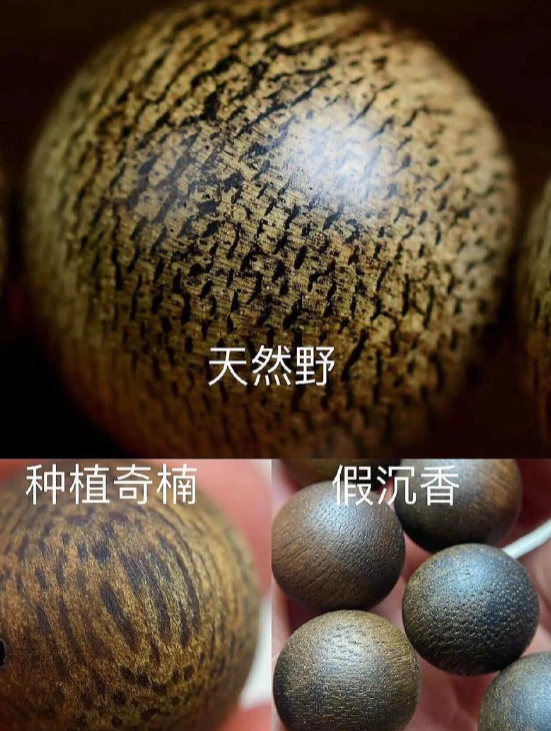
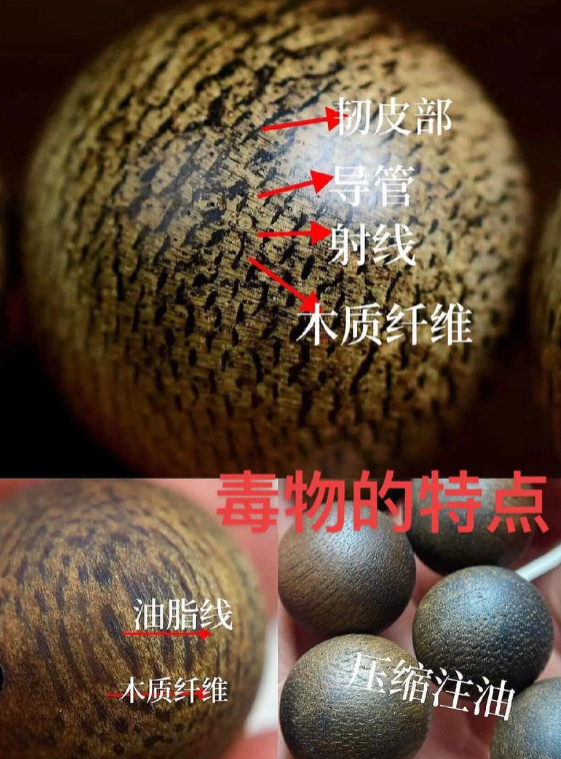
Natural agarwood has uneven oil distribution, with light and dark areas like an ink wash painting. But tech-made goods are different—they are uniformly jet-black, with oil as even as painted lacquer. Why? Because high pressure is used to force artificial oil paste into white wood. Remember: the more perfect it looks, the more suspect it is.
Truth three: "Sinking grade" at 20 yuan per gram? Laughable
Natural sinking-grade agarwood for incense starts at at least one hundred yuan per gram (except grafted qinan agarwood). What does claiming wild agarwood at 20 yuan per gram mean? It is equivalent to telling you: I have a genuine Rolex here, selling for only 200 yuan. Those who believe it are paying the "idiot tax."
Truth four: White wood injected with paste—the agarwood world's "Hextech"
White wood from agarwood trees that has not undergone resin formation is originally worthless. But its fiber texture is almost identical to agarwood oil lines. So unscrupulous merchants buy white agarwood in bulk and inject artificial oil paste and fragrance under high pressure. You cannot tell the finished bracelet from natural agarwood with the naked eye. Unless sent for testing, you may wear "tech and hard work" for a lifetime.
Truth five: Counterfeit workshops are more dramatic than spy movies
Counterfeiters have gotten smarter. The store displays only genuine goods; fakes are hidden elsewhere. Swipe a card, exchange a code word, have an acquaintance lead the way—only after three hurdles will you be taken into the real "selection room." Even more extreme: counterfeit workshops, warehouses, and sales points are scattered across different floors. Even if raided, they cannot be "taken down in one pot."
Truth six: Testing certificates? Don't be naive
Reporters sent oil-injected fakes to an authoritative institution for testing. The result was unexpected—they actually obtained genuine certificates! Staff explained: as long as the odor is not off and the structure is clear, oil injection does not affect identification. Moreover, the certificate does not state "whether oil was injected." In other words, a bracelet with a genuine certificate may still be a tech-made product.
Truth seven: Twenty-year veteran collectors, total wipeout
The president of the Guangzhou Agarwood Association revealed shocking data: at least eighty percent of agarwood products on the market have problems. He has received countless collectors, and the "treasures" they brought were almost all wiped out. One elderly gentleman had collected over a hundred pieces over twenty years, spending millions. The appraisal result: not a single one was genuine.
Truth eight: A 30-fold price gap harvests the information gap
At agarwood night markets, ordinary planted qinan costs a dozen or so yuan per gram. But "sinking grade" can sell for 300 yuan per gram. The price gap is nearly 30-fold. The enormous profit margin drives merchants to counterfeit madly. What they bet on is: you don't understand.

Truth nine: "Sinking grade" does not equal good agarwood
Many people think that anything that sinks is good incense. But oil injection to add weight can also make it sink—can that still be called good incense? The value of natural agarwood lies in the natural resin formation process. Anything artificially intervened, no matter how black or how sinking, is just a piece of oil-injected wood.
Truth ten: Industry standards exist, but enforcement is effectively nonexistent
The national agarwood grading standard is mainly the forestry industry standard "Agarwood Quality Grading" (LY/T 3223-2020), which divides agarwood quality into five grades: special grade, first grade, second grade, third grade, and fourth grade. Hainan, Guangdong, Guangxi, and Fujian have all issued provincial-level agarwood grading standards. These standards all require that "the natural properties of agarwood must not be altered." The problem is: does oil injection count as alteration? Should certificates indicate it? At present, these are all blind spots. No matter how good the standard is, if no one enforces it, it is waste paper.
Reference links:
Hainan Province local standard "Agarwood Quality Grades"
Hainan Province local standard "Agarwood Identification"
A confession from an ordinary consumer: A friend spent 3,800 yuan last year on an agarwood bracelet for his father's birthday. The merchant swore: "Sinking-grade qinan old material, worth at least twenty thousand on the market." After his father put it on, his wrist kept itching. Only later did they learn: it was oil-injected chemicals irritating the skin. 3,800 yuan bought not filial piety, but harm.
How can you avoid being scammed? Remember three iron rules, and you can avoid at least 90% of the traps:
First, don't believe in "bargain finds." "Sinking-grade agarwood" for a few dozen yuan, "qinan agarwood old material" for a few hundred yuan—treat them all as fake.
Second, natural agarwood has a subtle, elusive aroma that changes with air humidity and temperature. If you can smell a strong scent from half a meter away, it is basically certain to be oil-soaked or fragrance-injected.
Third, know what to look for on a certificate. Don't just check whether a certificate exists; check whether it includes key information such as an "oil distribution map" and "whether oil was injected." Without these, the certificate is waste paper.
Agarwood Net tips:
Agarwood is originally a gift from nature to humanity, formed over decades or even centuries. It should be an elegant pursuit, a spiritual practice, a reverence for time. But now it has become a carnival for counterfeiters and a sickle for harvesting the naive. If you also collect agarwood, ask yourself: the string of agarwood in your hand—is it a gift of time, or a "masterpiece" of technology? If you find this article useful, welcome to forward it to friends who like agarwood. One more person who knows the truth about agarwood means one fewer person being scammed.
This article was compiled by "Agarwood Net"; original source: https://www.chenxiang123.com/chenxiang-shige-zhenxiang/
Compiled for general knowledge; traditional references are cultural notes, not medical advice.
Frequently Asked Questions
What is Ten Truths Nobody in the Agarwood Circle Dares to Speak?
A million-yuan lesson: twenty years of collecting, not a single genuine piece. Late one night in Guangzhou, a collector handed his prized "top-grade agarwood" to an appraiser.
How should I choose agarwood?
Buy from traceable, testable channels and match the form (incense, beads, raw wood) to your use. Avoid exaggerated claims such as "wild" or "sinking grade" without proof, and prefer products with lab reports and origin documentation.
How should agarwood be stored and maintained?
Agarwood dislikes moisture, odours and direct sunlight. Keep it sealed, dark and cool, store different origins separately, and air and inspect long-stored pieces periodically against mould and insects.
How can I tell real agarwood from fake?
Authentication combines sensory checks with technical ones: natural agarwood has a clean, long-lasting, cool-sweet scent and burns with pale, non-pungent smoke. GC-MS analysis of characteristic compounds (chromones, sesquiterpenes) adds objective confirmation. Buying through traceable channels with certificates lowers the risk.
How do agarwood origins differ?
Climate, tree species and resin-induction methods give each origin a distinct scent profile — for example Hainan tends to be clean and elegant, Vietnam sweet and cool, Indonesia deep and full. Origin is a key factor in grading and pricing.
What is the current agarwood market like?
Prices diverge sharply by resin density, origin and form, with both top-end collectibles and entry-level consumer products active. Use actual transactions from legal, testable channels as reference rather than a single quotation.
What is the relationship between agarwood and incense culture?
Agarwood is the core medium of East Asian incense culture, spanning temple offerings, literati gatherings and contemporary lifestyle aesthetics. Understanding this cultural background helps explain its value.
Does agarwood have health benefits?
Traditionally agarwood has been used for calming and sleep-related rituals, but evidence quality and dosage need careful reading. Keep traditional use and scientific evidence clearly separated and follow professional guidance.
参考资料
You may also like
评论区
评论匿名可浏览,登录后可发表;提交后先审后显。
评论加载中…