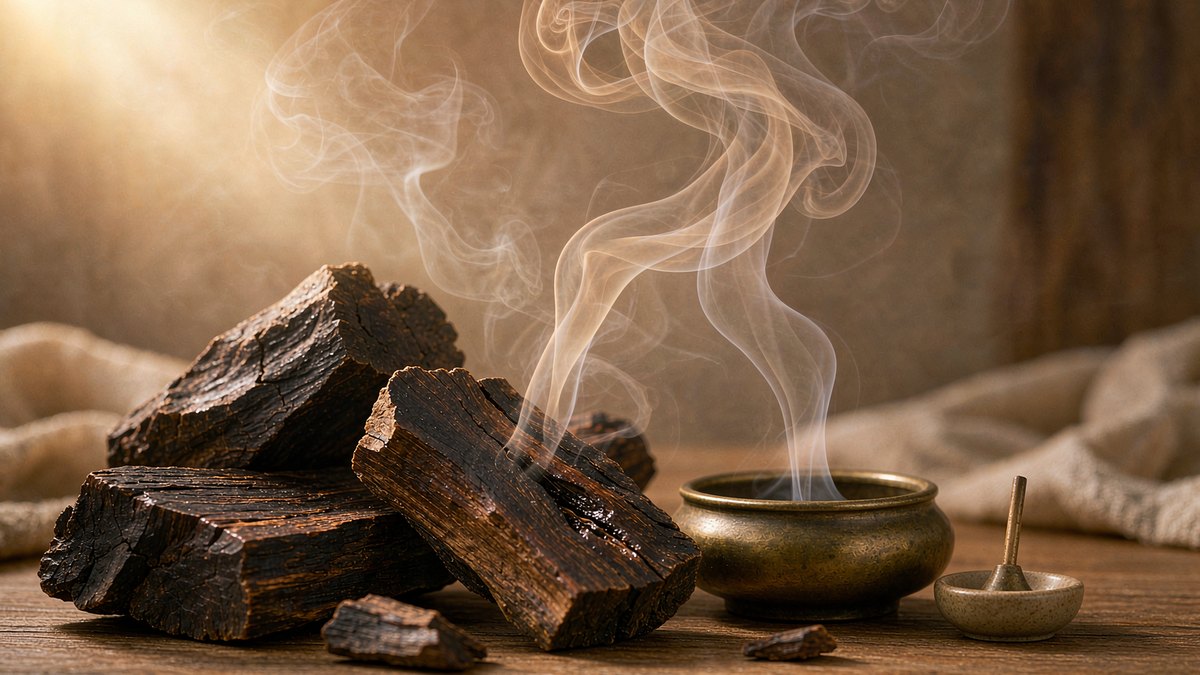
The Four Names and Twelve Forms of Agarwood
The Four Names and Twelve Forms of Agarwood is an important theory for classifying and grading agarwood proposed by Ding Wei, a Song dynasty master of incense studies, in his work Tianxiang Zhuan. This theory provides a detailed division of agarwood from two aspects—grade and external appearance—and has become an important foundation for agarwood research. The specific contents of the Four Names and Twelve Forms of Agarwood are as follows:

I. The Four Names (Four Grades of Agarwood)
Sinking grade: High resin content; when placed in water it sinks to the bottom. It is the top grade of agarwood.
Zhanxiang: Half-sinks and half-floats in water; resin distribution is uneven, and quality is inferior to sinking grade.
Shengjie: Resin formation occurs when the agarwood tree is wounded by natural factors while still alive; the material is taken directly from the branches and stems without natural aging.
Shujie: After the agarwood tree is wounded and falls, the resin-bearing part is buried in soil or water and undergoes long-term natural aging; the woody portion rots away, leaving a resinous concretion.
II. The Twelve Forms (Twelve External Appearances of Agarwood)
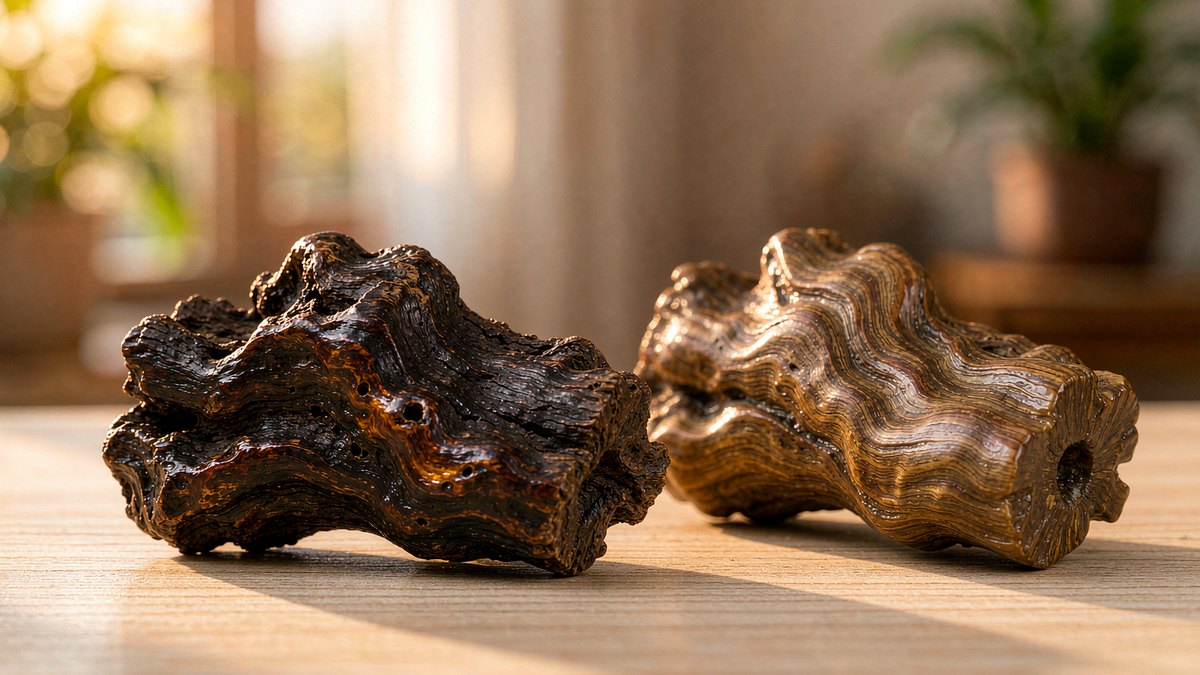
Jigu Xiang (Chicken-bone agarwood): Jigu Xiang refers to agarwood whose form resembles a chicken bone; it mainly grows at the nodes of somewhat thicker branches and is hollow in the middle. It is often found where salt accumulates at branch nodes. Because the branches are not compact enough, the resulting Jigu Xiang is mostly hollow in the middle. Its aroma is clear and soaring, with a faint scent of the fruit of Aquilaria sinensis blossoms opening at dawn.

Chen Zangqi of the Tang dynasty wrote in Bencao Shiyi: "Also among zhanxiang, there is one shaped like a chicken bone." Ye Tinggui of the Song dynasty said in Nanfan Xianglu: "Sometimes it sinks in water yet has a hollow center; this is chicken bone, meaning there is a decayed channel inside, like the blood-eye of a chicken bone." Ji Han of the Western Jin wrote in Nanfang Caomuzhuang: "The one level with the water surface is Jigu Xiang." Yue Dong Biji also says: "As for Jigu Xiang, it is the hard node of miscellaneous trees; its shape and color resemble agarwood, but it is purely woody in nature."
Xiaodouli (Small bamboo hat): Xiaodouli is named because its shape resembles the bamboo hats worn by the Li people; it mostly hides at places where the trunk or branches have fallen off or at large branch nodes. It is also named for resembling the shed shoot husks in emerald bamboo groves. It is charming and lovely, making one unable to put it down. As if unexpectedly encountering the Goddess of Mount Wu, its otherworldly beauty is intoxicating.

Yazhou Zhi gives a very vivid and expressive description: "Penglaixiang is agarwood whose resin formation is not yet complete. It mostly forms in pieces, like small hats and the shape of large mushrooms. Some are one or two chi in diameter, extremely hard and solid; their color and appearance are all like agarwood, but they float when put into water. If one hollows out the back where it carries wood, many will also sink in water."
Qinggui: Qinggui refers to incense formed on the bark, which incense farmers call piyou (bark oil). In lofty mountains and steep ridges, apes call and birds sing. Under the buffeting of strong winds, the branches and trunks of the incense tree sway, the bark and bone are twisted and injured, and tree sap flows out. With the hardship of bark and flesh, the incense tree refines the rich fragrance of Qinggui.

Ji Han's Nanfang Caomuzhuang explains: "The fine branches that are compact and not rotten are Qinggui Xiang."
Kong Pingzhong of the Song dynasty says in Tanyuan: "Agarwood that forms along the bark is called Qinggui."
Ji Han's Nanfang Caomuzhuang of the Western Jin also records another use of Qinggui Xiang: "Mixiang paper is made from the bark and leaves of the mixiang tree; it is slightly brown, with patterns like fish roe. It is extremely fragrant and tough, and does not disintegrate when soaked in water. In the fifth year of Taikang, Daqin presented thirty thousand sheets; ten thousand sheets were often bestowed upon Du Yu, Marquis of Dangyang and General of Zhennan. He was ordered to compile the Chunqiu Shili and Jingzhuan Jijie."
The ancient Chinese agarwood veneer painting box kept in the Shosoin of Japan is made precisely of Qinggui Xiang; its resin is translucent and radiates a scattered amber glow of interlaced red and yellow.
In Fan Chengda's Guihai Yuxheng Zhi, "the one like thatch bamboo leaves" and "the one as thin and light as paper, which also sinks in water" both refer to Qinggui.
Dinggai (Top cover): Dinggai refers to the following: whenever there are thunderstorms and storms, strong winds break off part of the agarwood tree's branches and trunk; after exposure to sunlight and soaking by rain, sap surges up at the broken surface and congeals into resin. Because it is exposed outside, the Li people can easily discover it; after removing the decayed wood on the surface, the thin layer covered by resinous liquid is Dinggai. The Li people call it thin slice.

Fan Chengda's Guihai Yuxheng Zhi says: "Penglaixiang is sinking-grade agarwood; those whose resin formation is incomplete mostly form in pieces." "Some are one or two chi in diameter."
Zhang Gui quotes the Fuzhi: "Yousu is not heavy enough to sink, but its fragrance is exceptional. Stored in a box, it fills a whole room with fragrance. Suxiang has congealed for only a few decades and is harvested too early, hence called suxiang." On the Li mountains of Qiong Island, whenever there are thunderstorms and storms, the incense trees are sure to be broken. Strong winds break off part of the incense tree's branches and trunk; after exposure to sunlight and soaking by rain, sap surges up at the broken surface and congeals into resin. Because it is exposed outside, the Li people can easily discover it. After removing the decayed wood on the surface, the thin layer covered by resinous liquid is Dinggai. Therefore, the Li people also call it thin slice. If the branches and trunk are sawed off, thin slices can also form within a few years. Among what the ancients called Penglaixiang there are also such thin slices. This is Dinggai.
Baotou (Wrapped head): Baotou is similar to Dinggai in that both form resin at the broken surface facing the sky after strong winds break the branches and trunk. The difference is that Dinggai is removed shortly after resin formation and lacks sufficient natural aroma. Baotou generally forms in deep mountains and old forests rarely visited by people, and resin formation takes a long time. Second, after the broken surface forms, it heals over a hundred years and the bark gathers around it, forming a wrapping. Often, when incense farmers gather a piece of Baotou deep in the mountains, its resin content is full. It sinks immediately when placed in water, with purple and brown interlaced; its top note lingers for a long time, and its aroma is cool and sweet, meaningful and prolonged.

Penglai is the place where immortals live in ancient Chinese myths and legends. Shiji: Fengshan Shu records: "From the time of Wei, Xuan, and Yan Zhao, envoys were sent to the sea to seek Penglai, Fangzhang, and Yingzhou. These three divine mountains, it is said, are in the Bohai Sea." The ancients named Hainan incense after Penglai, directly showing their infatuation with yaxiang and also implying their detached attitude toward worldly things and their preference for regarding yaxiang as heavenly incense. A kind reminder to incense lovers: since heavenly incense is obtained, one should wash hands and make offerings; how could one waste it?
In Guihai Yuxheng Zhi, Fan Chengda gladly recorded it as Penglaixiang because the shape of Baotou closely resembles the immortal mountain of Penglai. Later generations mostly excerpted this and regarded it as a standard. Because the descriptive features of Penglaixiang encompass Xiaodouli, Dinggai, and Baotou, and these three incense types each stand on their own and represent different modes of resin formation, one can only reluctantly part with it.
Daojia (Fallen frame): Daojia refers to the imperishable incense material formed after an agarwood tree falls due to age or natural causes and is then subjected to wind and insect erosion.
Daojia has a pure, upright, clear, and far-reaching aroma, and its aroma profile is relatively rich. If it is light black heartwood with a slight earthy yellow, the top note is clear and mellow with sweetness, while the base note is slightly bitter.
Generally, Daojia is light black with a slight earthy yellow, distributed relatively evenly. If there is a water source where Daojia forms (such as rivers or lakes), due to years of influence by moisture, its heartwood may sometimes also appear blue-black like water-sinking agarwood, but the bark material remains light black with a slight earthy yellow.

Zhang Gui explains in Yazhou Zhi: "When the tree falls and the wood rots but the incense remains, it is called shusu; when half of the tree remains, it is called zanxiang."
Wang Qi of the Ming dynasty says in Baishi Huibian: "There is what is called shujie, which naturally congeals solid within. Tuoluo is what naturally separates due to rotten wood."
Ye Tinggui summarizes: "Sheng su has a long-lasting scent, while shu su has a scent that easily scorches; therefore the raw is superior and the ripe is secondary." The imperishable incense material formed after an incense tree falls due to age or natural causes and is then subjected to wind and insect erosion is Daojia. Shujie and sishen are the same thing. Tuoluo and zanxiang mean incense with a short resin formation time. Shuishen and tushen are aliases for sishen.
Diaokou (Hanging mouth): Diaokou, also called comb-tooth Diaokou or cliff, is a special agarwood form. It refers to wounds hanging on the tree body or branches; these wounds are usually located on slanted sides and vary in size.
The formation process of Diaokou is full of natural power and beauty; its aroma and form are gifts from nature. Every piece of Diaokou incense is a masterpiece of nature, worthy of careful appreciation and treasuring.
Due to natural factors such as strong winds breaking, flying stones striking, lightning splitting, and wild boars gnawing, the broken surface of the incense tree's branches and trunk faces the ground; sap flows and congeals into resin, later forming a shape like hanging thorns. After cleaning away the white wood, what remains is Diaokou with incense like hedgehog skin. When inverted upward, it resembles the immortal mountain of Penglai, so the ancients also classified it under the Penglaixiang sequence.

Diaokou incense has a soaring aroma and strong penetration; hanging threads and oil lines interlace, white wood and resinous liquid intertwine, and freshness and excellence are both prolonged.
Most Diaokou incense does not sink in water and belongs to the zhanxiang category. The quality of Diaokou agarwood is extremely high; its aroma is pure and clean, soaring, with extremely strong penetration. The comb-tooth part is located within the tree heart, so it carries the unique charm of heartwood oil.
Due to destruction by strong winds, flying stones, lightning, or wild boars, the incense tree's branches and trunk break, and sap flows and congeals into resin, forming a shape similar to hanging thorns. After cleaning away the white wood, the Diaokou with incense like hedgehog skin is revealed.
Hanging threads and oil lines interweave, white wood and resinous liquid entwine each other, showing freshness and excellence both prolonged. In Hainan and Shanxi regions, Diaokou incense initially looks like a chestnut thorn pod together with the wood, and locals call it cixiang (thorn incense). After peeling off the wood bark with a knife, one can take out firm and glossy agarwood; this is what scholar-officials call Penglaixiang.
"Produced in the mountains of Hainan and Shanxi, it initially looks like a chestnut thorn pod together with the wood; the locals call it cixiang. After hollowing out the wood with a knife and taking out the incense, it is firm and glossy; scholar-officials call it Penglaixiang." The evaluation in Ye Tinggui's Nanfan Xianglu reads almost like a safety notice. Fan Chengda in Guihai Yuxheng Zhi
Compiled for general knowledge; traditional references are cultural notes, not medical advice.
Frequently Asked Questions
What is The Four Names and Twelve Forms of Agarwood?
The Four Names and Twelve Forms is an important classification and grading theory for agarwood proposed by Ding Wei, a Song dynasty master of incense studies, in his work Tianxiang Zhuan. It divides agarwood by grade and appearance.
How should I choose agarwood?
Buy from traceable, testable channels and match the form (incense, beads, raw wood) to your use. Avoid exaggerated claims such as "wild" or "sinking grade" without proof, and prefer products with lab reports and origin documentation.
How should agarwood be stored and maintained?
Agarwood dislikes moisture, odours and direct sunlight. Keep it sealed, dark and cool, store different origins separately, and air and inspect long-stored pieces periodically against mould and insects.
How can I tell real agarwood from fake?
Authentication combines sensory checks with technical ones: natural agarwood has a clean, long-lasting, cool-sweet scent and burns with pale, non-pungent smoke. GC-MS analysis of characteristic compounds (chromones, sesquiterpenes) adds objective confirmation. Buying through traceable channels with certificates lowers the risk.
How do agarwood origins differ?
Climate, tree species and resin-induction methods give each origin a distinct scent profile — for example Hainan tends to be clean and elegant, Vietnam sweet and cool, Indonesia deep and full. Origin is a key factor in grading and pricing.
What is the current agarwood market like?
Prices diverge sharply by resin density, origin and form, with both top-end collectibles and entry-level consumer products active. Use actual transactions from legal, testable channels as reference rather than a single quotation.
What is the relationship between agarwood and incense culture?
Agarwood is the core medium of East Asian incense culture, spanning temple offerings, literati gatherings and contemporary lifestyle aesthetics. Understanding this cultural background helps explain its value.
Does agarwood have health benefits?
Traditionally agarwood has been used for calming and sleep-related rituals, but evidence quality and dosage need careful reading. Keep traditional use and scientific evidence clearly separated and follow professional guidance.
参考资料
You may also like
评论区
评论匿名可浏览,登录后可发表;提交后先审后显。
评论加载中…